Preorders are open · Reserve your username and play on day one of Early Access, October 1, 2027
STEADFALL

Devlog

28 September 2026 · Hazmad

Preorders are open, and Early Access has a date

Big news first: Steadfall has a release date. Early Access is currently slated for October 1, 2027, and preorders are open right now.

Preorders

Preorders are live on the Steadfall Ko-fi page, in three tiers:

  • Standard, $14.99
  • Survivor, $29.99
  • Steadfaller, $59.99

The price of the full game is set at a modest $29.99, the same as the Survivor tier. That makes the Standard preorder a discount on the game itself, for anyone getting in early.

Every tier reserves your username and gets you in on day one of Early Access. After you buy, you get an email with a link to claim your username and set up your steadfall.com account. If you want to move up a tier later, tip the difference on Ko-fi from the same email address and your preorder upgrades on its own. The Ko-fi page lists what each tier includes.
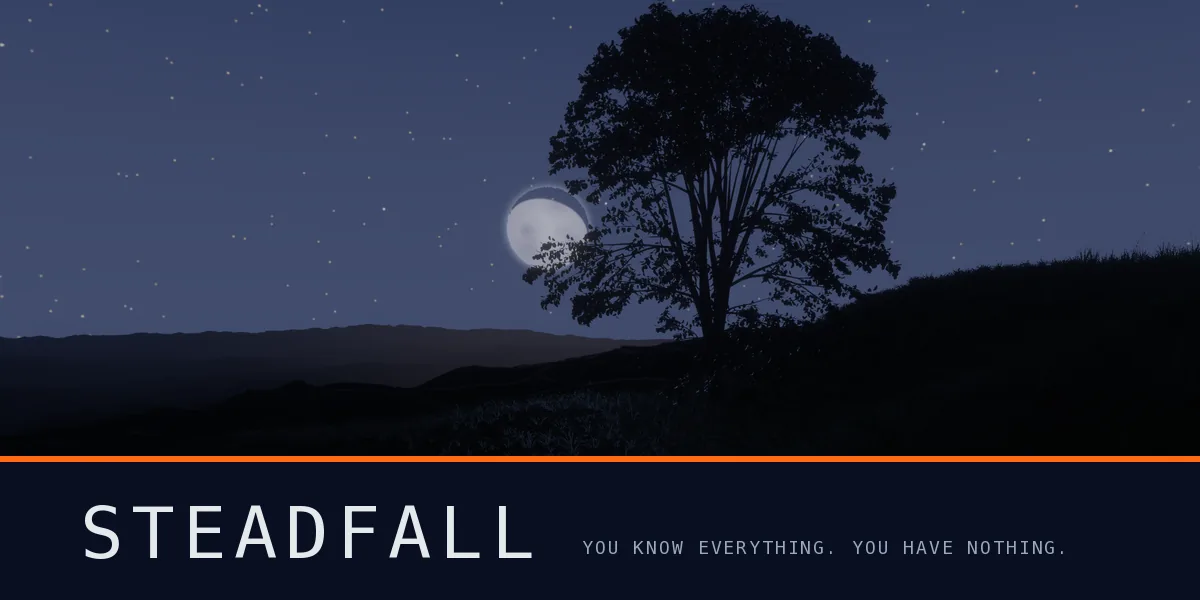
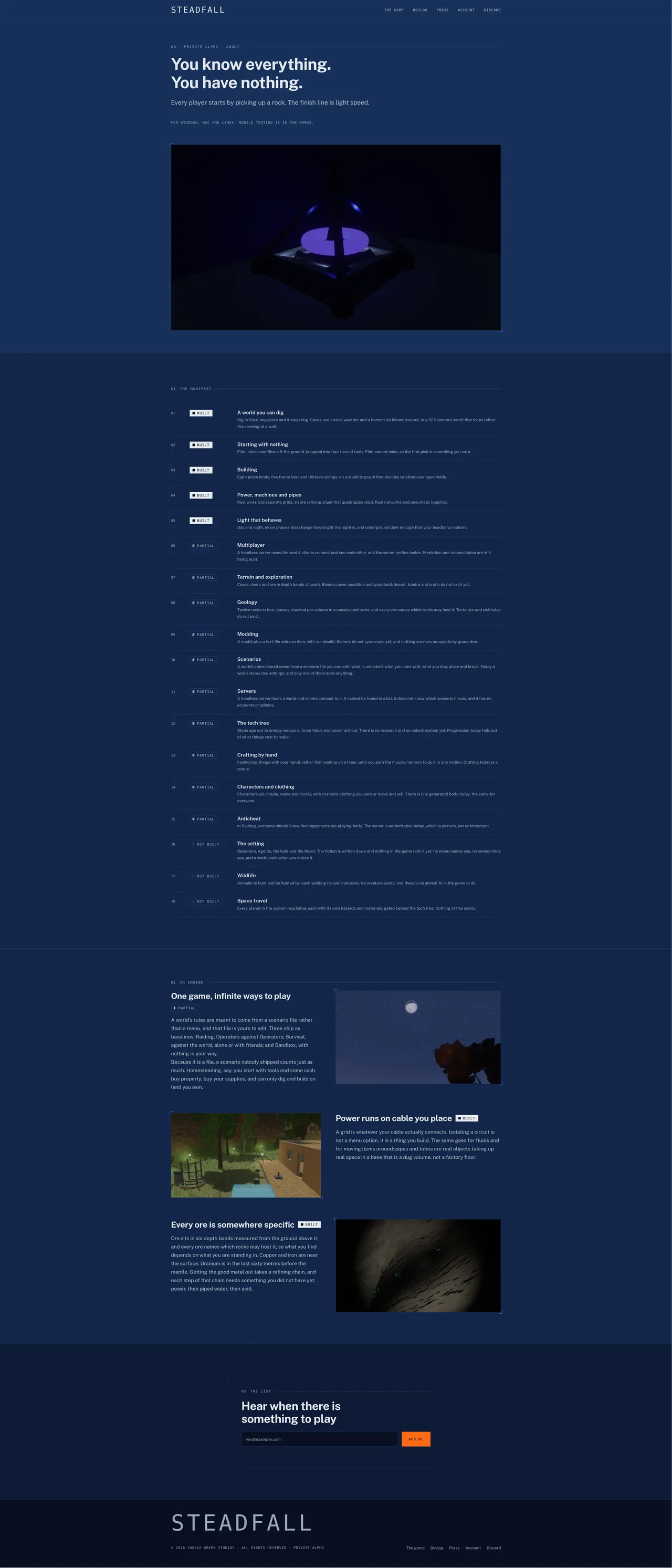
The Steadfall preorder banner: a lone tree silhouetted against the moon over a starry night sky, with the wordmark and the line You know everything. You have nothing.

Ko-fi is only the first storefront. A Steam page and an itch.io page are both in the works, and there will be other platforms to buy a preorder copy of the game on as well. If you would rather wait for one of those, that is completely fine. Every preorder, wherever it is bought, supports development directly, and it means a lot to the two of us building this.

Modular guns

The first gun is modeled, and how guns will work is settled. Both came from Dragonfly9307.

Guns come in tiers of mechanical complexity. The first tier is a break action shotgun, and each tier above it is a more complex mechanism.
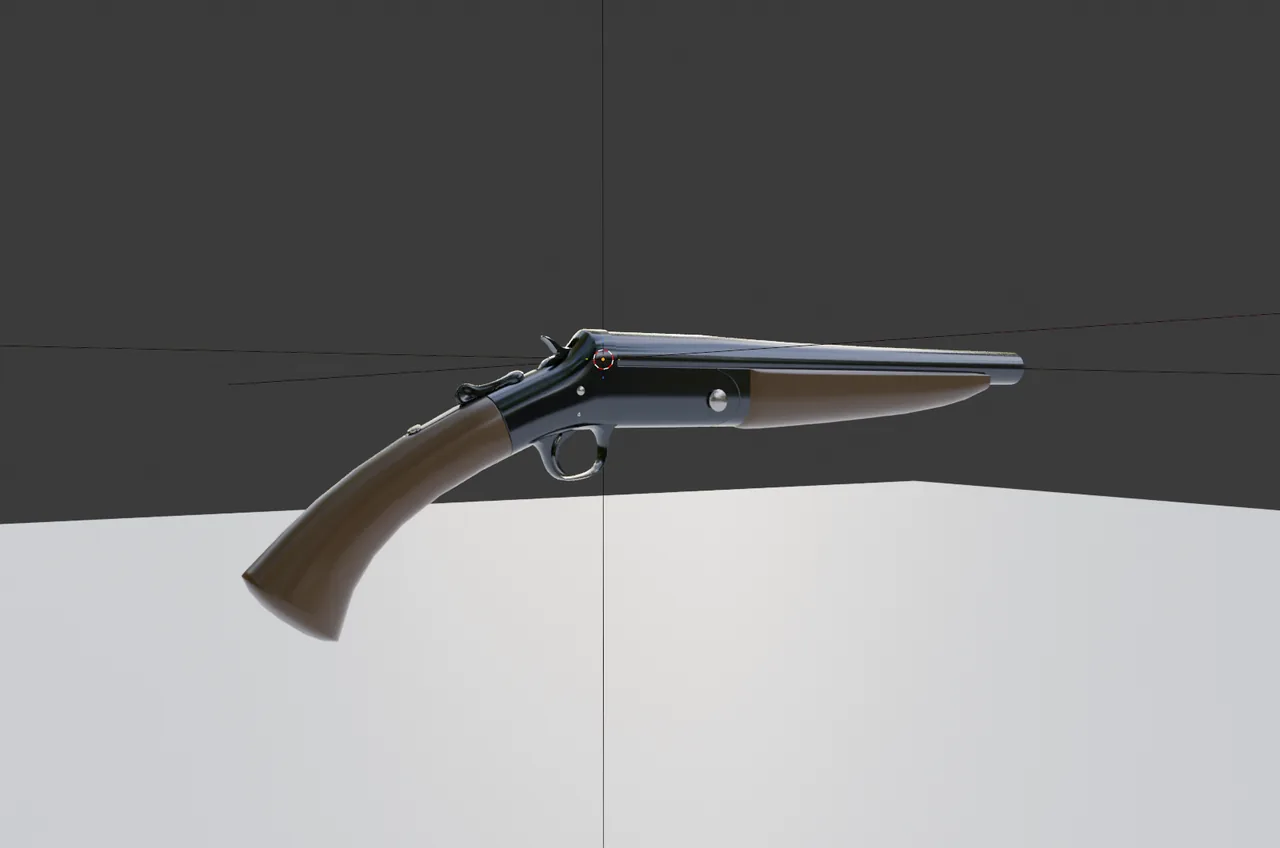
The break action shotgun with a blued receiver and a wooden grip and forend.

The receiver and barrel decide how good a gun is. They carry the refinement, so they are where accuracy comes from, and they belong to their tier.
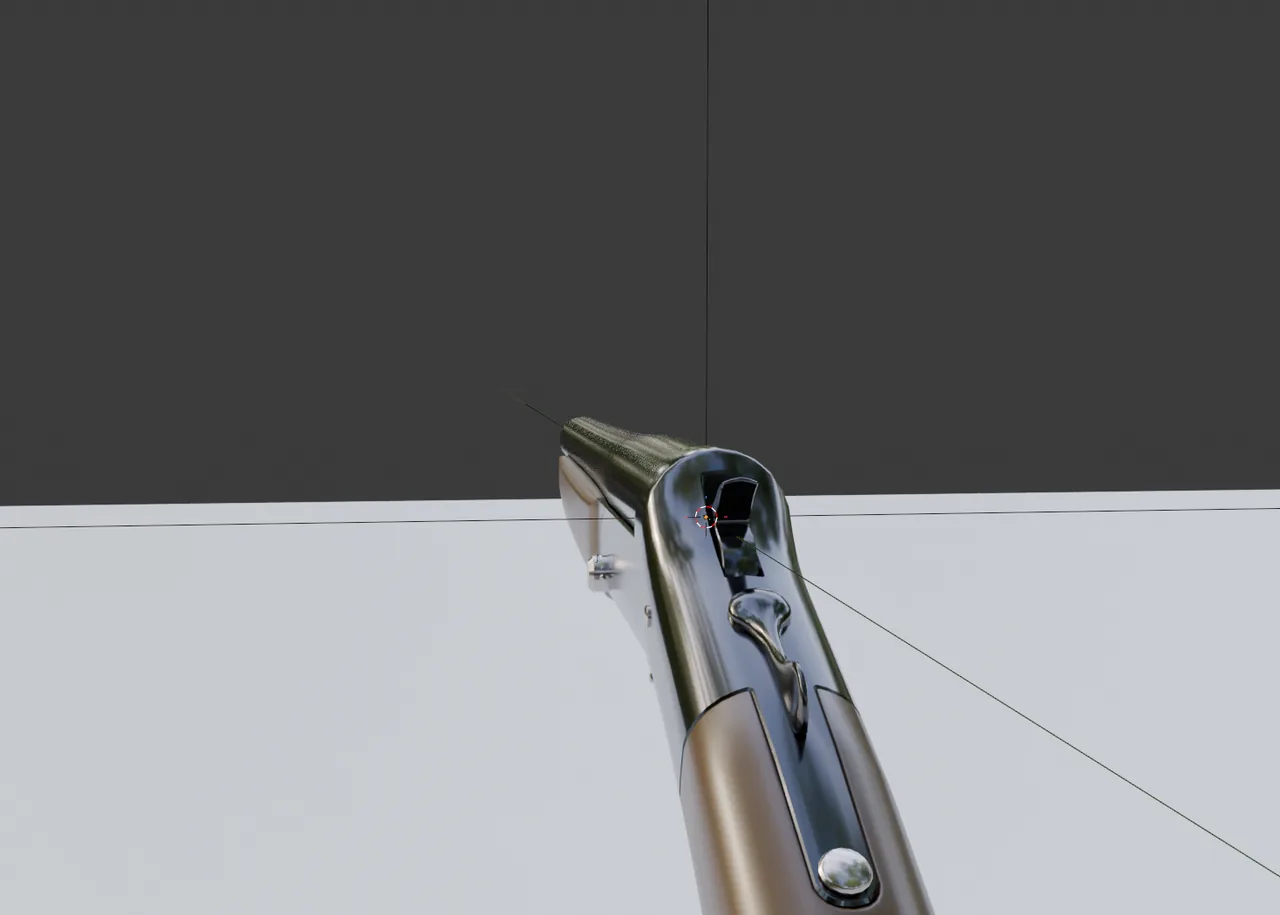
The shotgun from above, looking along the top of the receiver.
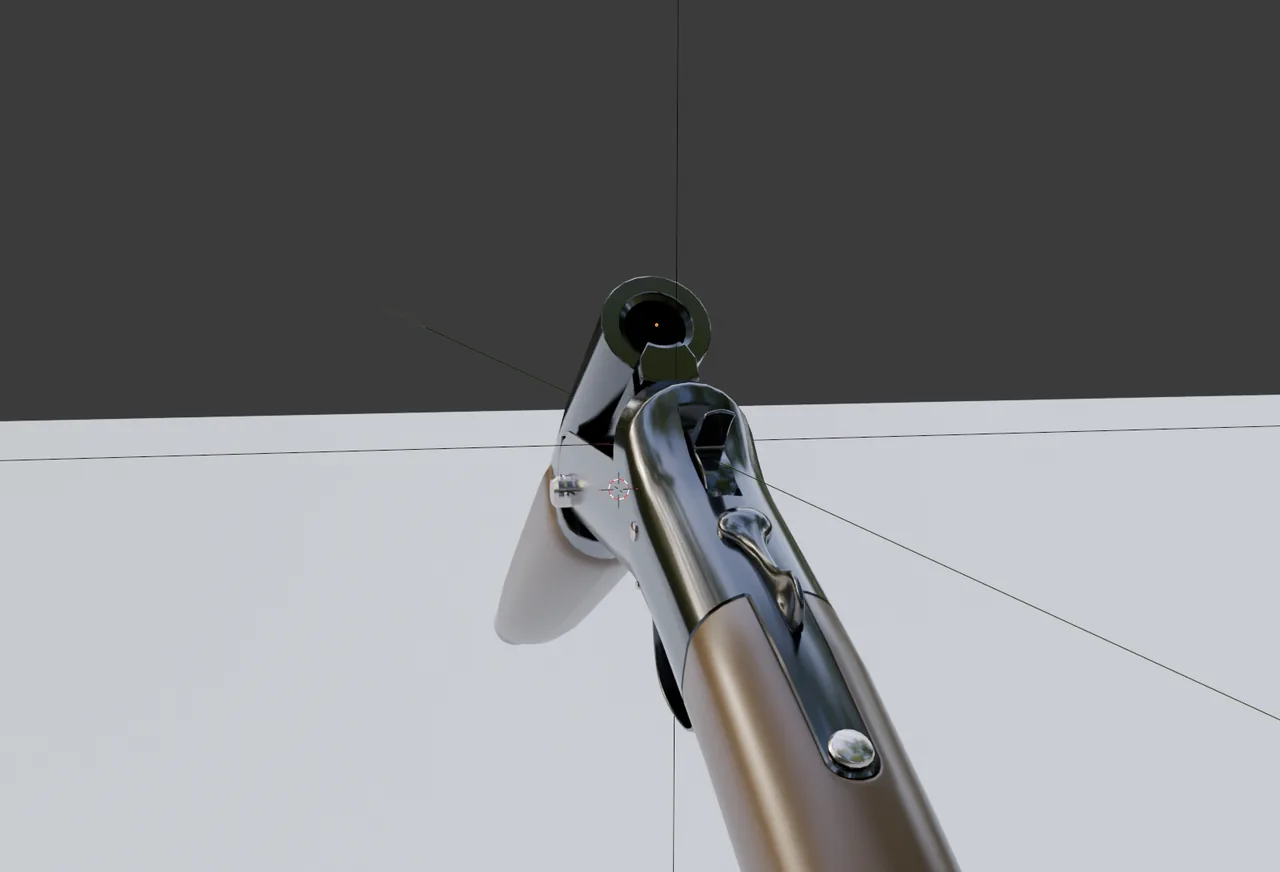
The shotgun from the muzzle end, looking down the barrel.
From above, and down the barrel.

Everything else fits wherever the receiver allows. Stocks, grips and sights are as universal as they can be. A simple receiver takes only a few attachments, while a more complex one takes more of them and more kinds, like side rails for a laser. The lowest tier has no scope rail at all: a break action uses iron sights.
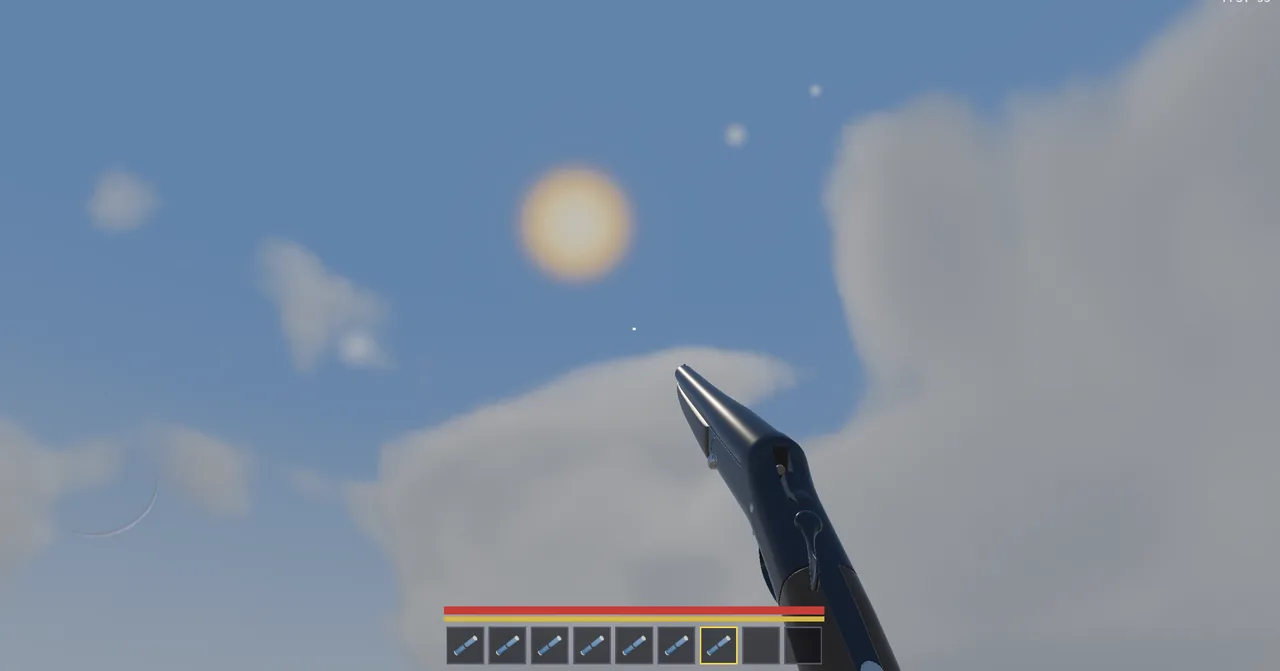
The shotgun held in first person, pointed at the sun on a clear day.

Parts are physical. A stock bolts on and comes off, and a break action with no stock is a shotgun pistol. Swapping the barrel changes the caliber. Sawing a barrel off is permanent: the gun gets shorter and lighter, spreads wider and loses accuracy, and the piece you cut off is scrap metal.
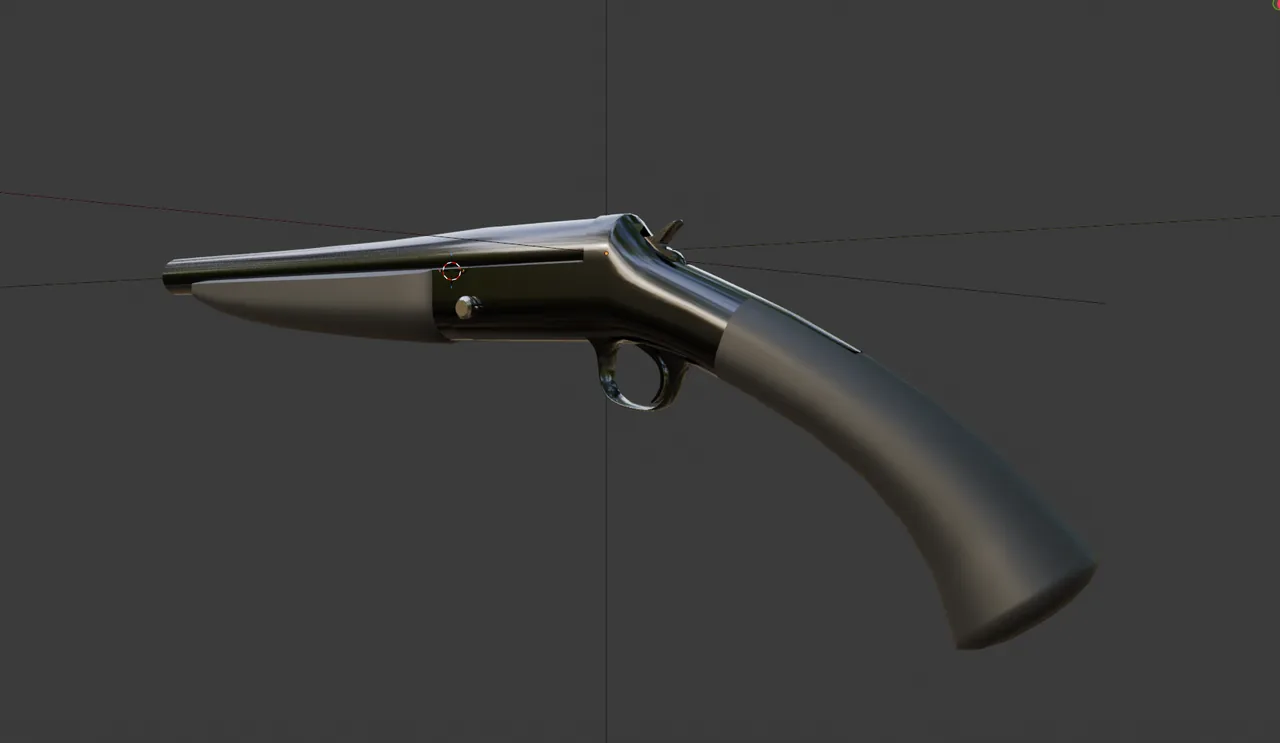
A darker version of the shotgun with a gray grip.

Frankenstein guns are allowed. You can build a gun out of parts from different tiers, and it will fire. It will also have serious drawbacks, so a mismatched gun is a stopgap or a gamble, never a shortcut.
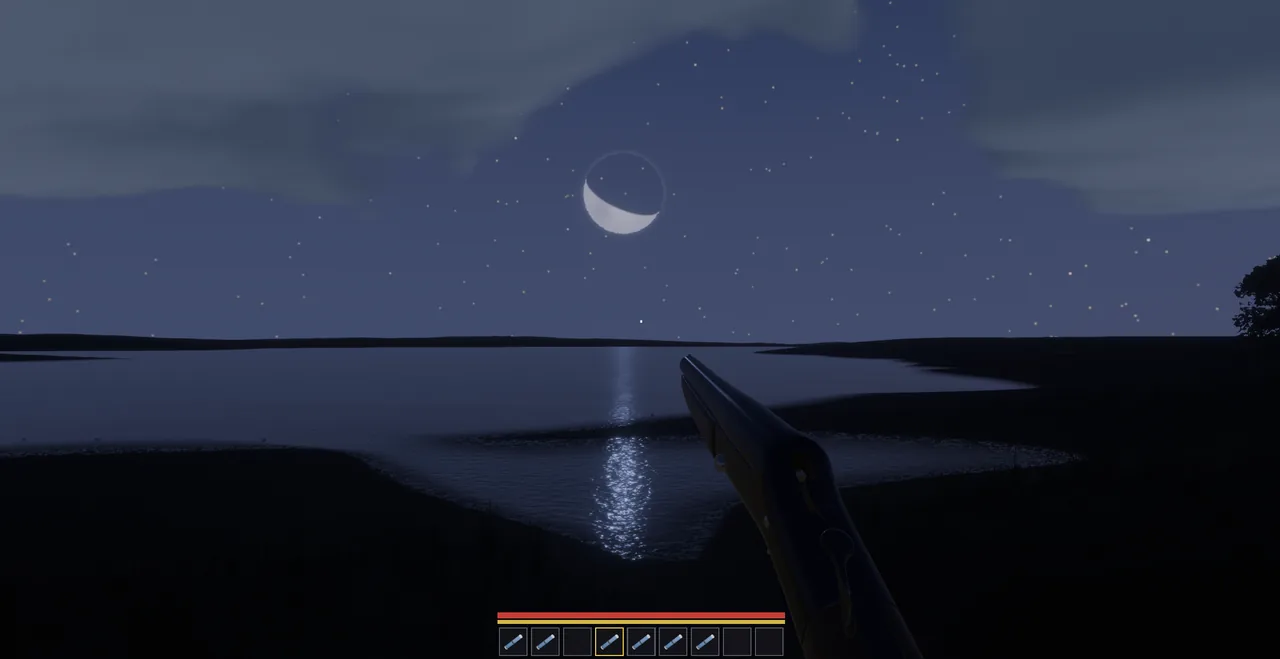
The shotgun held in first person at night, the moon reflected on a lake.

Preorder finishes

Some preorder tiers include cosmetics, so here is exactly what you are buying.

A cosmetic in Steadfall is a finish, not a skin for one item. Own a finish and it applies to every item that could take it: tools, weapons, armor and your Scroll. That includes items added after you bought it, so a finish never goes out of date as the game grows.

The preorder finish is Tempered Tantrum. The Ko-fi page lists which tiers include it. Other finishes, like chrome, are in the works, and gold will be one of a kind, reserved for a single player.
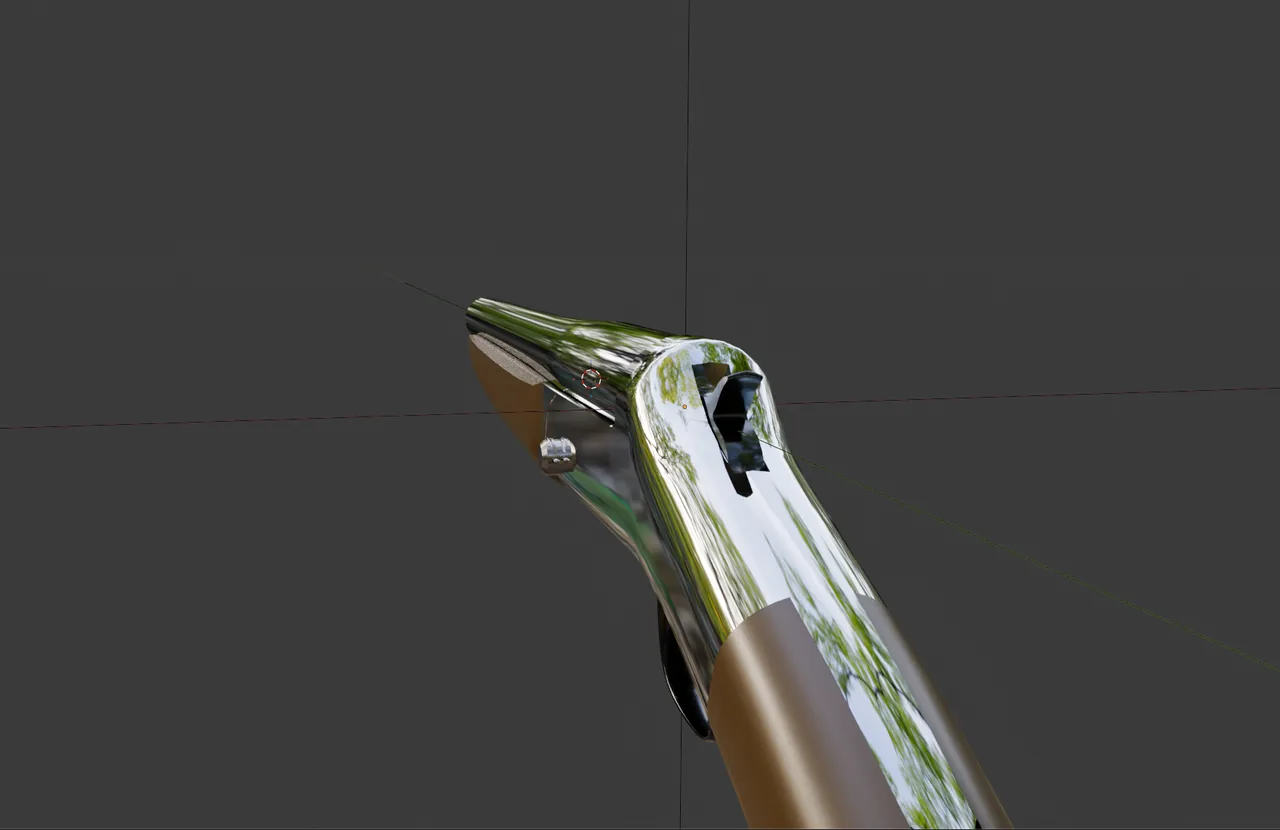
A chrome finish concept on the shotgun, reflecting the trees around it.
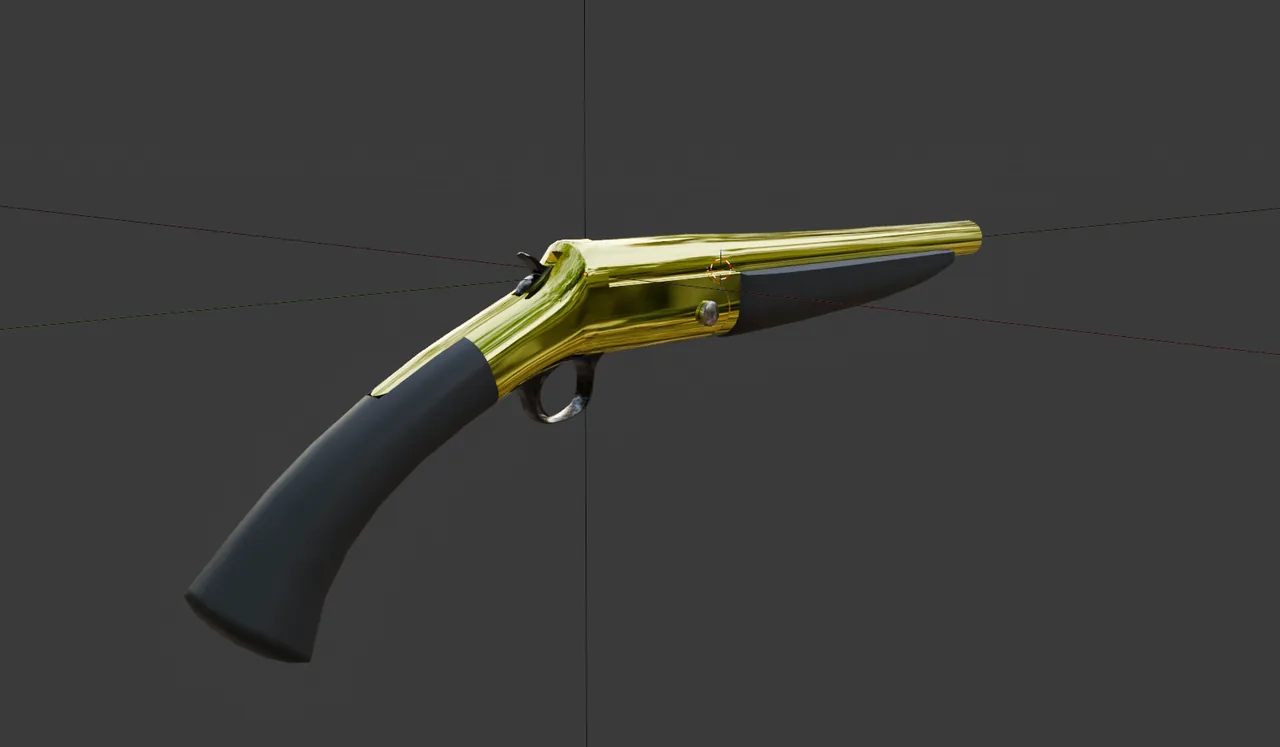
A gold finish concept on the shotgun.
Early finish concepts on the shotgun: chrome, and gold.

You apply a finish at a reskinning bench, to something you have already crafted, or you pick it while crafting. Any item with an alternate finish shows a swatch on its crafting tile.

A finish never implies anything about performance. No finish looks like a material the tech tree actually uses. Carbon fiber, for example, will never be a cosmetic, because a carbon fiber part is genuinely lighter and should look like it. If something looks better made, it is better made.

Exclusives stay exclusive. If a color is ever sold to everyone later, it will never be one a preorder finish already uses. Third person view (F5) means other players see your finishes too, not just you. And every supporter goes in the credits.

The Scroll

The biggest decision this fortnight is the Scroll. The model is finished and can already be held in game. This is how it will work.

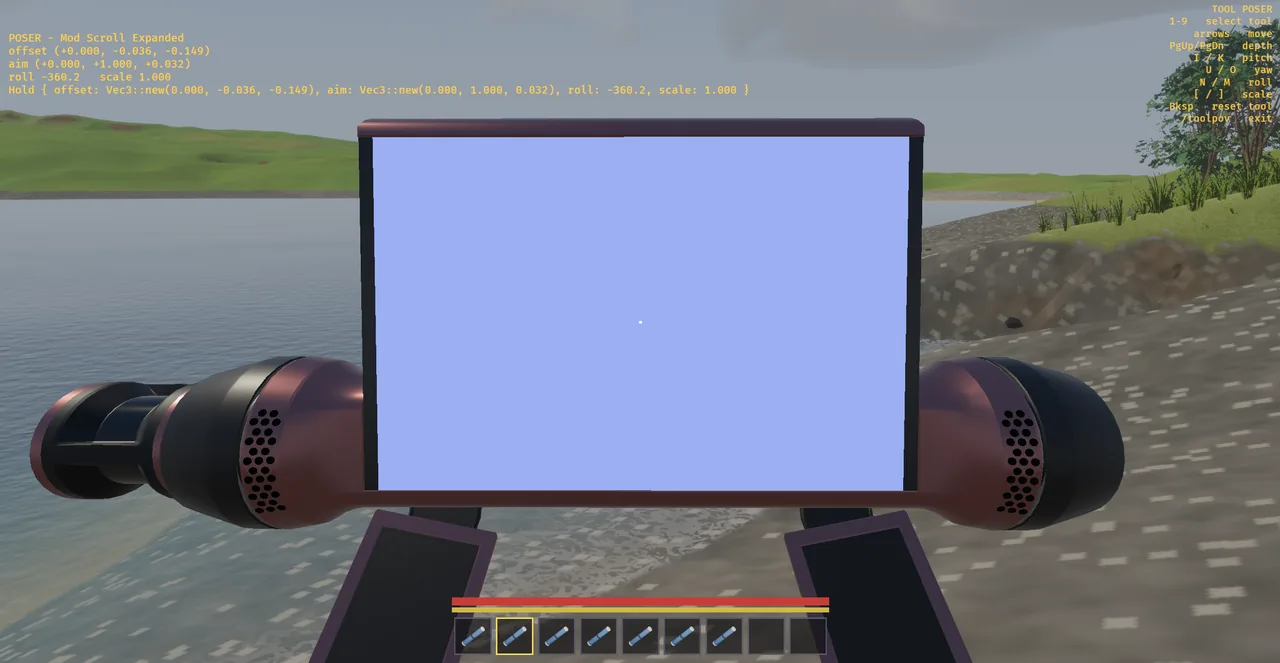
Every player starts with a character, their clothes and one device: the Scroll. Dragonfly9307 modeled it and named it. It is a handheld tube with a screen that slides out of it, a light and a camera on one end, and room for one more module that pops out.
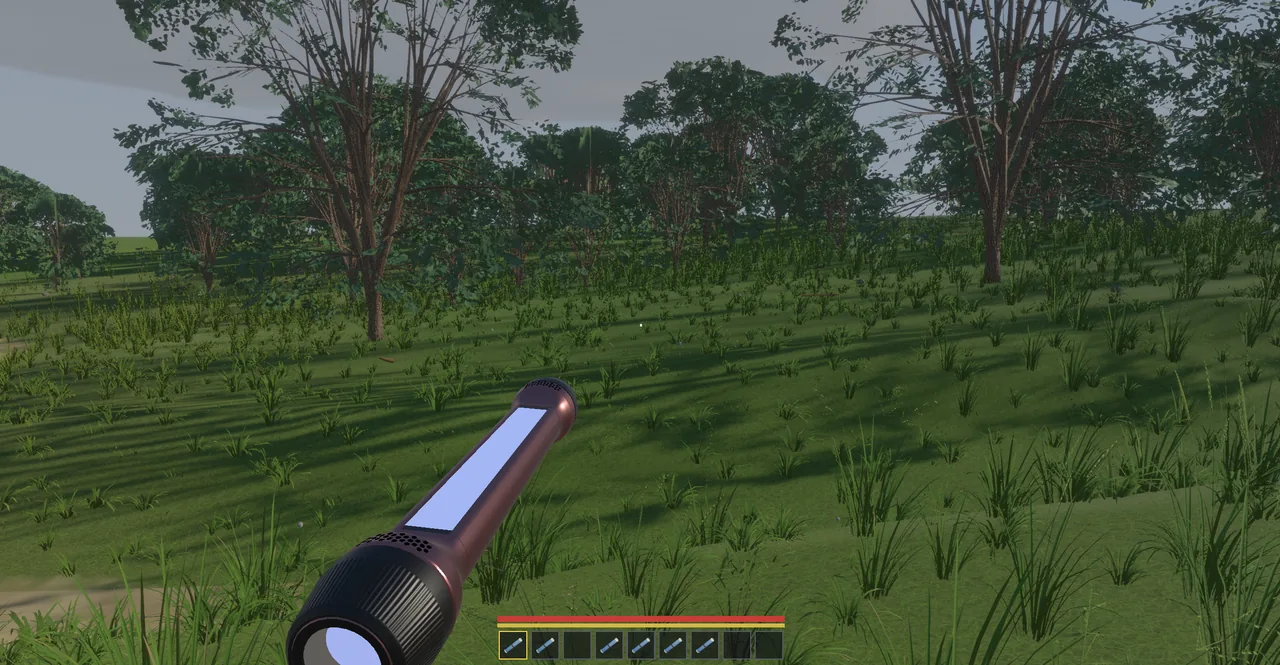
The Scroll held closed in first person, a tube with a light on the end, in a grassy field.
The Scroll held open in both hands, its screen slid out between the two ends.
The Scroll closed, and open with its screen slid out.

It is your guide. The Scroll carries a snapshot of human knowledge, survival advice and objectives to follow. You are never lost on what you can do, but deciding what you should do is still up to you. Early on it gives hints too, like where flint is usually found.

It lives in your left hand. That keeps your right hand free for tools and weapons. One handed items leave it where it is; a bow, or anything else that takes both hands, puts it away. When you are not using it, it is simply gone: no wrist strap, no necklace.

Every interface opens on it. Press Esc and your character raises the Scroll in both hands like a controller, and the menus, the build menu and the map all open on its screen. The screen is 3:2 rather than widescreen, because the Scroll is a device for lists, and the interface scales to fit your display. The first plan for this device was a tri folded tablet, a flat slab in three panels that unfolded on two hinges. It became the Scroll instead.
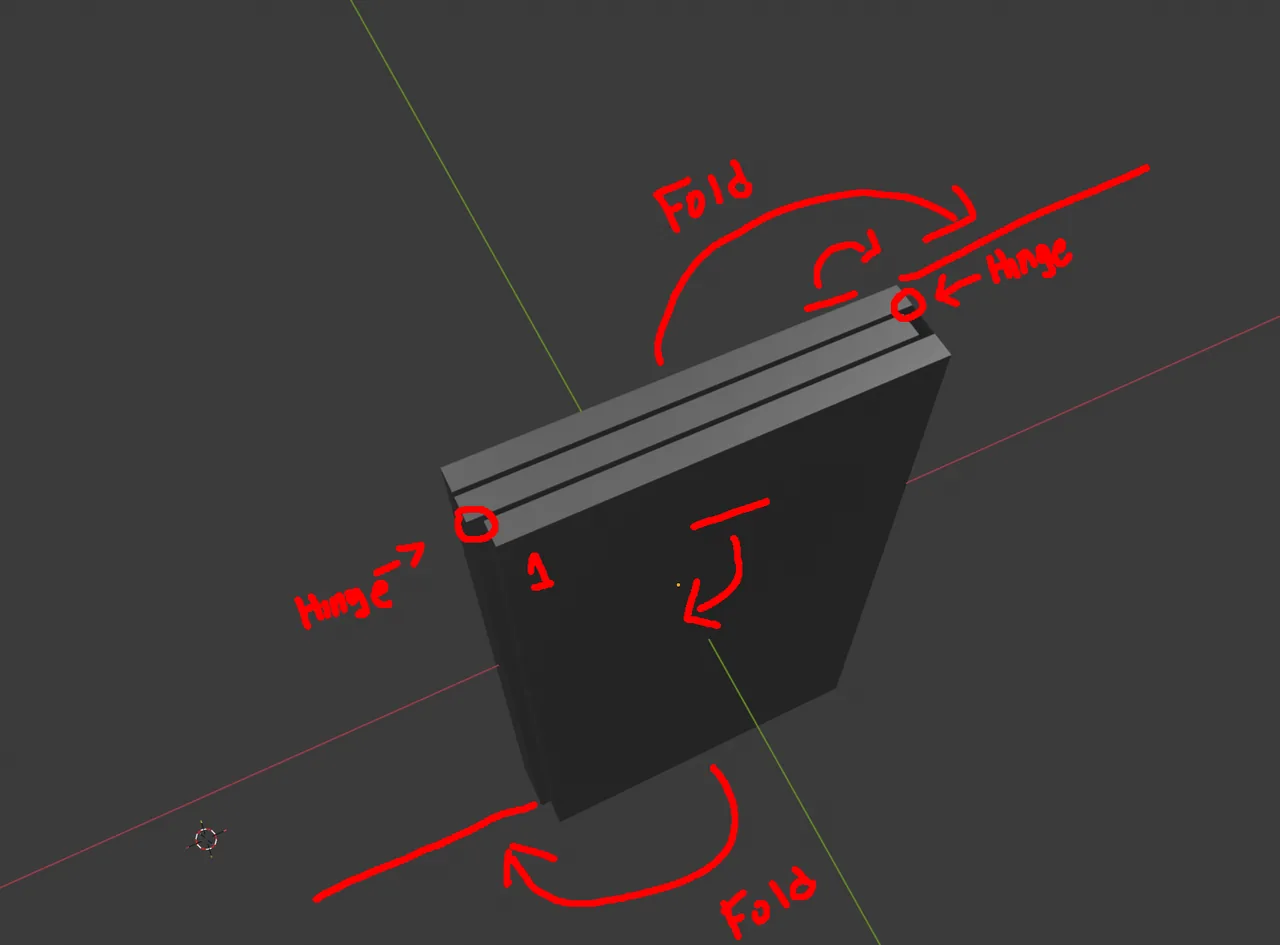
The tri fold concept: a flat tablet in three panels, with hand drawn arrows showing where it folds on two hinges.
The tri fold concept, before the Scroll.

It is your toolkit. Middle mouse opens a utility wheel with a flashlight, a scanner, a camera and zoom. The flashlight is the Scroll's own light, the same one the camera flashes with, like a phone. For hands free light, you can clip it to one of three spots on your body.

It is how you talk. There are no cell towers on this planet. Messages go from Scroll to Scroll, so players close enough to each other can text, and you have to open the Scroll to read what arrives. A new message buzzes, and that buzz can give your position away. Reaching further means building antennas, and whoever owns an antenna can read everything that passes through it unless you encrypt.

It grows with you. The plan is for new features to install onto the Scroll as apps instead of arriving as new items, like a sample analyzer for minerals the camera cannot identify, or a short range resource scan. It is a starting device, not the ceiling: crafted lights, holders and mounts can outgrow it.

The tutorial is played on it. The first time you launch the game there is no menu. You are holding the Scroll, piloting a training character inside it through a guided survival course on a fixed map: find and scan flint, build a starting camp, make your first tools. Finish it and your character puts the Scroll down, the splash plays, the menu comes up, and the full size of the game arrives all at once. You can skip it from the Esc menu, and replay it any time from the Scroll.

The short version: the game got a lot faster, the water was rewritten from scratch, grass came back as real modeled clumps, and the first hand modeled tree is growing across the world.

Frame rate

A lot of this stretch went into performance, and it paid off. The biggest find was the clouds. The cloud pass turned out to be the most expensive thing in the entire frame, and none of our tools were timing it, so for months the game looked like it was waiting on the CPU when it was really waiting on the sky. Once we could see it, the clouds were reworked to spread their work across several frames and look identical doing it. At 4K, walking through the world went from 74 fps to a median of 116, and the worst frame dropped from 59 ms to 19 ms.
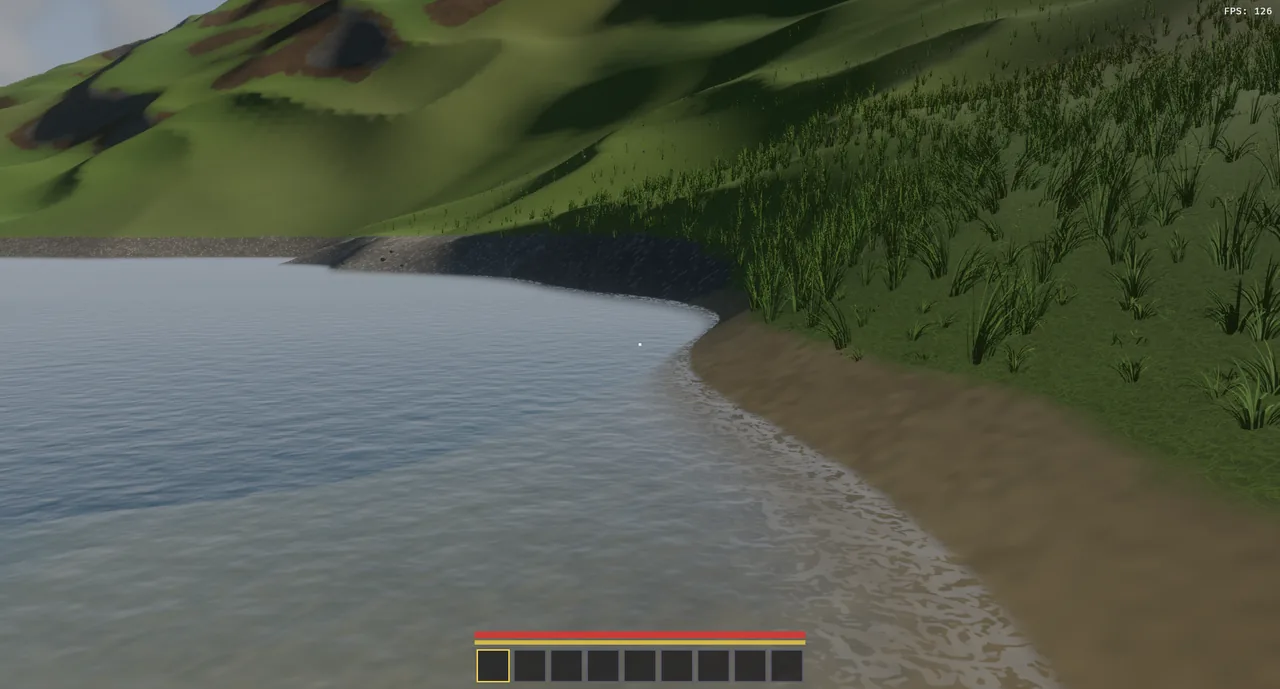
A grassy shoreline at 126 fps, the lake bed showing through the shallows.

That same hunt also fixed a rare crash where the graphics driver would lock up and take the game down with it.

Smaller wins came from all over: the settings screen was quietly redrawing 44 text labels every single frame even while closed, loading far terrain got much cheaper, and cave meshes far below you are no longer built while you stand in a field. There is also a new Render Scale setting (100, 85, 75, 67 and 50%) that draws the world at a lower resolution while keeping the interface sharp, which is a big help on weaker hardware.
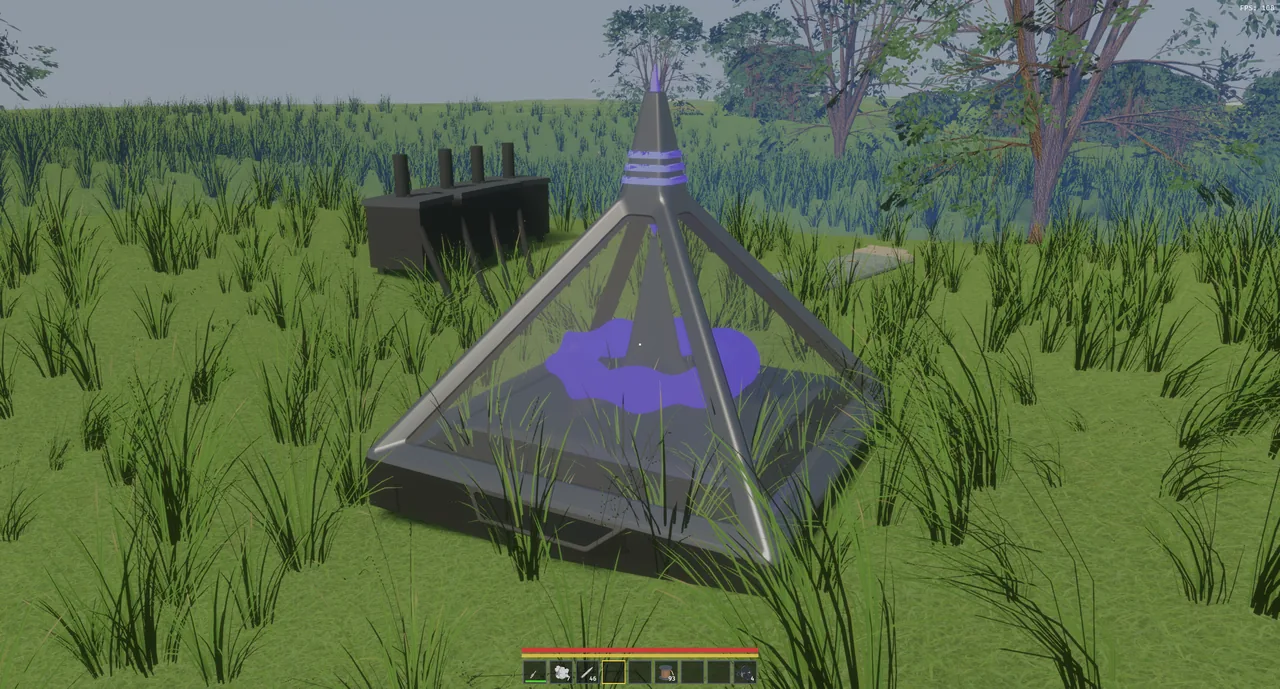
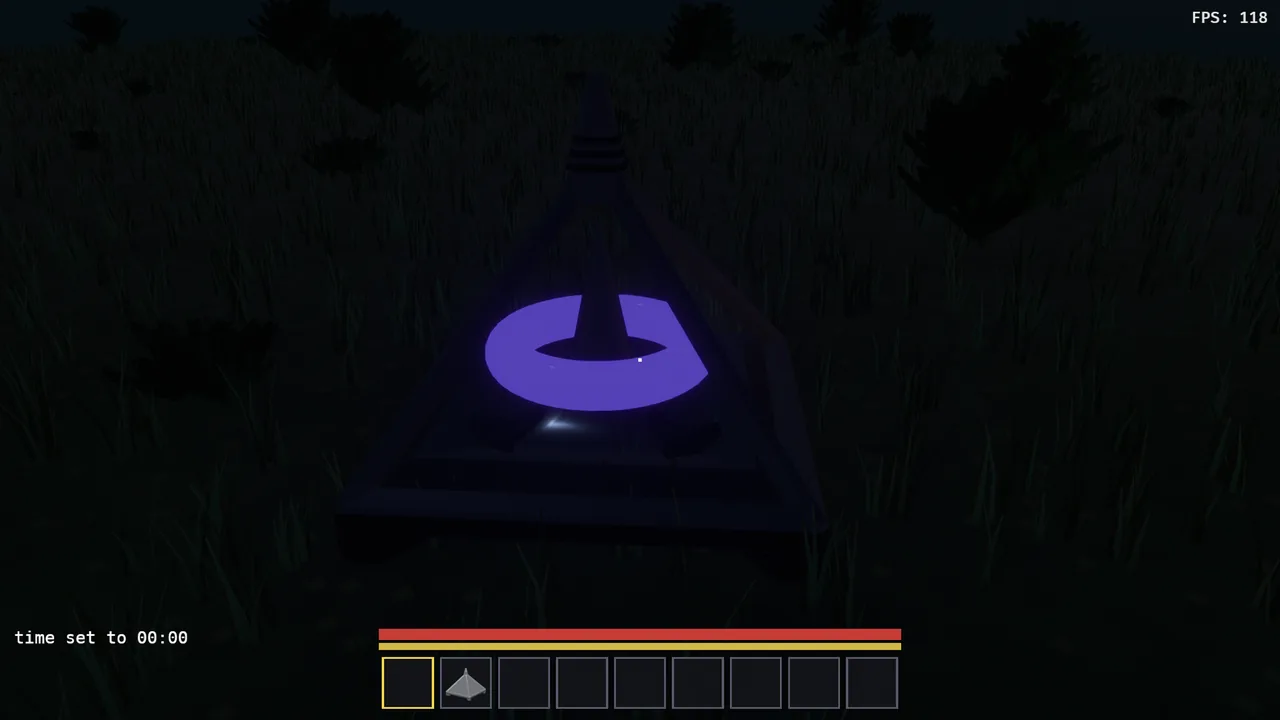
The Logos Drive placed in a grassy field beside other machines, its field glowing purple, at 108 fps.

A few quality of life fixes came along with it: fullscreen is a proper setting now, F11 works from the main menu, and alt tabbing out of the game releases your mouse.

New water

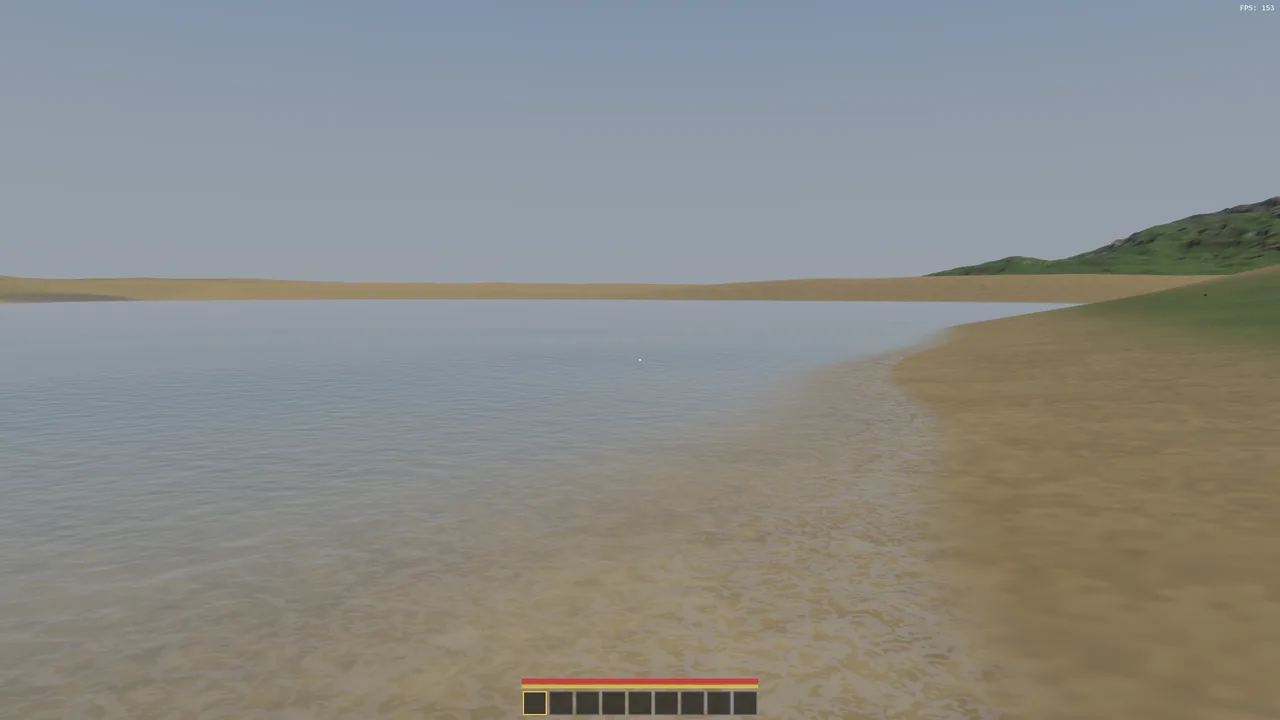
The water was rebuilt from the ground up. Before, the sea could not show what was under it at all. Now you can see the bed through shallow water, and it fades into deep color the further down it goes.
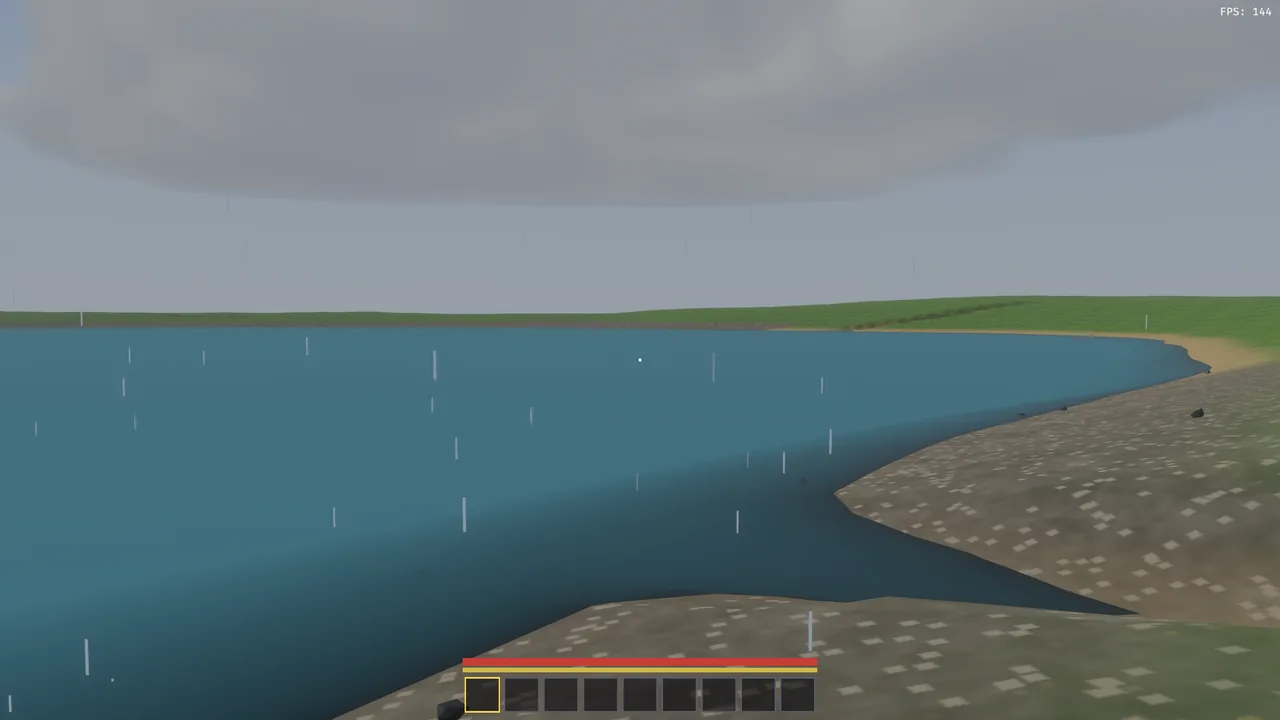
The old water in the rain: a flat, opaque blue sheet that shows nothing beneath it.
The new water at a sandy beach, the sand bed clearly visible through the shallows before it fades into deeper water.
Old water on the left, new water on the right. The old sea was an opaque sheet; the new one shows the bed through the shallows.

It reflects the real sky instead of a flat gray, and it has rolling waves, ripples, rain rings when it storms and foam where it meets the shore.
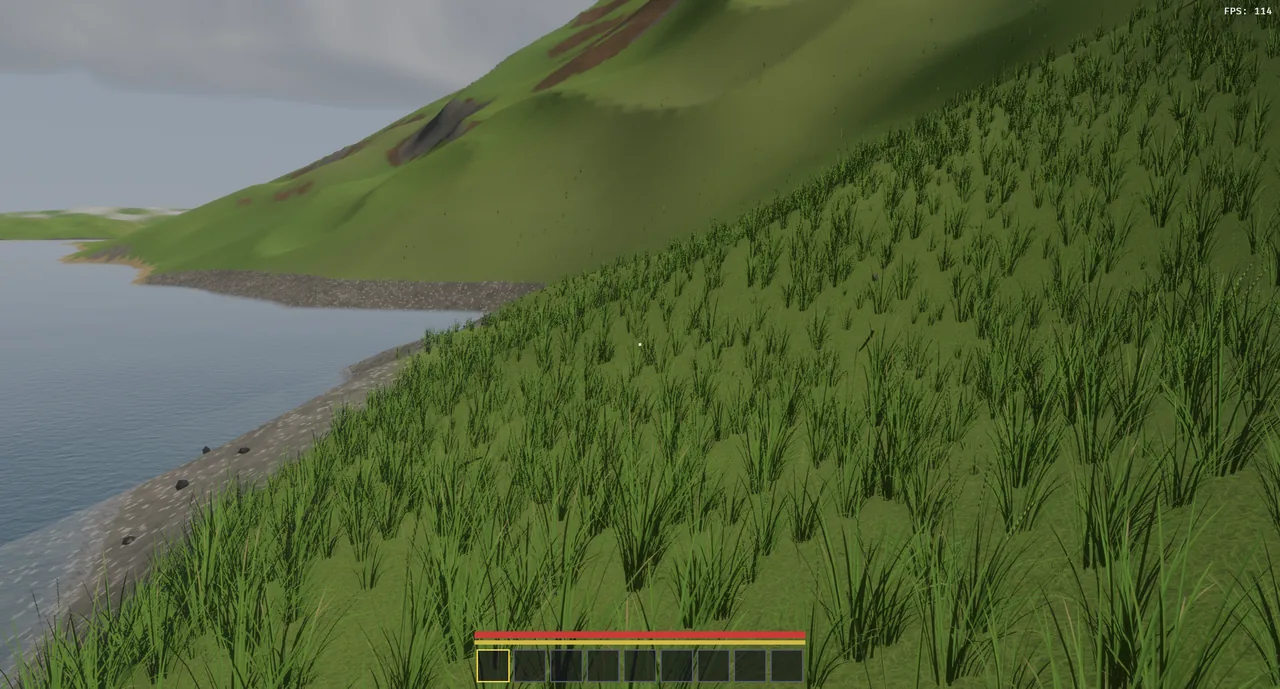
The new water below a grassy hillside, the pebbled bed visible through the shallows along the shore.

It comes in Low, Medium and High quality, and it costs about the same as the old water did.
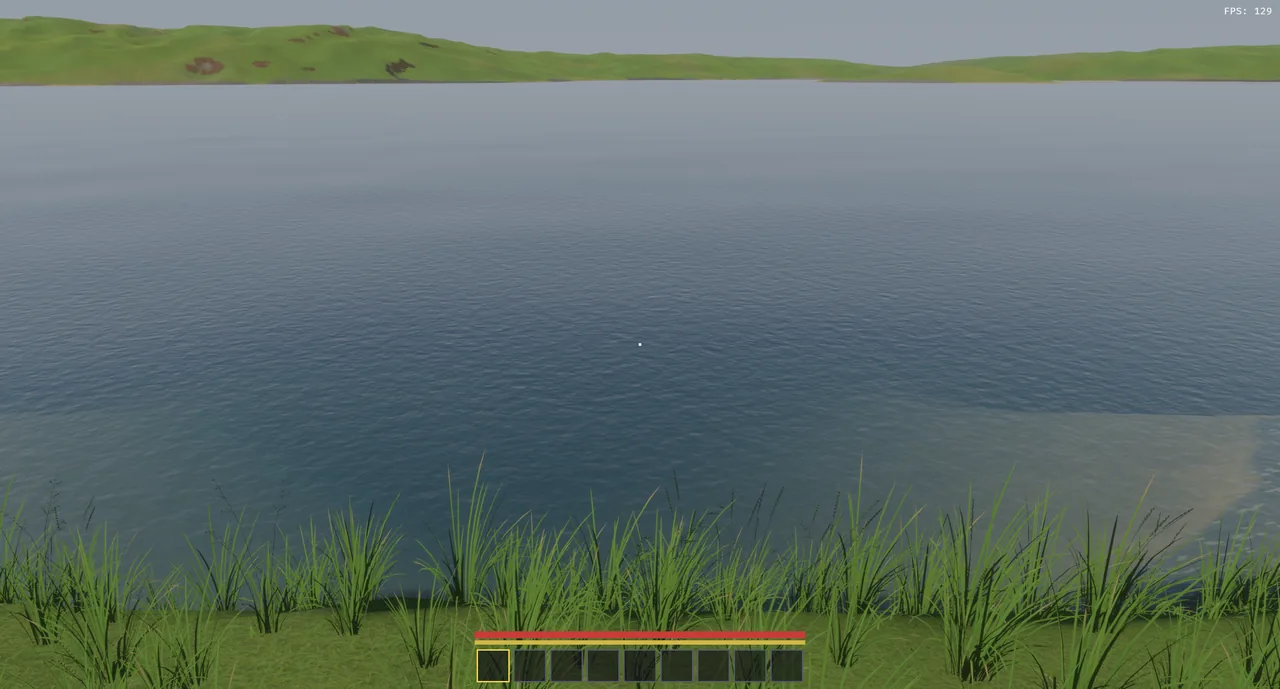
Open water from the bank, fine ripples across the surface and a sandbar showing through the shallows.

The ground and the grass

Ground textures now blend by height, so where grass meets dirt or rock the edge looks like the materials meeting instead of a smear along the terrain mesh. Steep slopes and crater walls no longer streak.
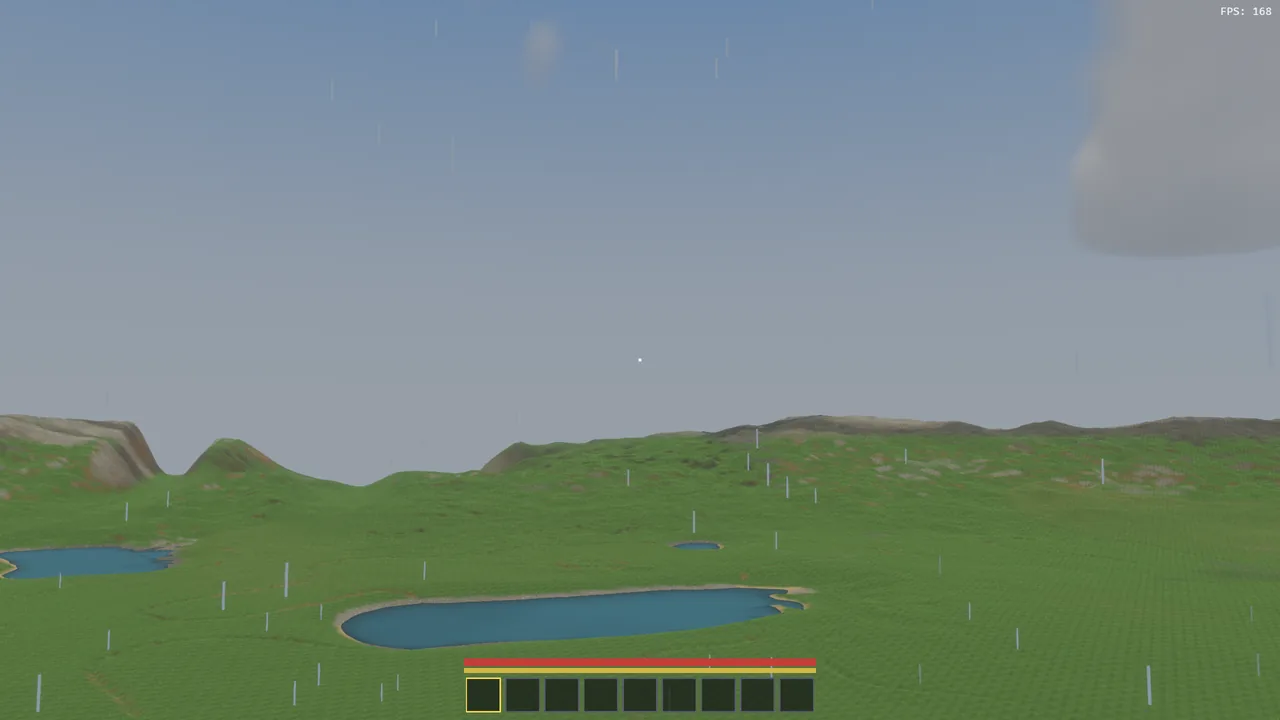
The ground before: flat green terrain with no grass on it, and the old flat blue ponds in the rain.

Grass is back, and it is a lot more than it was. Every clump is modeled in Blender: short turf, bunch grass and tall grass with seed heads, plus dandelions with leaves, flowers and seed clocks. The graphics card decides which clumps to draw each frame, so a meadow can hold over 220,000 clumps and still run well. Under it all, the ground's grass layer is now based on a photo of a real lawn, blended so it never visibly repeats. And the clouds no longer draw over grass blades against the sky.
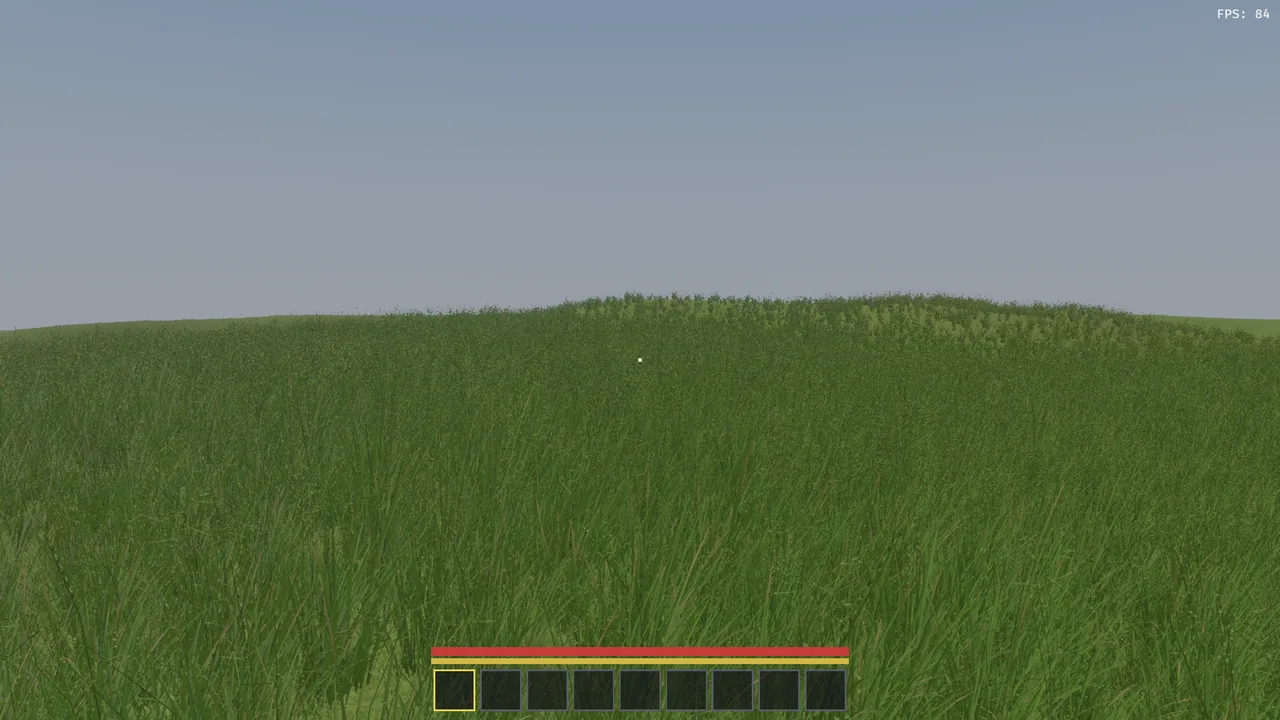
A meadow of dense, tall modeled grass rolling up to the horizon.

Trees, for real this time

Last devlog ended with trees starting over "and over, and over". They started over one more time. The procedural tree generator has been removed entirely, and trees are modeled by hand in Blender instead.
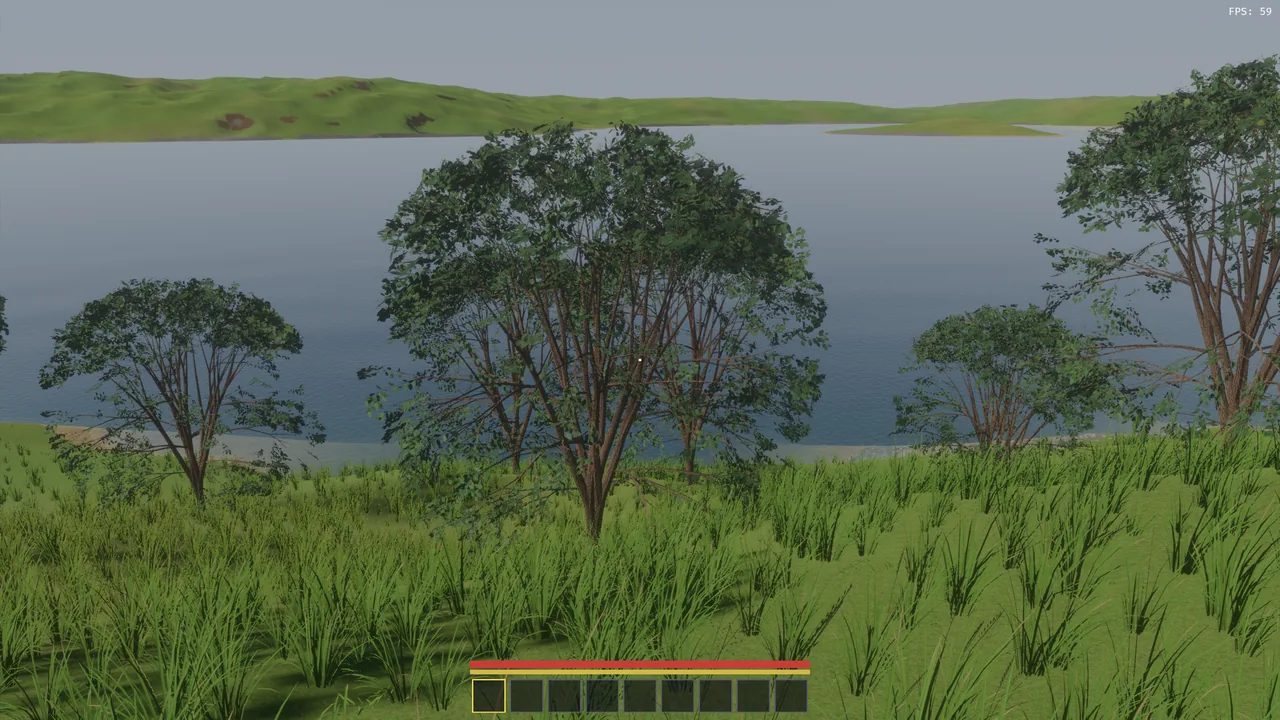
A row of apple trees on a grassy slope above the lake.

The first one is in: an apple tree. I sculpted the tree, and Dragonfly9307 made the assets for it. It follows the seasons. It has six looks: green, unripe fruit, ripe fruit, autumn, late autumn and bare, and the world switches between them as the calendar turns. There are ripe, unripe, rotten, bitten and fully eaten apples too.
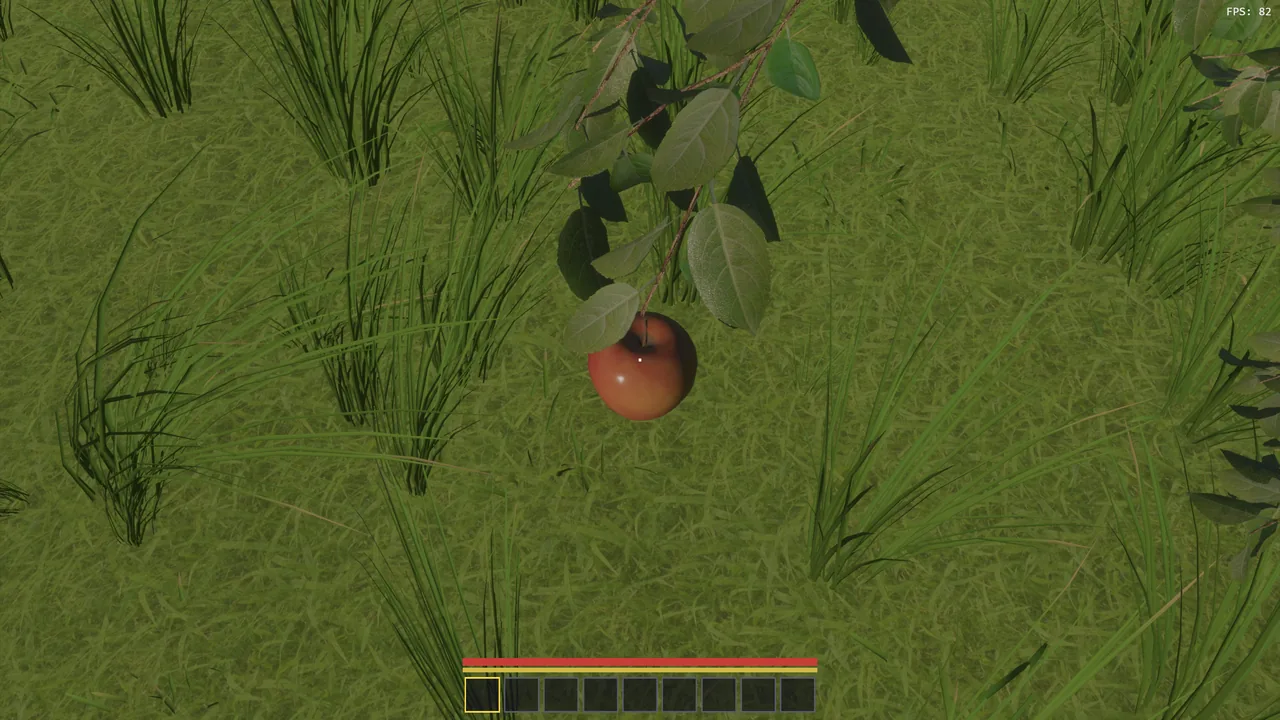
A single red apple hanging from a branch over the grass.

The model as delivered was 1.47 million triangles with over 35,000 individually modeled leaves, far too heavy to put in a forest. So it is baked down into four levels of detail, from about 75,000 triangles up close to a simple flat stand in far away, with the leaves grouped into clusters where they actually hang.
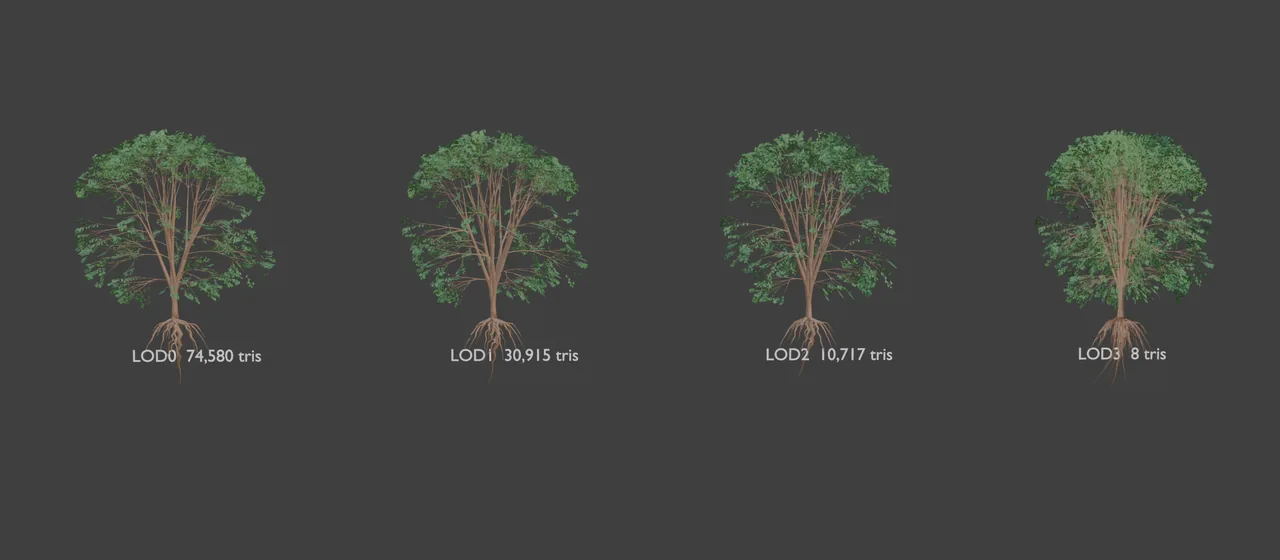
The same tree at four levels of detail: 74,580, 30,915, 10,717 and 8 triangles.

A whole forest of 555 trees now costs under 3 ms. The world grows its own trees again, and chopping, felling, stumps and logs all work on them.
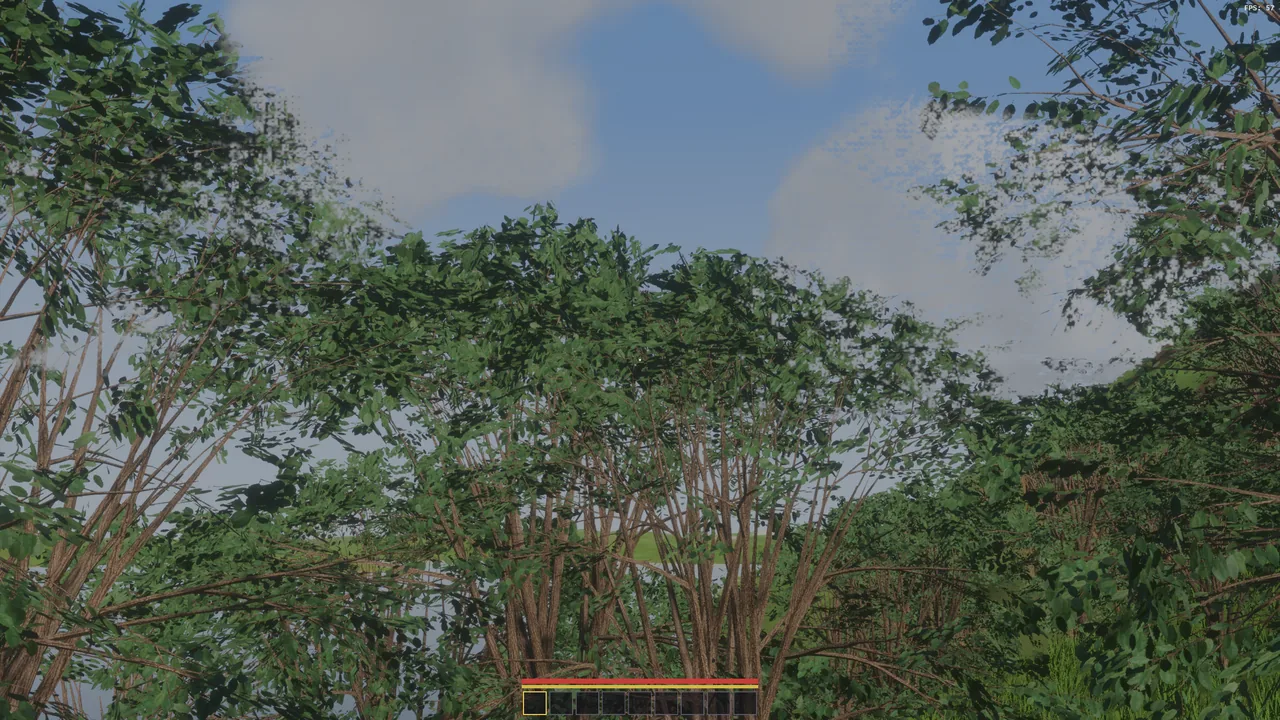
Looking up through the canopy of an apple orchard at a partly cloudy sky.
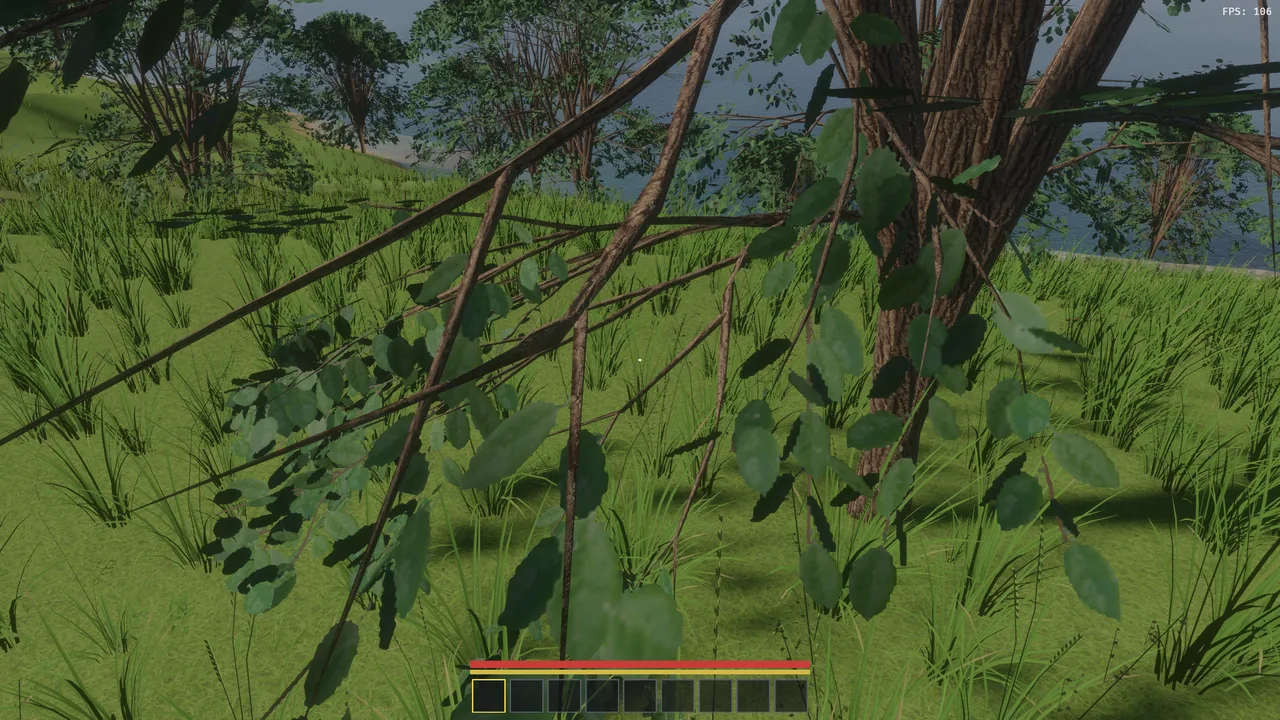
Apple tree branches up close, with more trees and the sea behind them.
Inside the orchard: the canopy, and the branches up close.

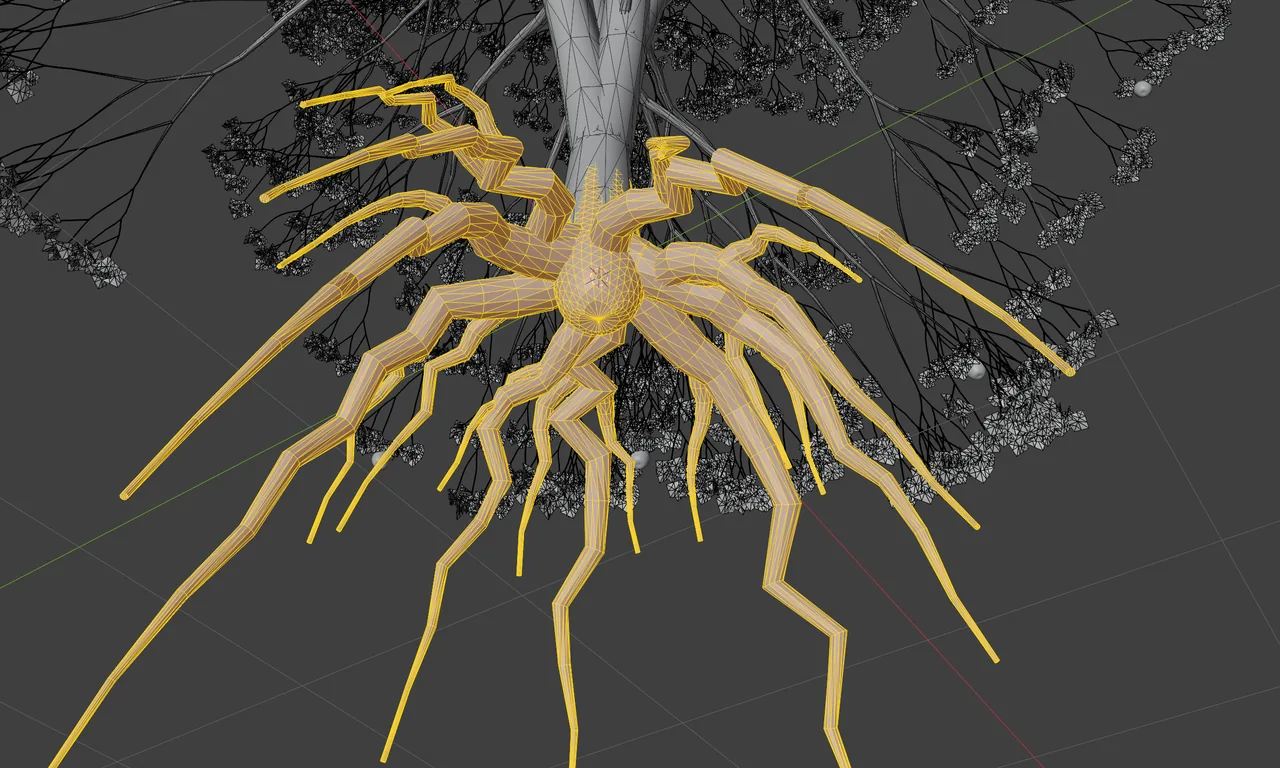
The roots are a work in progress too.
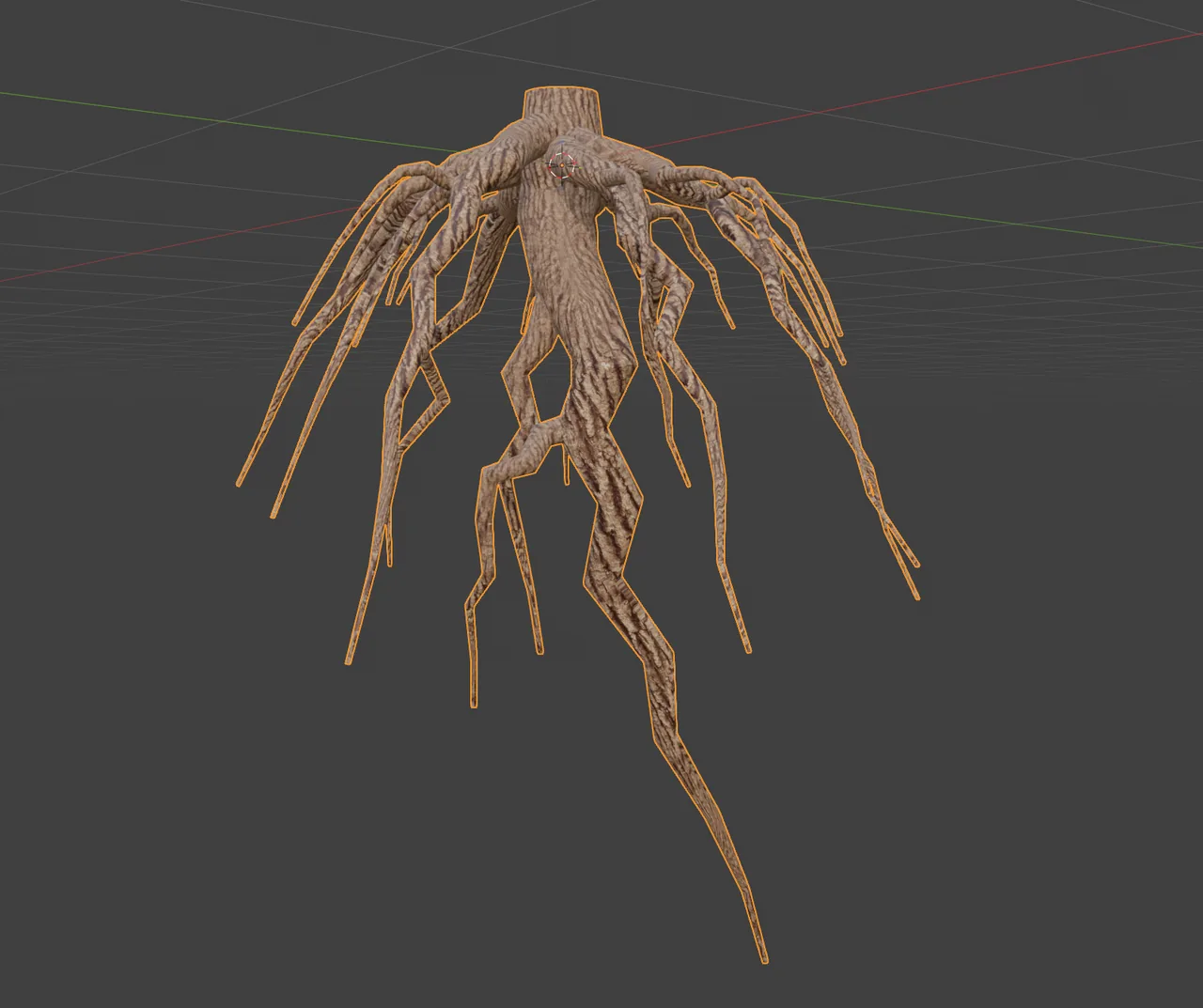
The tree's root system on its own, textured with bark.
The root mesh in wireframe beneath the trunk and canopy.
Work in progress: the roots, textured and in wireframe.

The Shell Emitter, in game

The Shell Emitter from last devlog is placeable and working now. Power it and it plays its start up animation, then its core pulses red while the barrier holds. Cut the power and it winds down and goes dark.
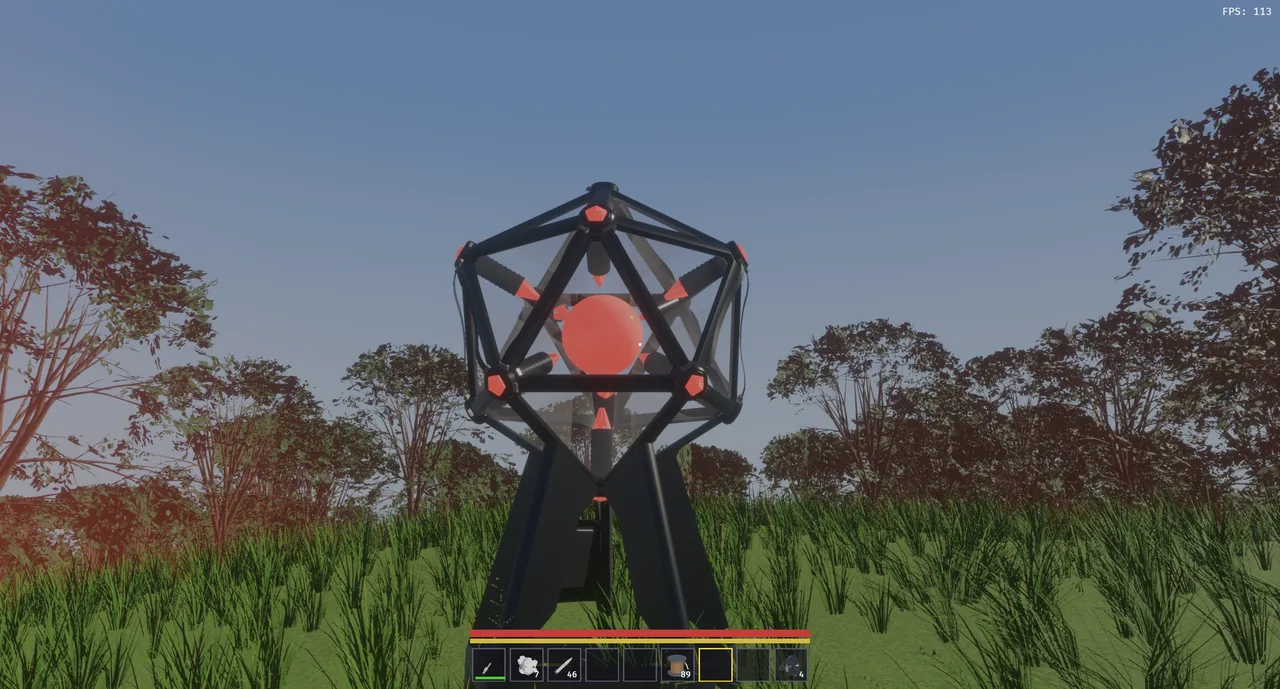
The Shell Emitter standing in a grassy clearing, its caged core glowing red.

The Logos Drive also got some fixes: every placed drive was secretly being drawn twice, which is where its stray glow with no power came from, and its idle animation was sitting frozen for four seconds out of every five. Both are fixed, and its ring light now follows the field.

Held items and dropped models

Anything you held used to lose detail the further you walked from the center of the world. Kilometers out, small details like vent holes turned into jagged blobs that crawled as you moved. Held items are now drawn from a fixed point, so they look the same everywhere. Models with nested parts also dropped to the ground in pieces, and the bow's arrow slid off the string when you dropped it. Both fixed.

What else we have decided

A lot more design got settled this fortnight, and this is where things are headed:

  • Damage types. Sharp weapons cause bleeding that gets worse with every hit. Patching up stops the bleeding but does not heal you. Hard armor plates counter sharp damage, while blunt weapons stun and concuss instead. Each player's health and strength matter, so landing more hits is not a guaranteed win.
  • Body sizes. Height and build will be adjustable in character creation, and your hitbox will follow your body and armor.
  • Crafting runs one way. Raw materials become components, components become machines. Destroying something gives back a small amount of salvage, not the parts that went into it.

Next up is more trees and foliage, the Scroll, and getting ready for Steam and itch.io. Thank you to everyone who has already preordered.
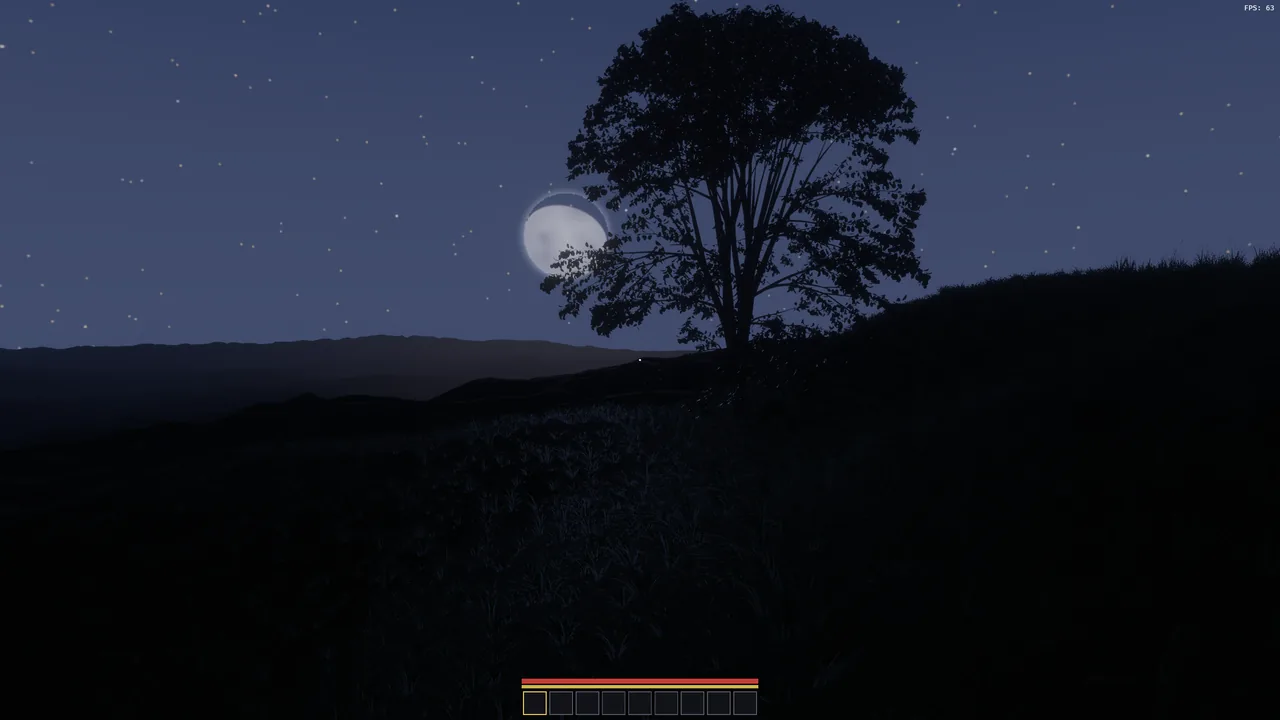

A tree silhouetted against the moon on a starry night.

14 September 2026 · Hazmad

Two weeks: a phone, a new way to build, and trees from scratch

Another two weeks, another long list. The short version: Steadfall runs on Android now, building was torn down and rebuilt around a whole new system, bases can be found by what they give off, and the old trees and plants are gone so they can come back properly.

Logo and banner concepts

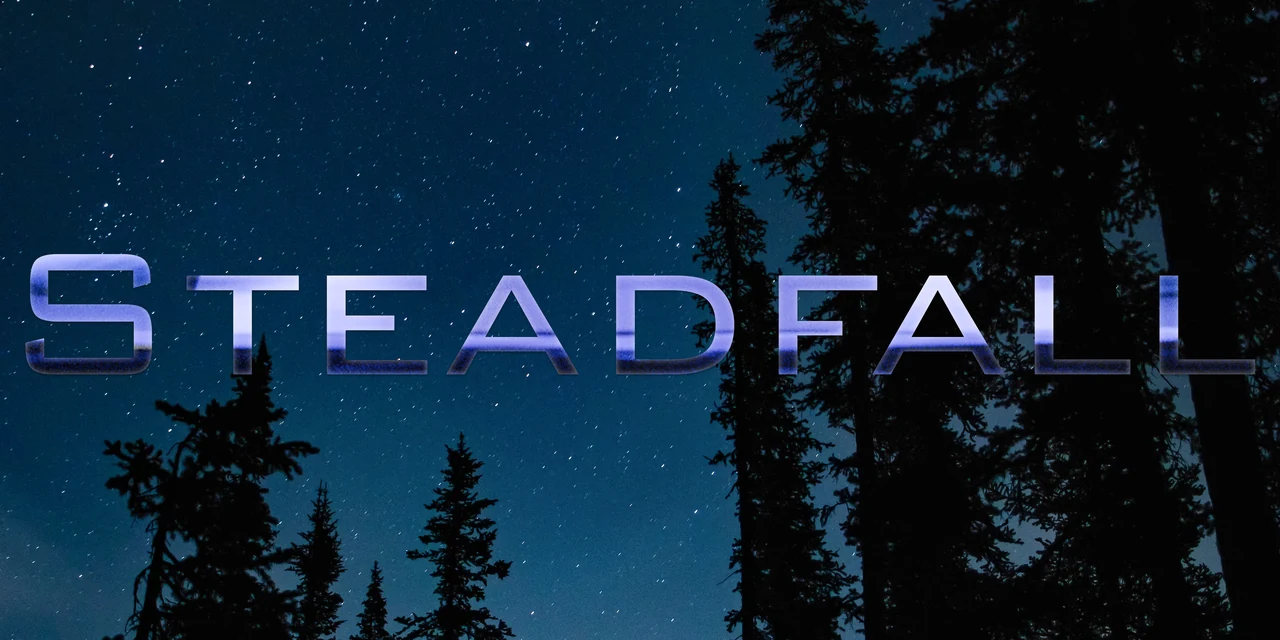
Dragonfly9307 has some logo and banner concepts in the works for Steadfall. Nothing here is final yet.

A Steadfall banner concept: the wordmark over the glowing core of the Logos Drive.
A Steadfall banner concept: the wordmark in lit metal over a starry sky and pine silhouettes.

Steadfall on a phone

The game builds, installs and plays on Android. Menu, world creation, terrain, water, sky and saves all work, and a saved world reloads from the list with its thumbnail. Then came the controls: a movement stick, a look area, a sprint gesture and a hotbar strip along the bottom. The inventory works by touch too, with a long press to split a stack, and a UI scale slider lets you size everything to your screen. The phone keyboard types into chat and menus the way it should.

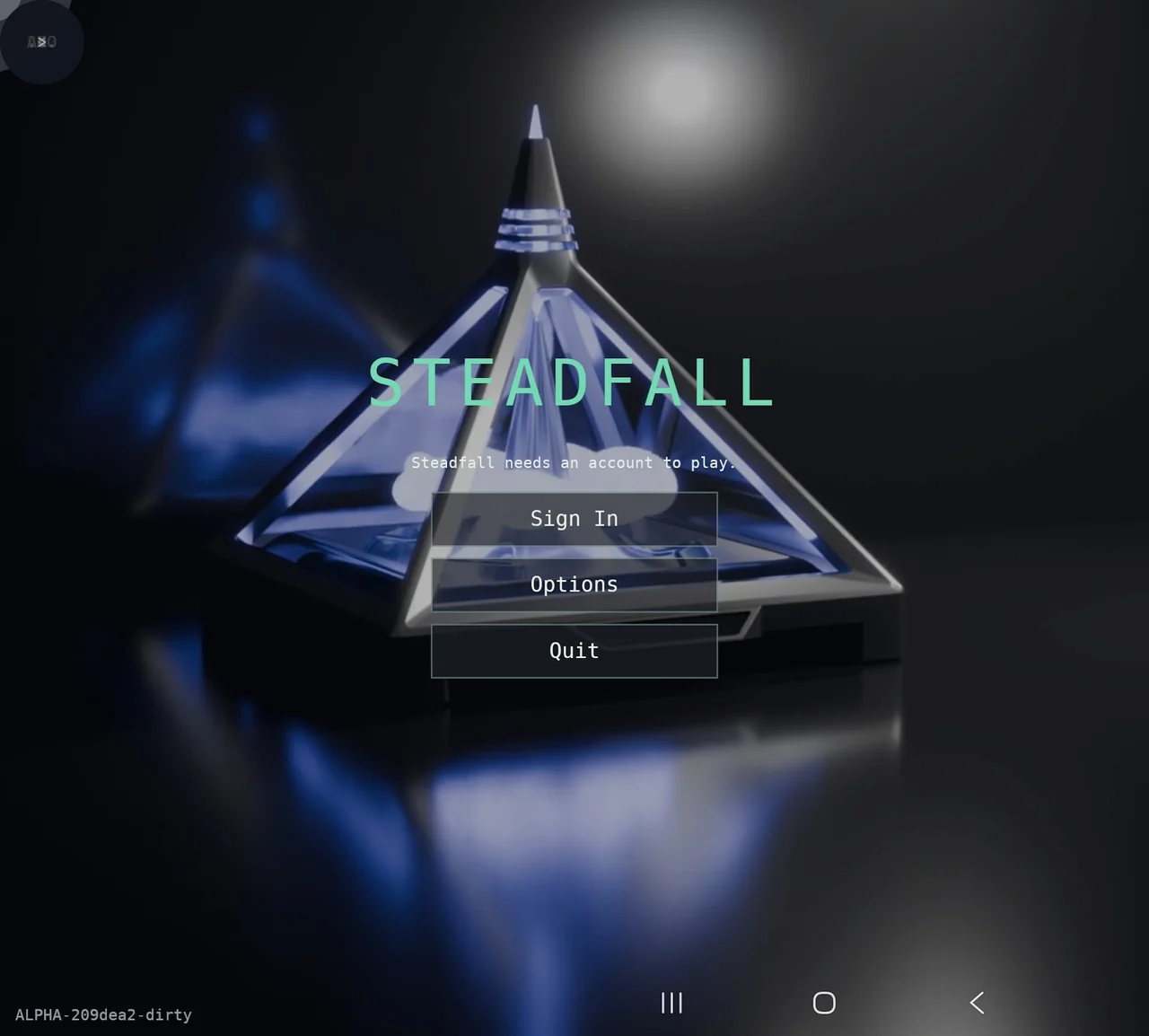
The Steadfall main menu on an Android phone, over the Logos Drive render, with Sign In, Options and Quit.

Gamepads are supported as well, on desktop and on Android. Every input now runs through one layer, so a controller, a finger and a keyboard all drive the same actions.

Underneath that, I checked that every platform grows the same world. Linux, Windows and Android generate the terrain, rock and climate from a seed, and all three come out matching, so a phone player and a PC player on one server are standing on the same ground. A Linux server with a Windows player connected now agrees on everything they share, too.

Building, rebuilt

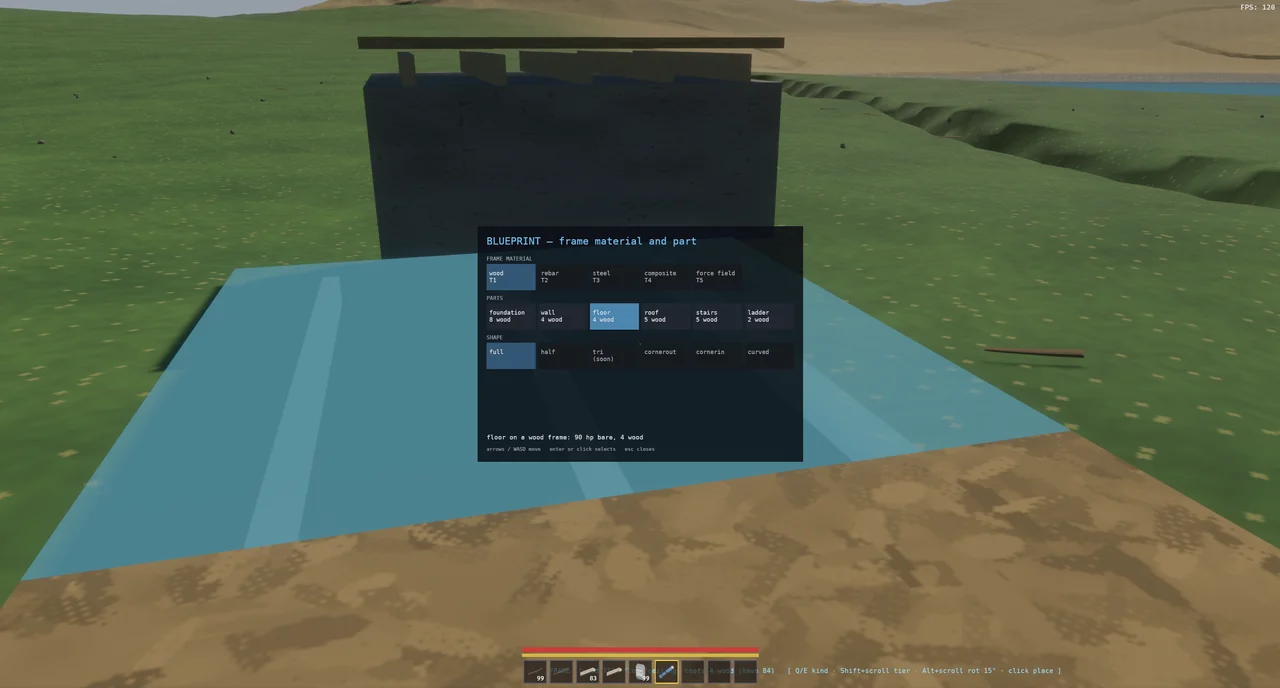
Building got the biggest overhaul it has ever had. The grid moved to 4 meters, and right click with a build tool opens a proper build menu: pick a frame material and a part, or a wall material, and keep placing.

The build menu, still a work in progress: frame materials, parts and shapes in rows, with the cost and health of the selection underneath.
  • Shapes. Walls come in full, half, outer corner, inner corner and curved.
  • One frame, one wall. Health adds together, and four resistances (fire, weather, impact and melee) average between the frame and the wall. A wooden frame under stone still burns, just slower. No pairing is strictly best.
  • Fourteen new building materials, including concrete, plaster, glass, rebar, steel beams, metal sheet and plate, each with a model and a recipe. Walls cost what they are made of now.
  • Openings. Doorways, windows, hatches and skylights are holes cut into a wall, floor or roof rather than their own pieces. Water respects all of it: a wall with a door holds back a flood everywhere except the door.
  • The Crowbar. Left click takes a piece apart and gives back every material that went into it. Right click repairs. A piece that gets blown up is a different story: it breaks into wreckage and you get far less back.
  • The construction drone. Place a powered Drone Station, deploy, and fly out to build where you cannot reach. Your body stays where you left it, standing and exposed, which is the price of the view.

Being found

Every building material now gives off an electromagnetic signature, and every running machine makes noise. A tin wall is cheap, fast armor that advertises you. A composite wall is silent. A cold smelter is quiet and a running one is not, so switching things off before someone comes looking is a real decision. A handheld scanner reads both.

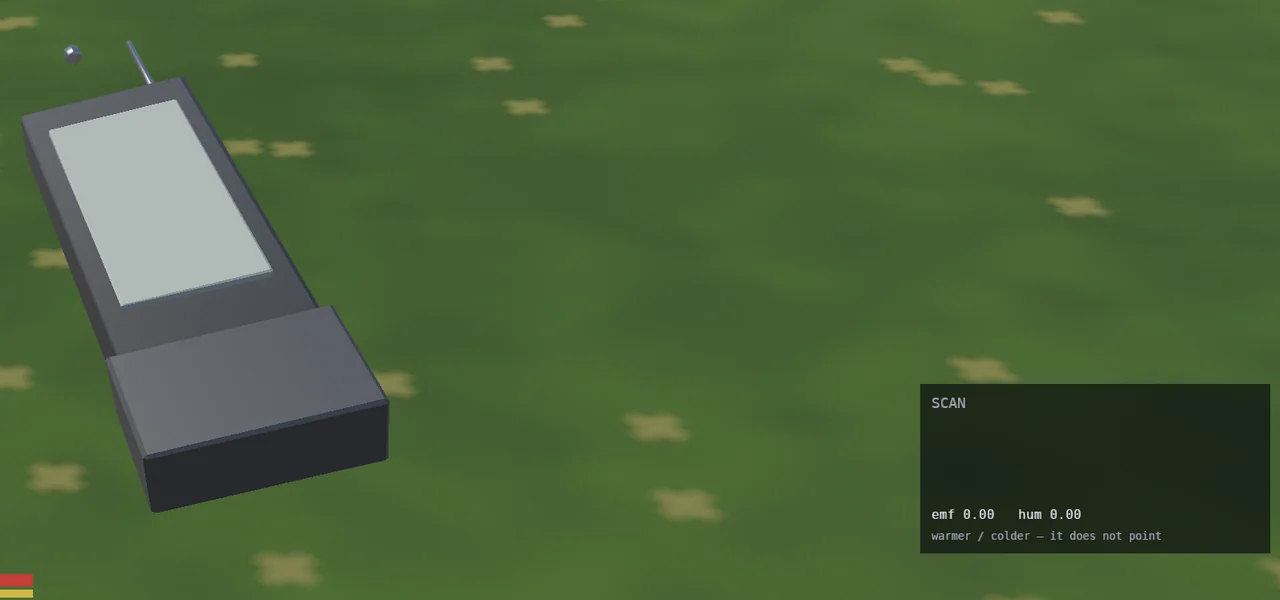
The handheld scanner out in a field, its readout showing no signal nearby.

The scanner model in that shot is an AI generated stand in. It is marked for removal and will be replaced by a model from our 3D modeler.

Walls can take modules to play with that:

  • Chameleon makes a wall look like any other material. It fools the eye, not the scanner.
  • Passthrough makes a wall see through.
  • Suppressing cuts a wall's signature a long way down, but never to zero.
  • Logos Shield adds a regenerating health pool while the grid can power it.
  • Gravitational anchors a floor like a foundation, for bases that do not touch the ground.

Power, the Shell Emitter and the Logos Drive

Cables come in three tiers now, and each carries more power than the last. A grid carries only as much as its thinnest wire, so one light cable in a heavy run caps the whole thing: find the weak link and replace it. Pipes follow the same rule across clay, copper, steel and composite.

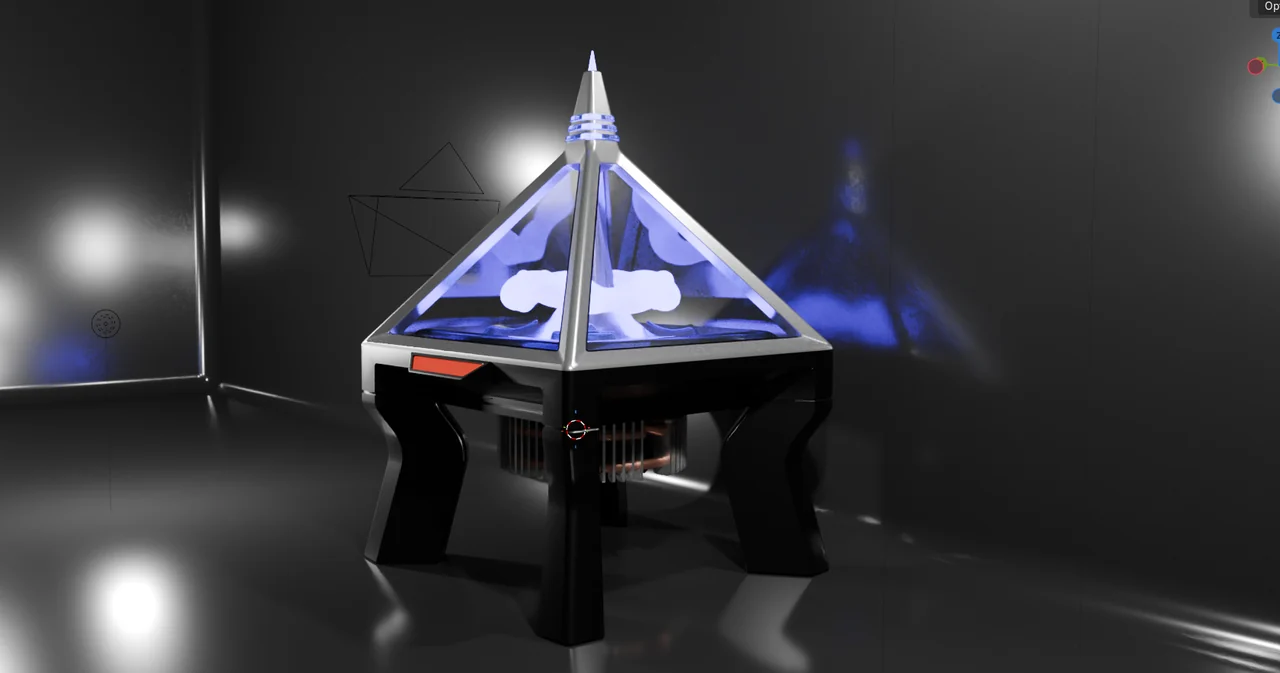
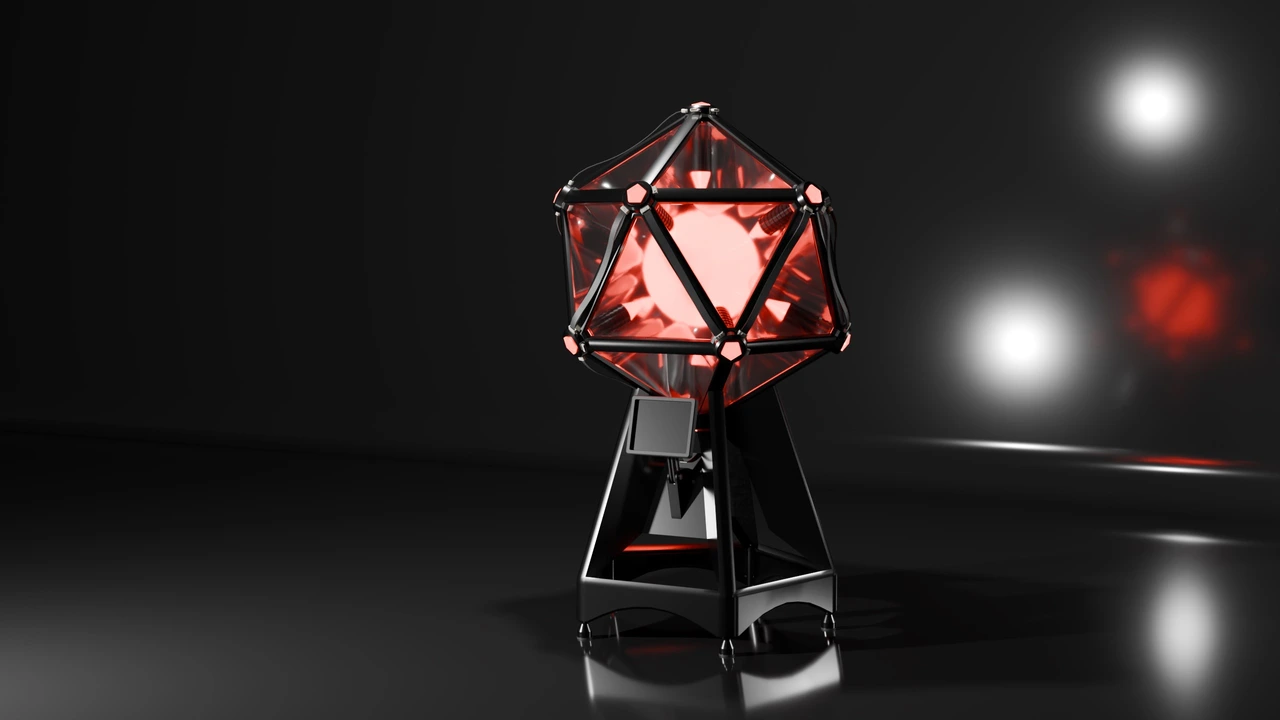
Force fields split into two machines. The new Shell Emitter raises the actual barrier. Run a cable to it and it projects a sphere that nothing crosses in either direction: players, blasts and missiles, which detonate against the shell instead of the base inside it. Bigger shells draw more power, and if the grid browns out the shell drops. The emitter itself can be destroyed, because a projector nobody can crack is a base nobody can crack. The Logos Drive, the old force field emitter, handles territory enforcement. Dragonfly9307 modeled both, along with the new stand below.

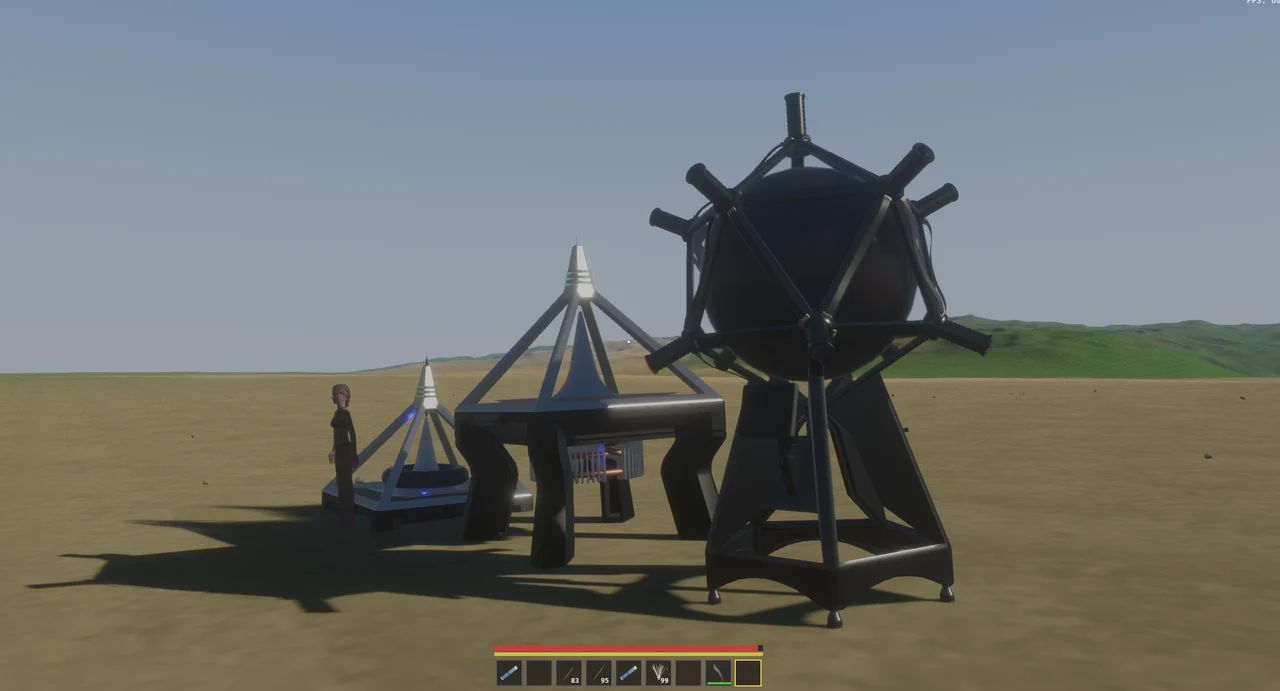
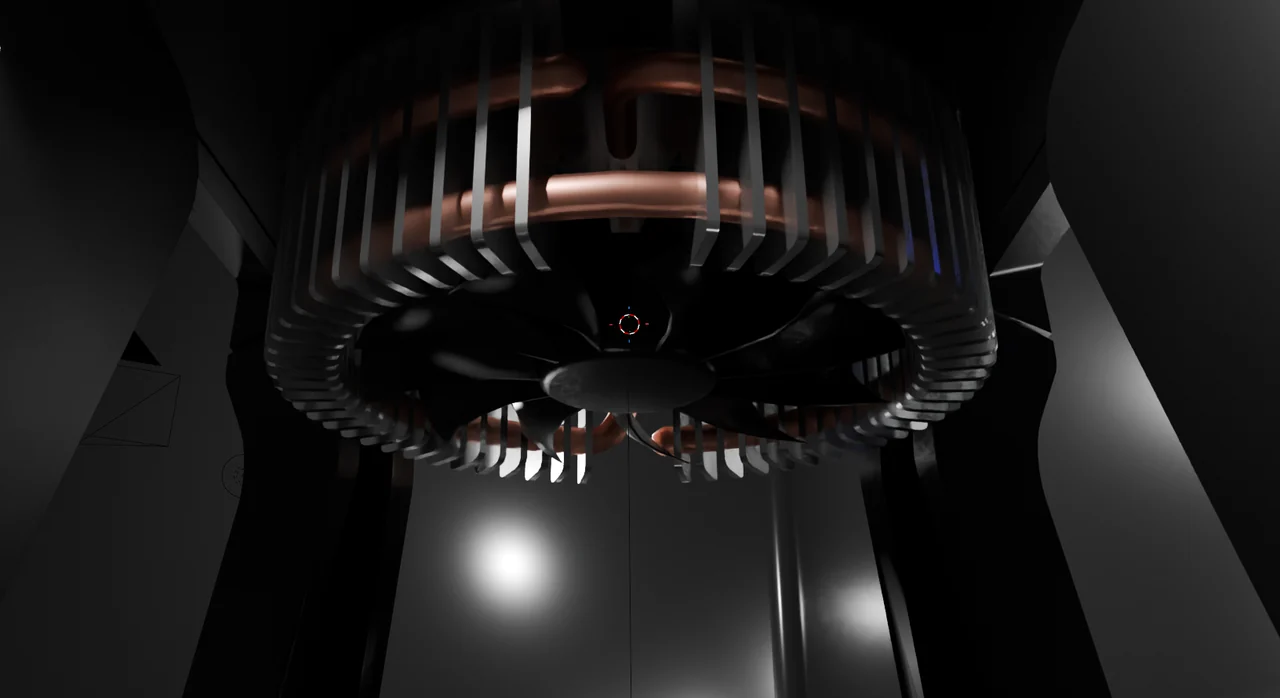
The Logos Drive also has a new stand. A drive's range scales with the power it draws, and the stand adds cooling, so a drive mounted on one can take more power for a longer reach and wastes less of the power it uses.

The Logos Drive on its own and on its new stand, beside the Shell Emitter, with a player for scale.
The Logos Drive mounted on its stand, glowing blue.
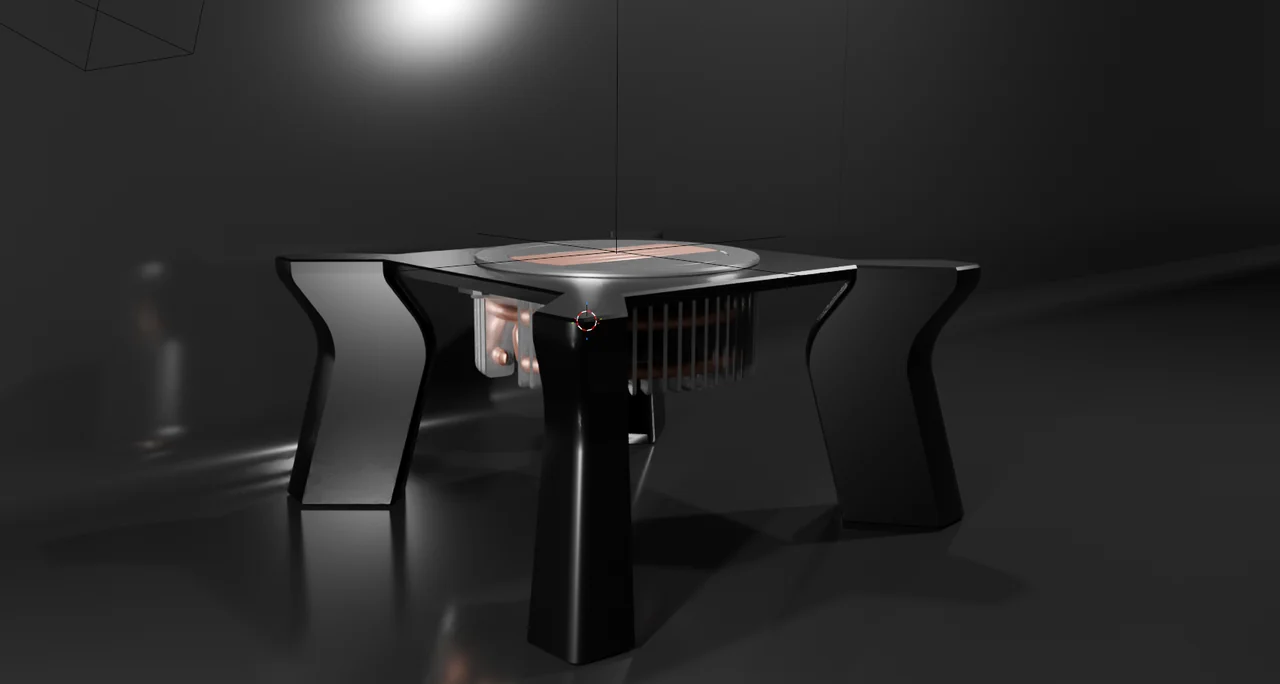
The stand on its own, its copper cooling coil tucked under the deck.
Under the stand: the coil, the fins and the fan.
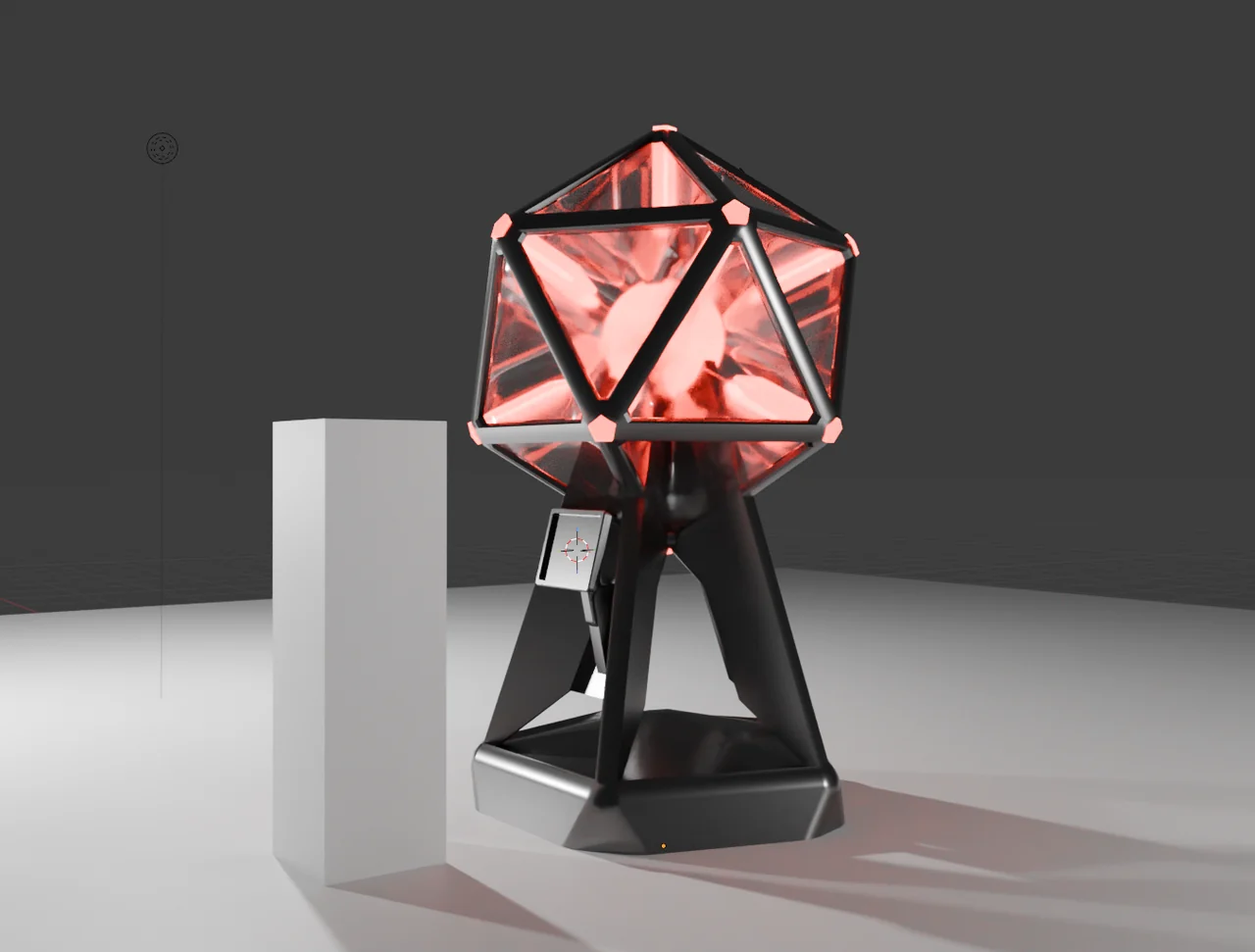
The Shell Emitter in the modeling kit, its caged core glowing red.
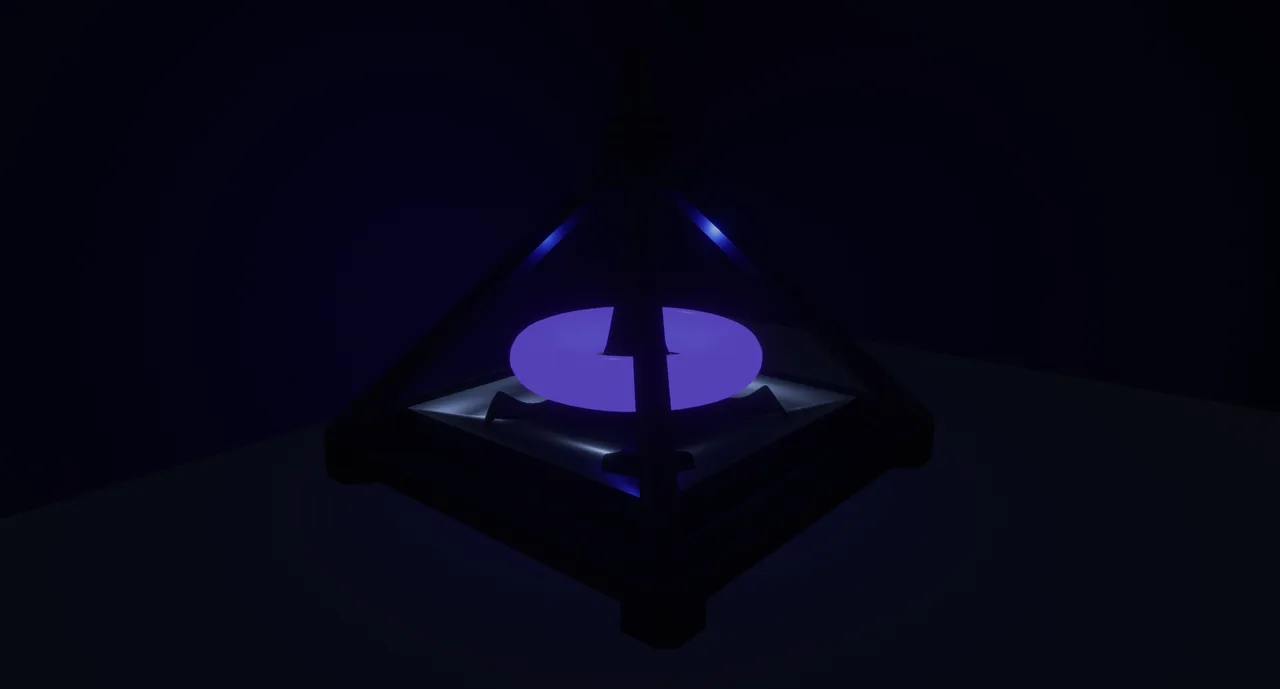
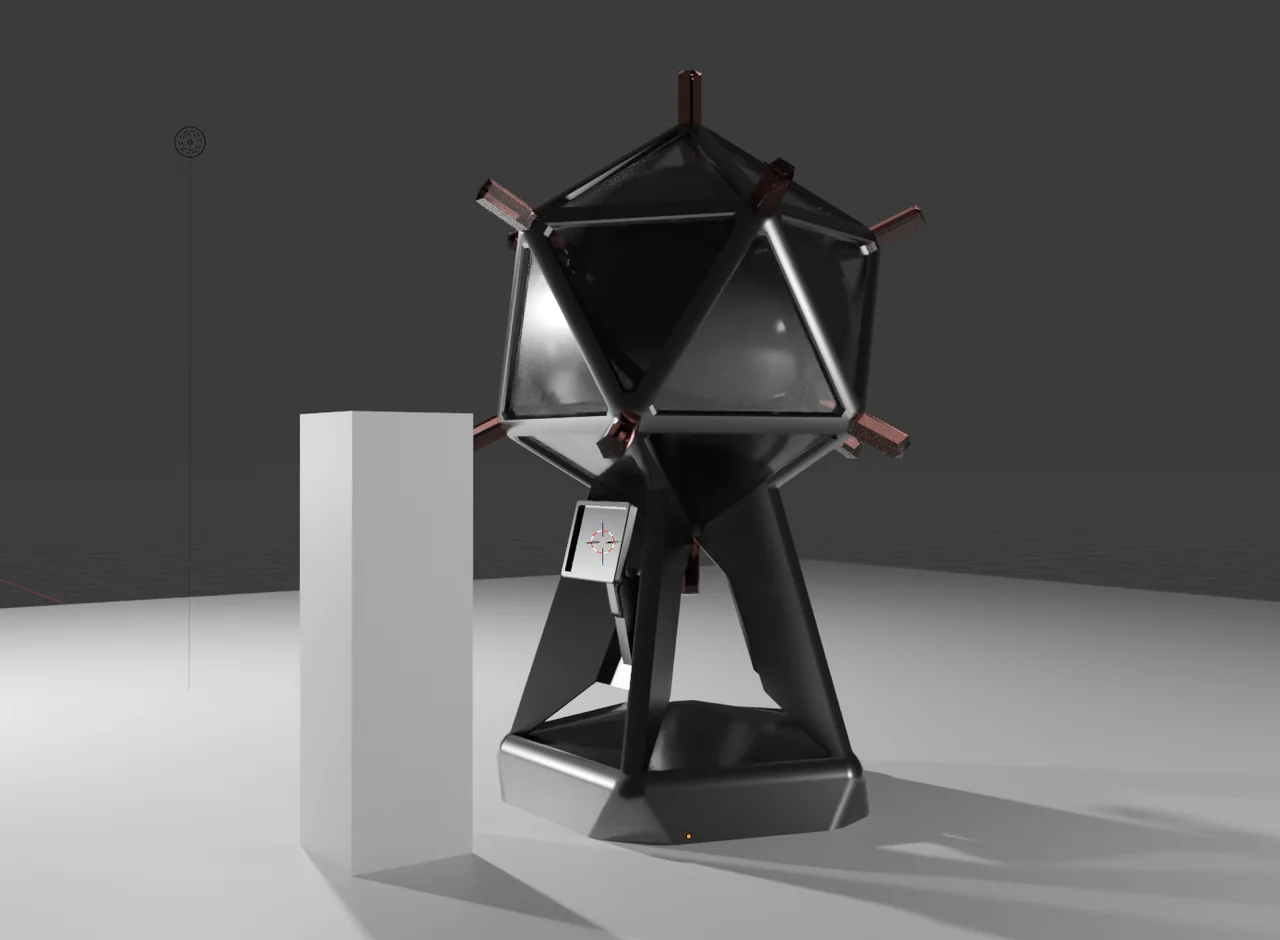
The Shell Emitter dark, in the modeling kit.
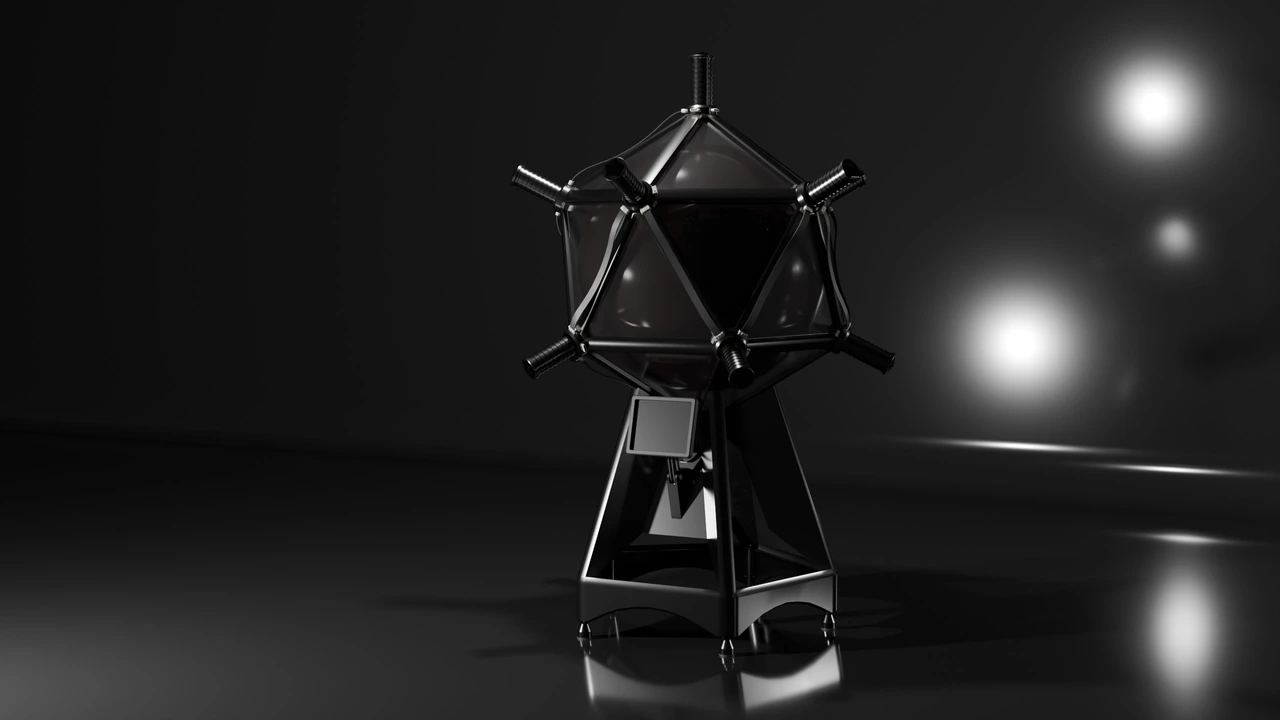
A finished render of the Shell Emitter on a glossy black floor, its caged core glowing red.
The same render with the emitter dark, its projector barrels standing out from the frame.

Trees start over (and over, and over)

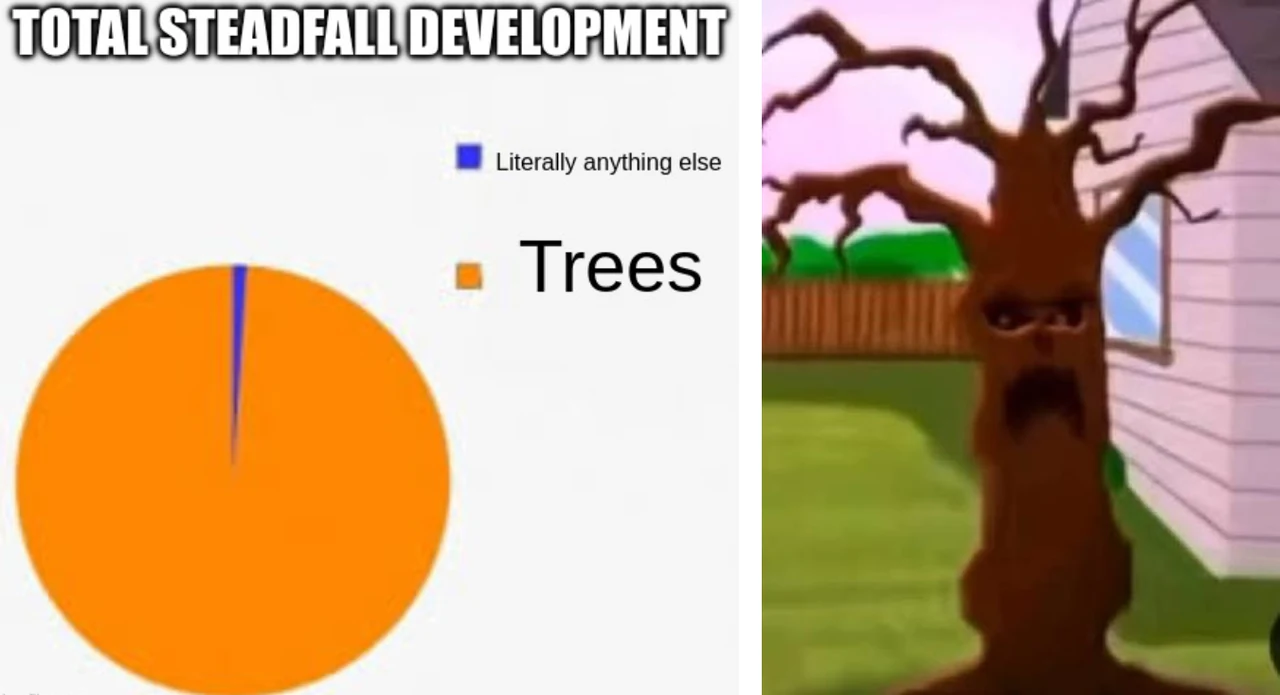
If you have been wondering where the time went this fortnight, this chart is accurate.

Two memes: a pie chart titled Total Steadfall Development that is almost entirely Trees, and a cartoon tree glaring back.

Every old tree and every plant came out of the game: grass, bushes, reeds, pebbles, all of it, along with their assets. The old forest was a set of modeled trees repeated across the world, and where trees are going, each one needs to be grown on its own.

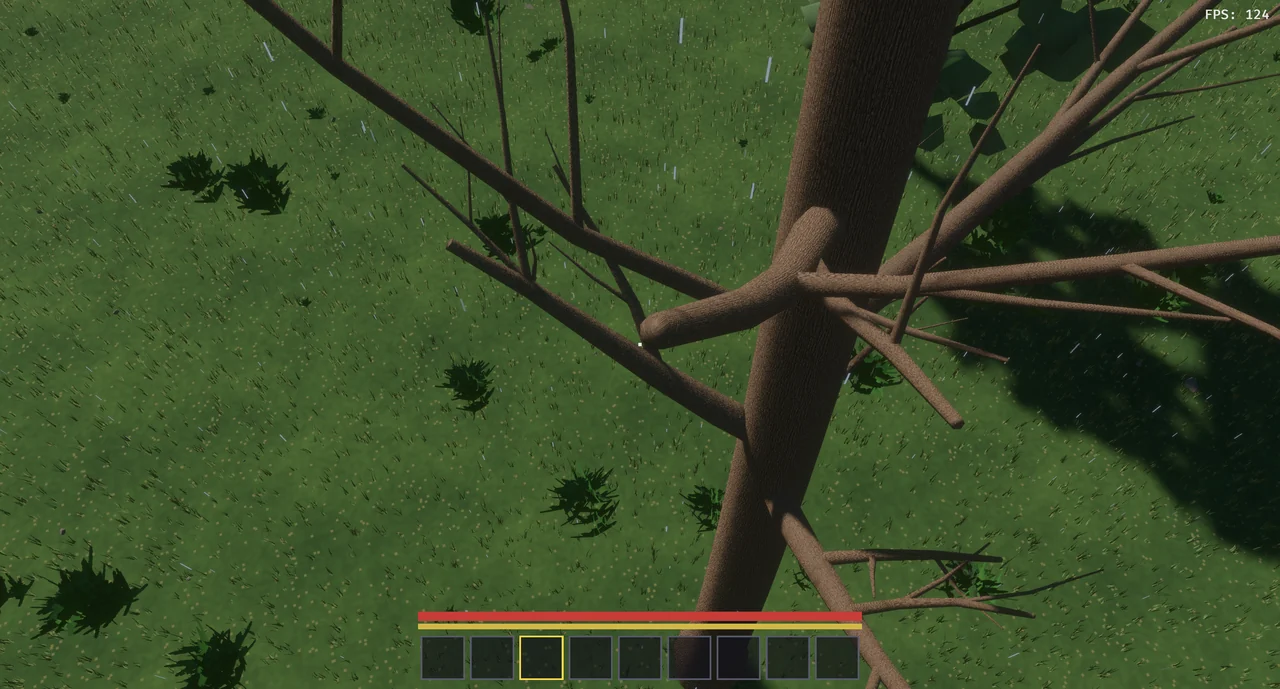
The old trees, looking down from the top of one onto the grass.
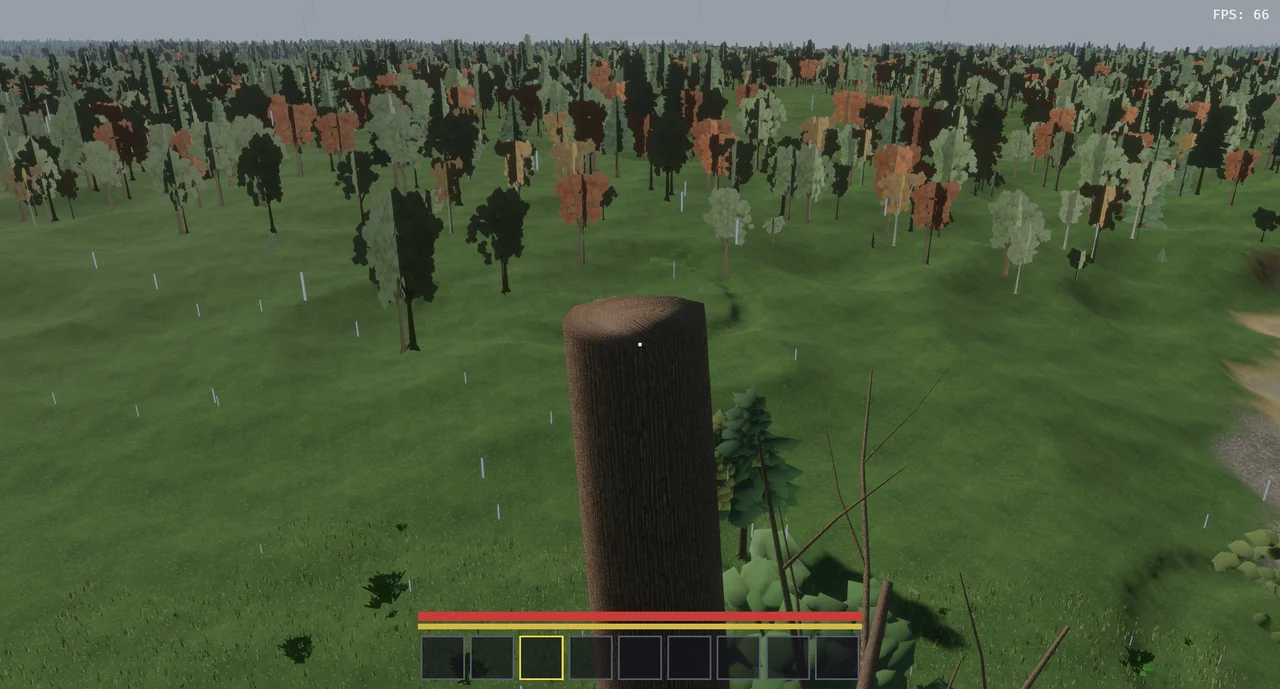
The old forest from up high in autumn colors, a cut trunk in front.
Old bark up close, with the forest and a pond behind.
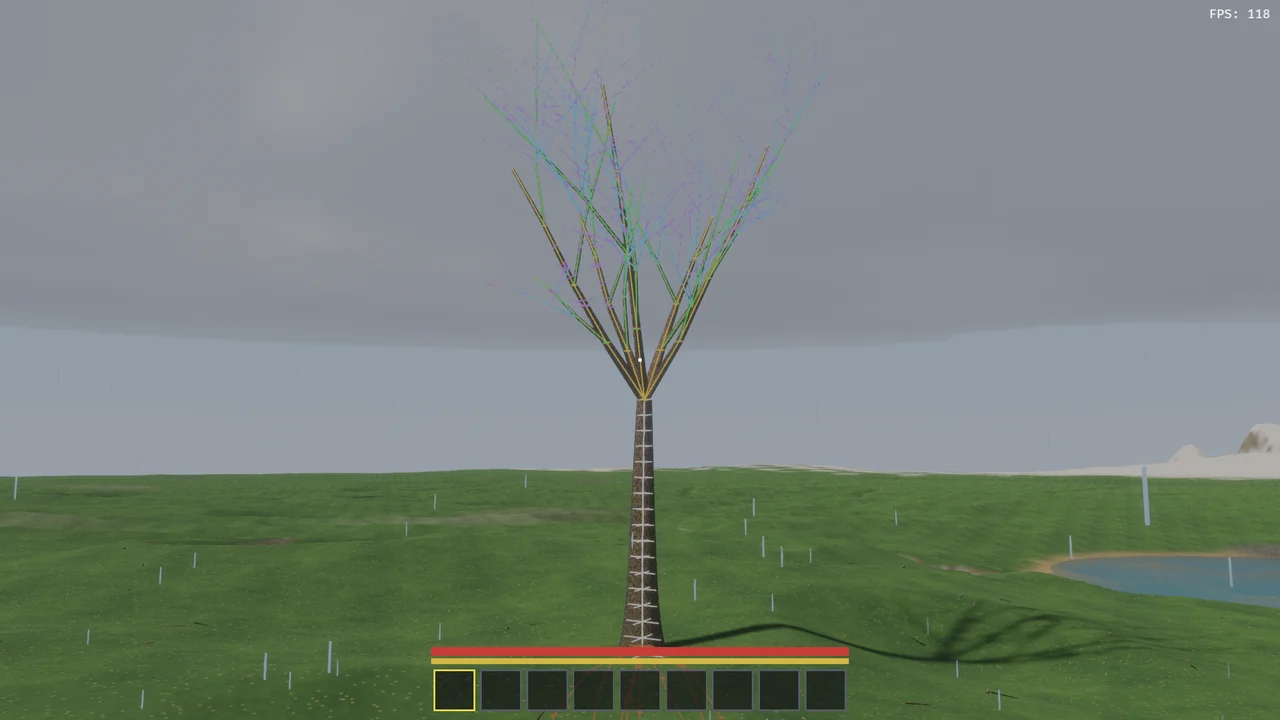
In their place, trees are grown procedurally from a seed, with tapering branches, five size tiers from sapling to fully mature, and bark from Dragonfly9307. Getting there took a detour. The first generator looked right, then species, modeled segments and roots went in on top of it, it all fell apart, and we rolled back to that first version. There are two shapes so far, the default and a low, spreading orchard tree, and a debug view draws the skeleton each tree grew from right over the top of it.
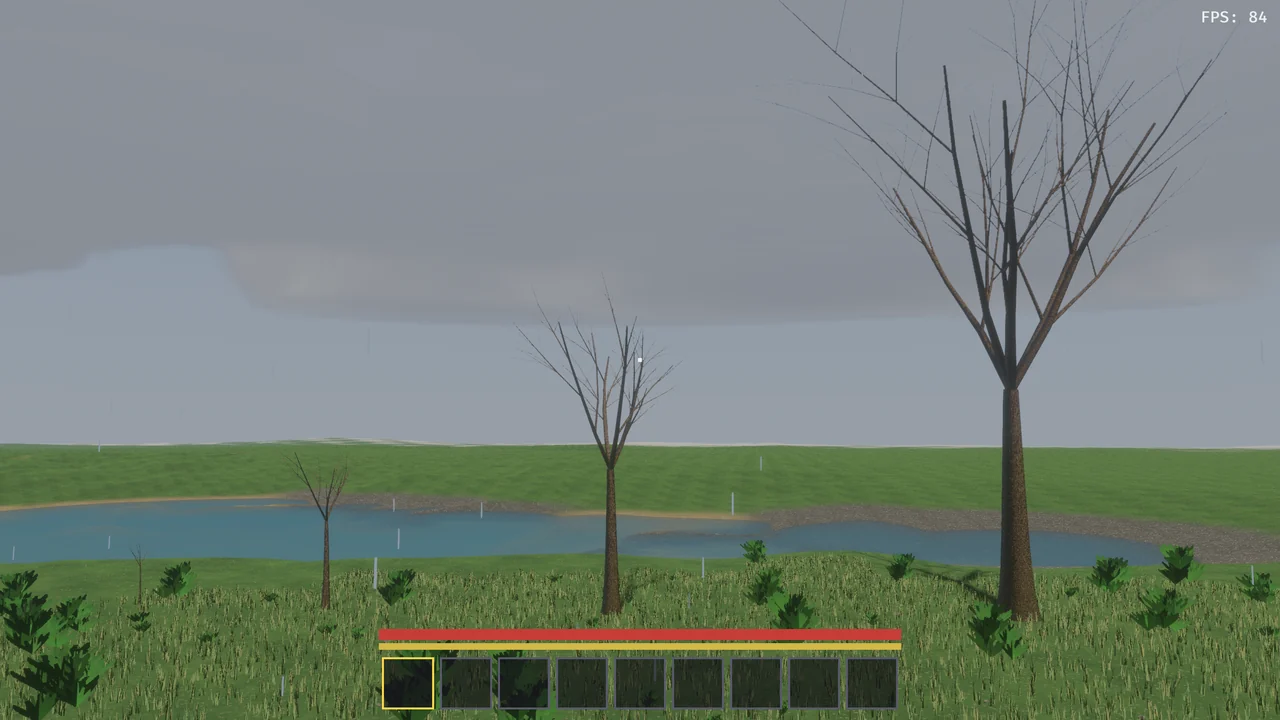
The first procedurally grown trees by a pond, bare branches tapering to twigs.
A grown tree with its skeleton drawn over it, each level of branching in its own color.

Leaves and fruit

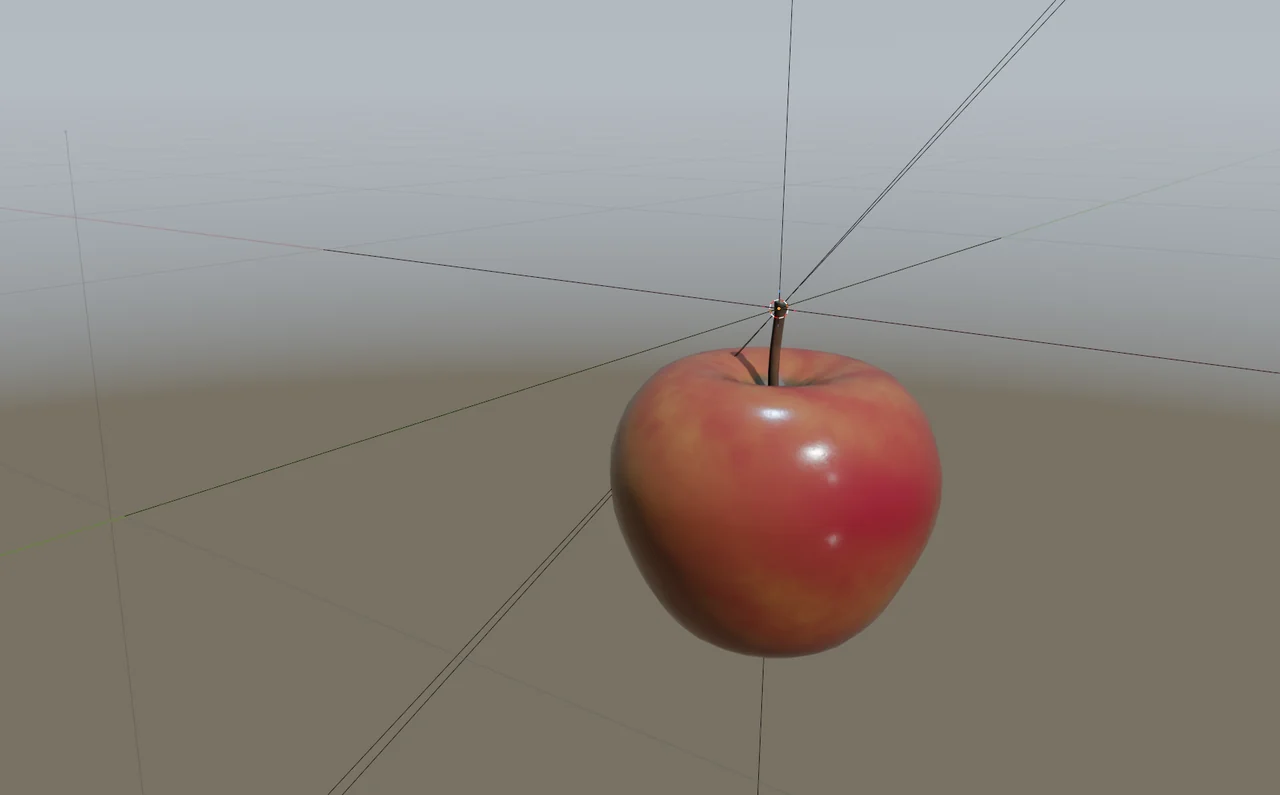
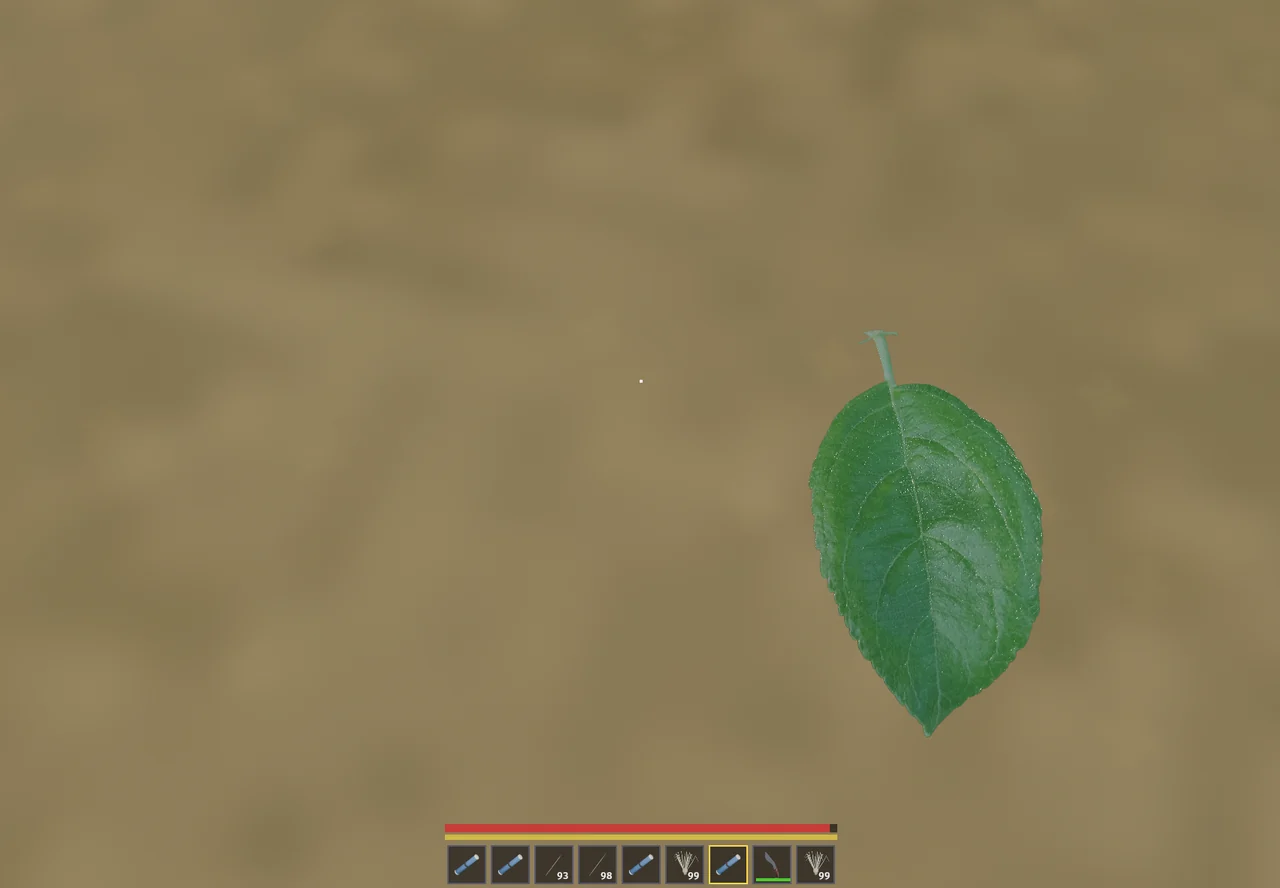
The trees are getting something to wear. Dragonfly9307 made an apple and two apple leaves, fully textured. They are already in the game as items you can hold while they wait for branches to hang from.

A textured apple in the modeling kit.
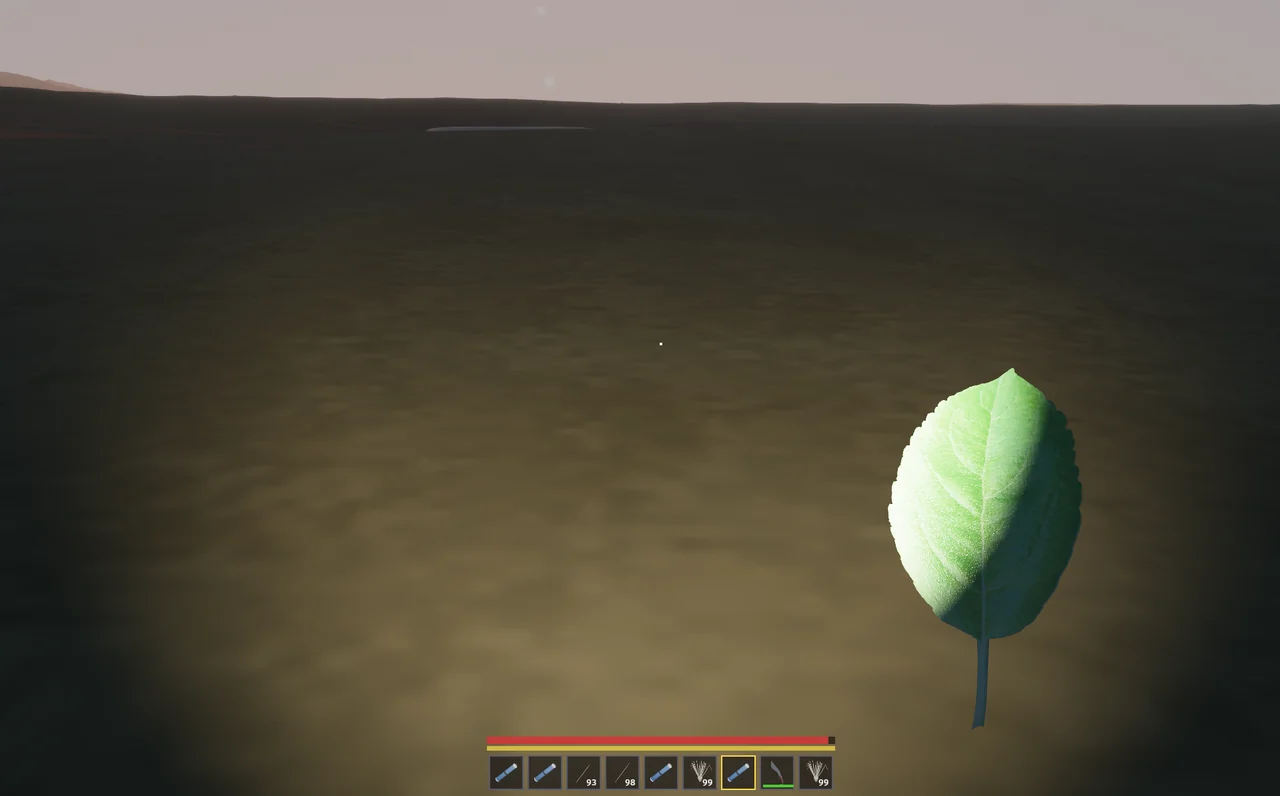
An apple leaf held up in the evening light, its veins showing.
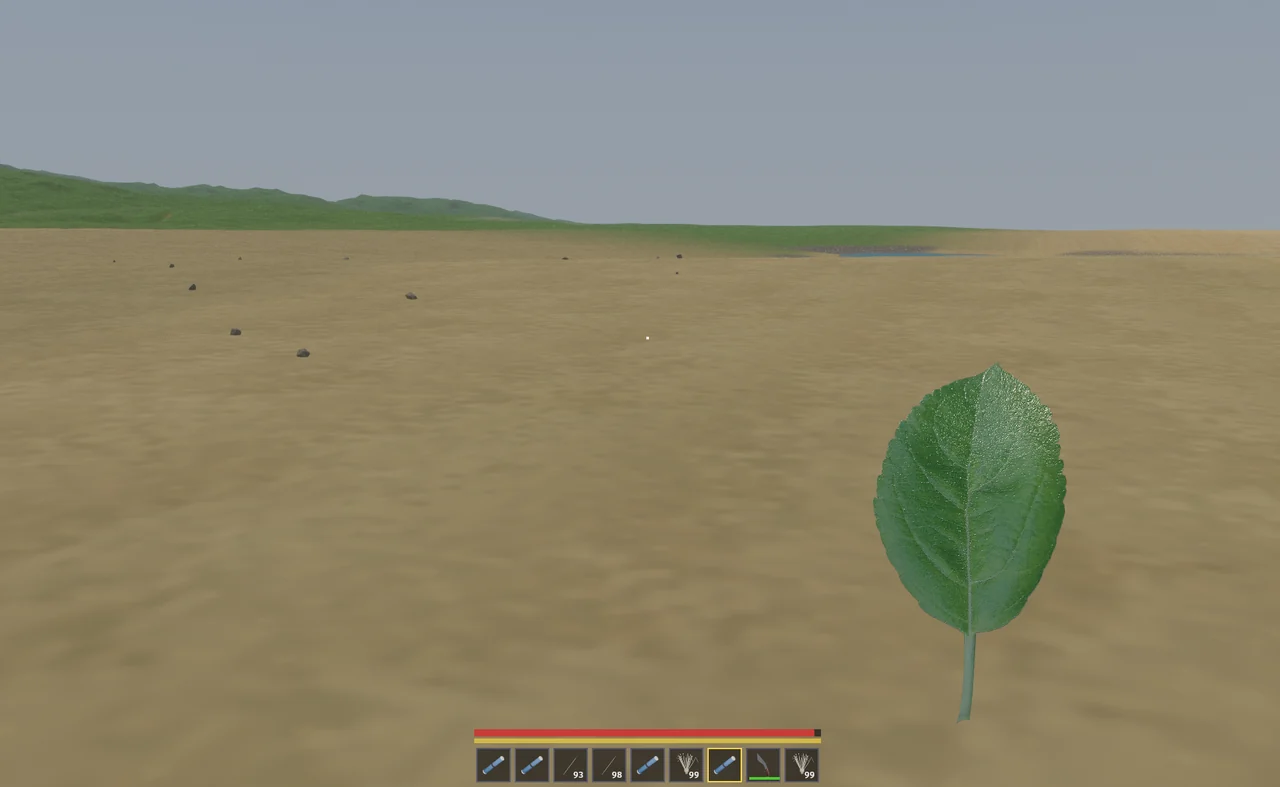
An apple leaf held in the desert.
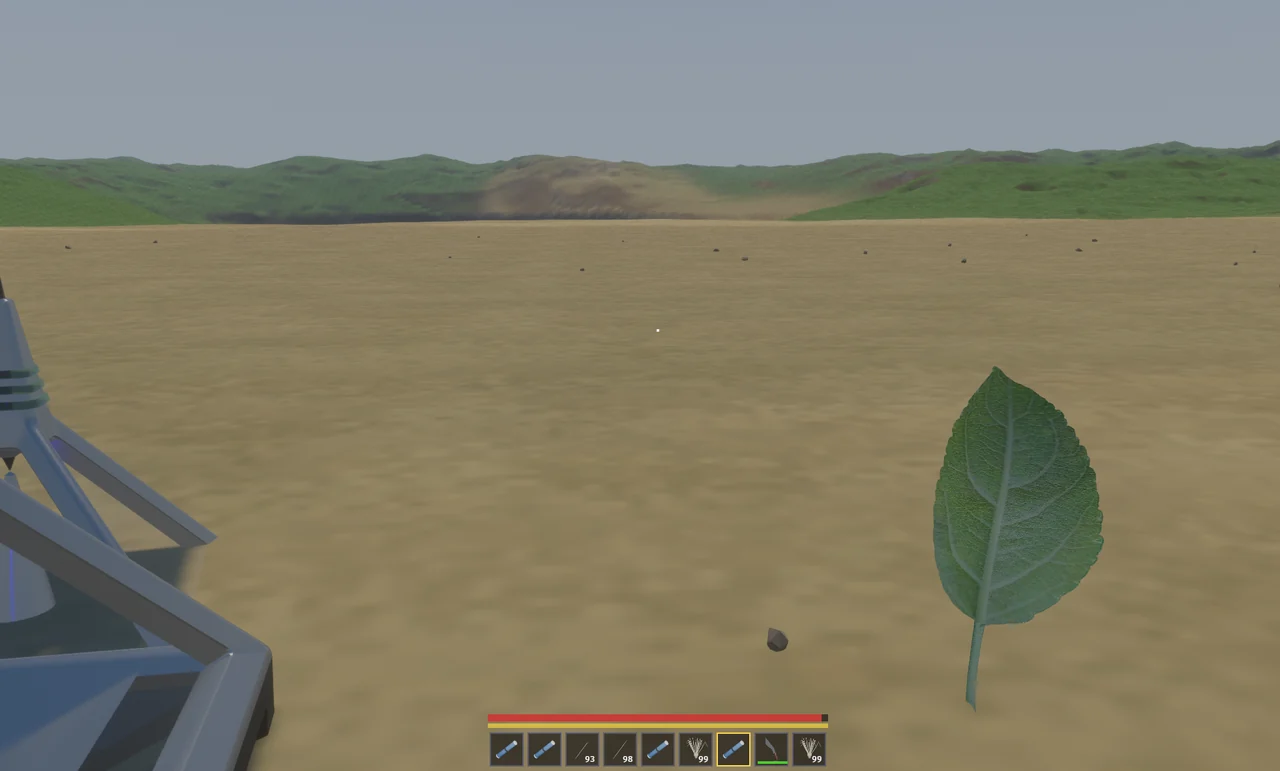
The second leaf, beside the Logos Drive.
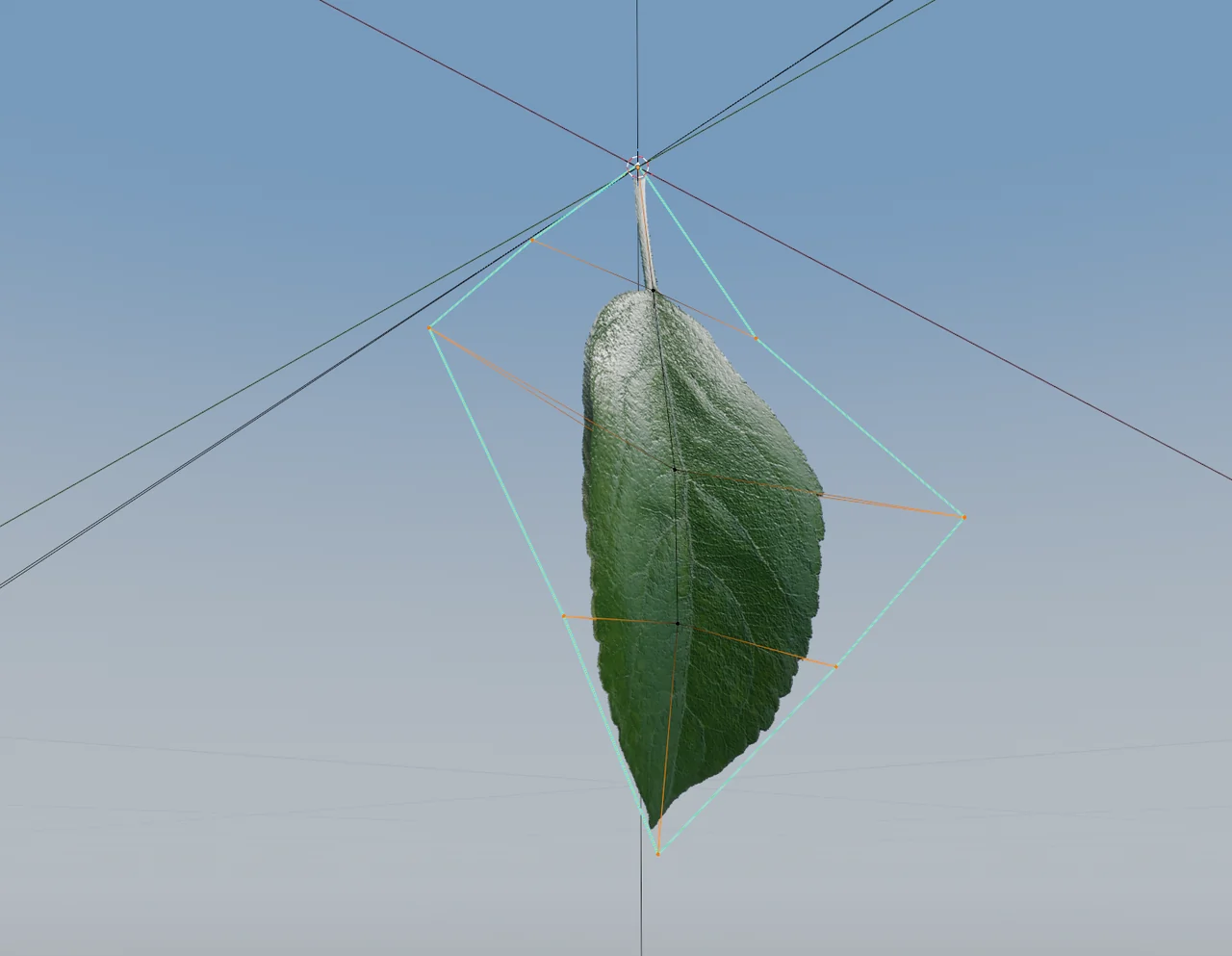
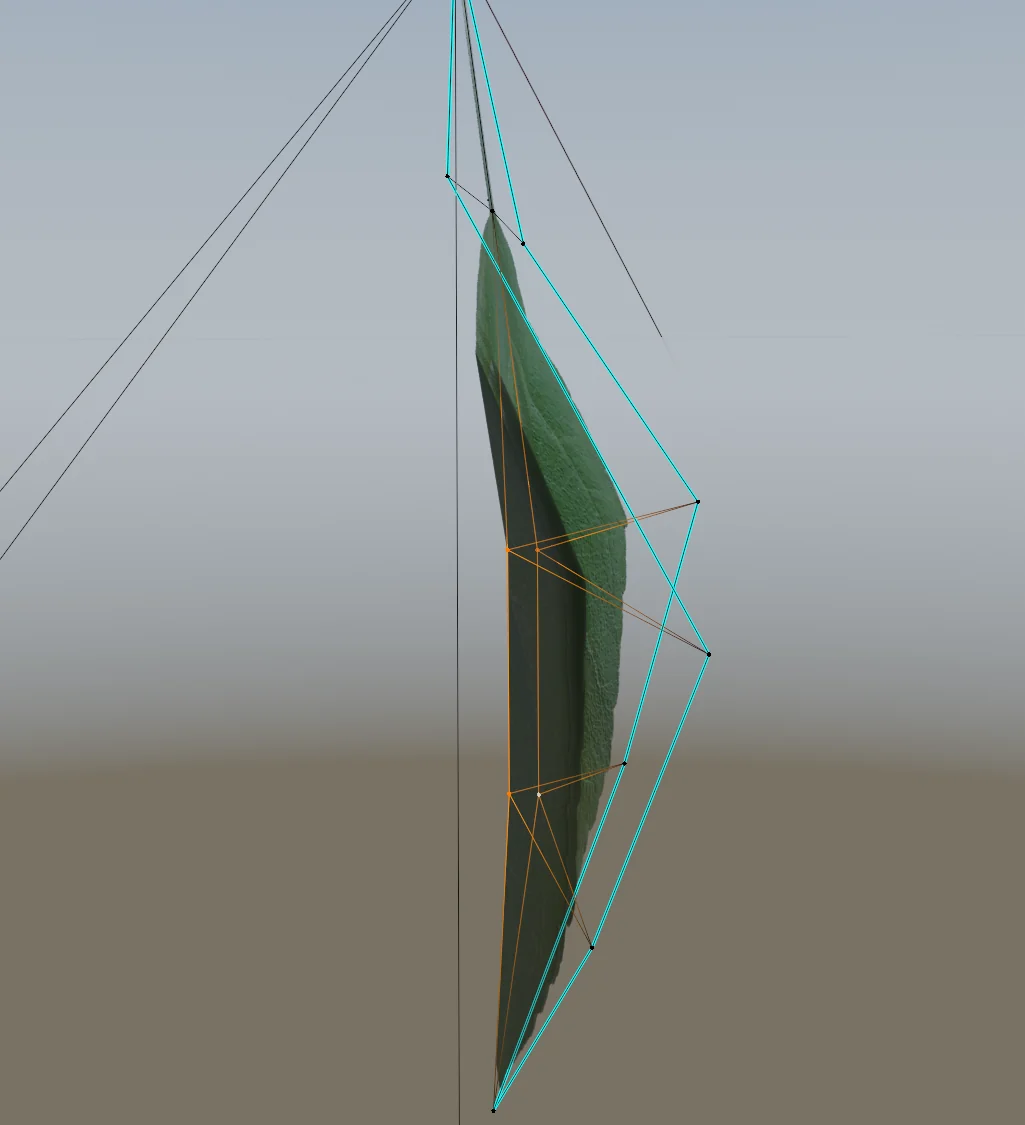
The leaf face on in the modeling kit.
The same leaf from the side, showing its curl.
The leaf from above, held over sand.
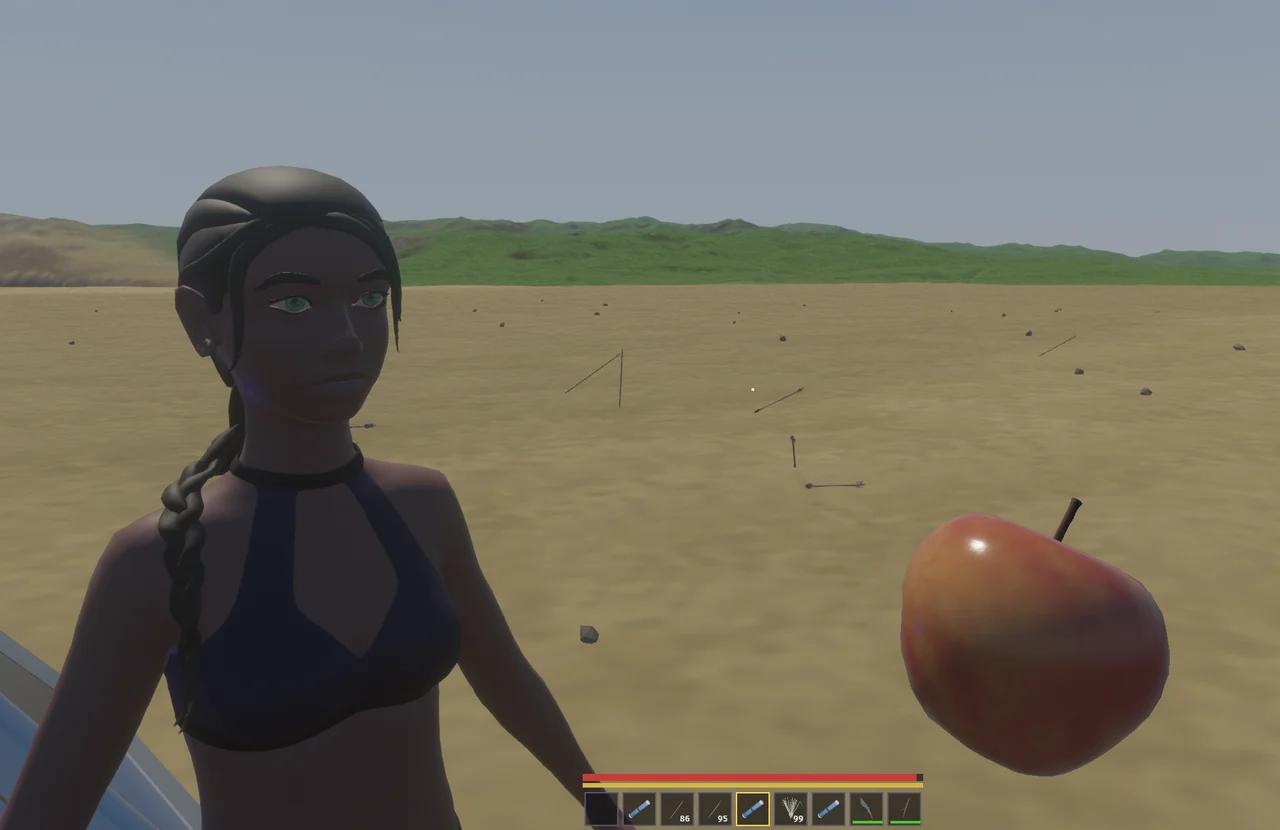
Eve beside a held apple, for scale.

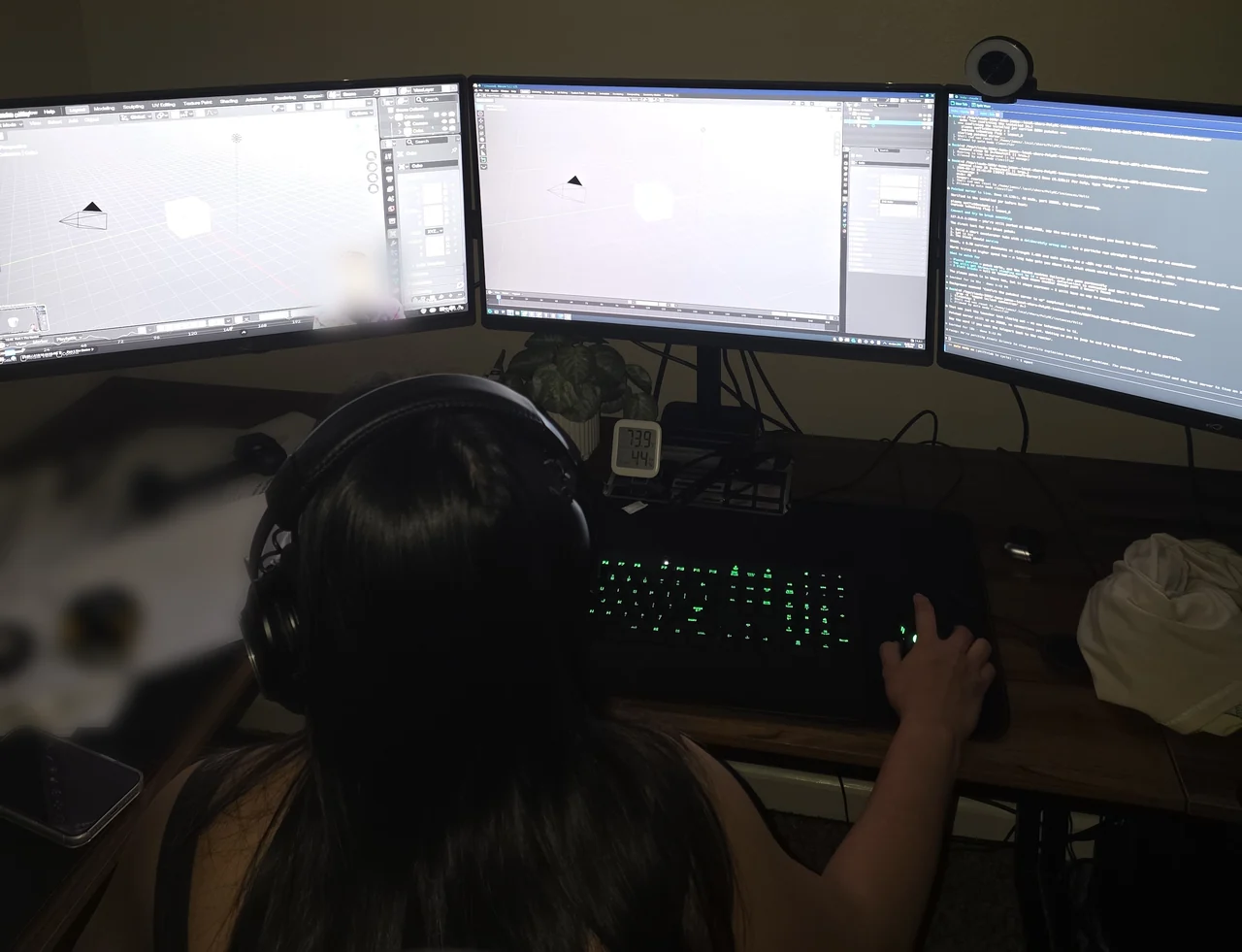
Plants come back after the trees are right, and they have a new pair of hands: my wife, Ging, is learning Blender to help model the foliage.

Ging at the desk, learning Blender across three monitors.
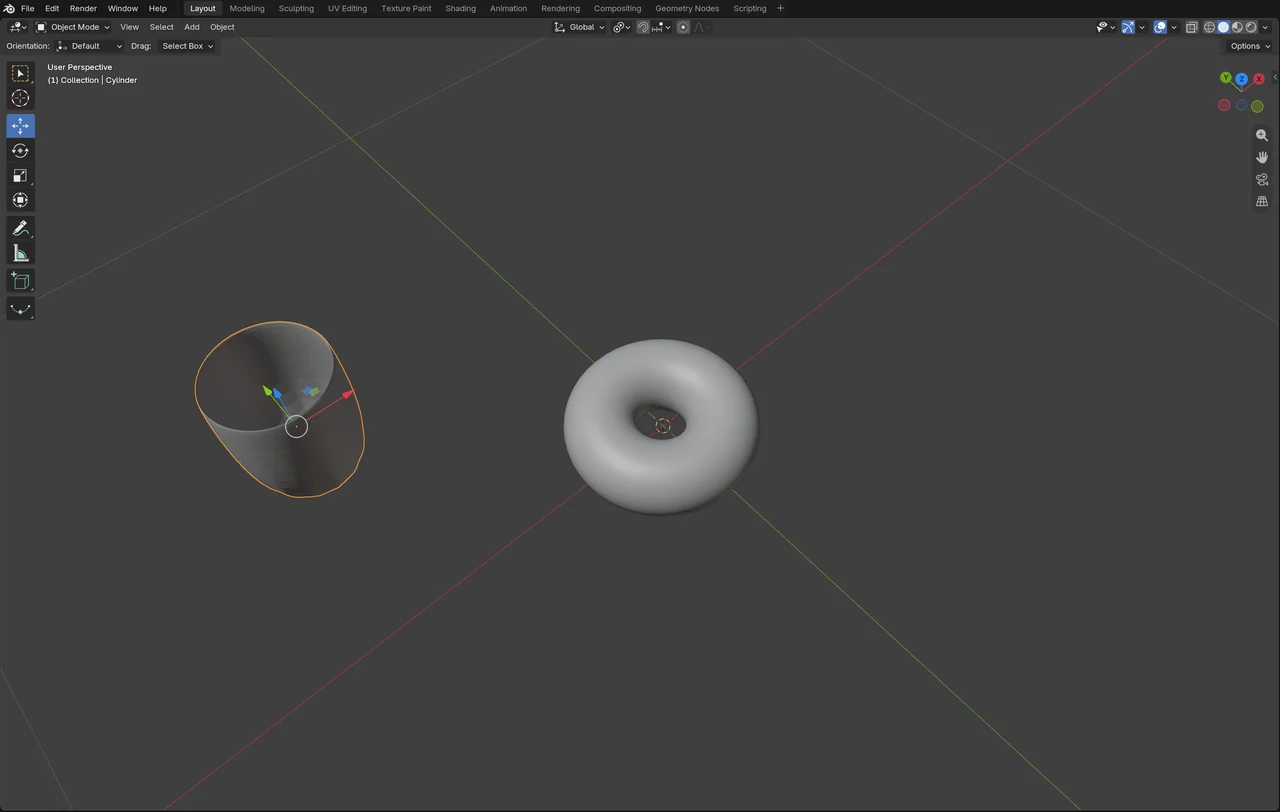
Ging's first Blender donut, a smooth gray torus in the viewport beside a hollow cylinder.

Ging's first Blender donut!

The menu, the sound and the map

The game opens on the Jungle Green Studios logo over its intro sting, then the menu fades up out of black over Dragonfly9307's animated render while the wordmark types itself in. The music is Dragonfly9307's too: the sting and the menu theme, "Fire Escape". Audio has a proper mixer now, with separate Music, Sounds, Voices and Input levels and a mute on each. The interface also scales to fit whatever window it is in.

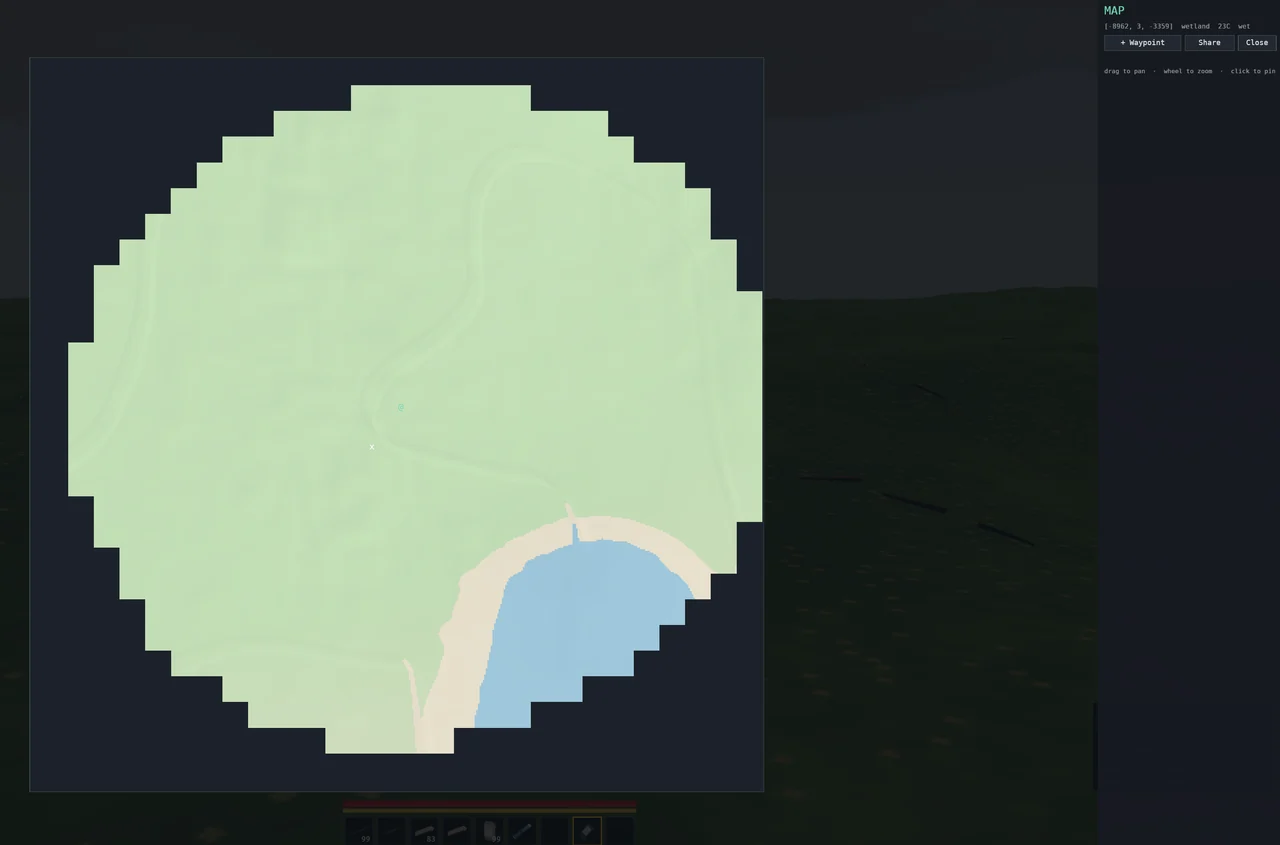
Press M for the map. It fills in as you explore, stays dark where you have not been, and holds your waypoints and where you last died. Share a spot and it drops coordinates into chat, where anyone can click them to open their own map right there. Other players are not on the map, and whether they ever are will be up to each scenario.

The map, still a work in progress: an explored circle of grassland with a river winding through it and a lake on its edge, the unexplored ground dark around it.

Servers and accounts

Server owners can now grant operators, trusted players who get admin commands on that server, tied to their account so the role cannot be claimed by typing a name. Steadfall now needs a signed in account to play, single player included. Sessions last long enough that playing offline works. Accounts are still closed while the alpha is private.

A note on AI generated assets

A few assets in the current builds were made with AI, as temporary stand ins so those items are not blank while the game is being built. Every 3D model made with AI will be replaced by our 3D modeler as he gets to it, and anything illustrative made with AI will be replaced by artwork drawn by a person. They are marked for removal and will not appear in any public release of the game.

Fixes worth mentioning

  • Jumping no longer counts as falling, so a standing jump or a step down no longer costs health.
  • Deleting a world could delete the wrong one. It deletes the one you clicked now.

That is the fortnight. Next up is testing all of this in real multiplayer sessions, more trees, and the art that goes with the new building system.

31 August 2026 · Hazmad

Two weeks: the world loops, and the server takes charge

It has been a packed two weeks since the last big update, so this one is a long list. The short version: the world wraps around now, the ground is made of real rock, the sky became an instrument, and multiplayer went from "clients can see each other" to a dedicated server that actually runs the rules.

The world comes back around

The world is a loop now. Walk in any direction for long enough and you arrive back where you started, with no wall, no seam and no loading screen on the way. The far country even bends away over the horizon. The map is 32 kilometers around, so it is finite, which means anywhere in it is worth finding, but the walk never ends.

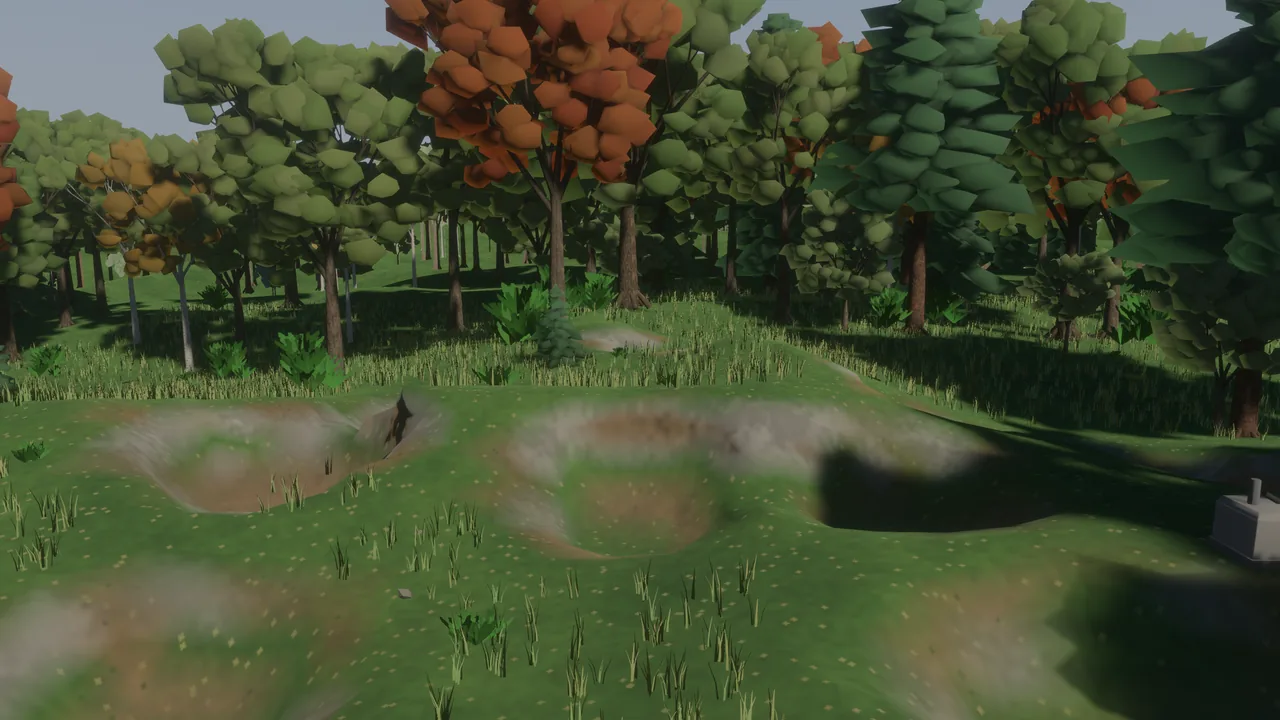
Dug craters in a forest meadow, autumn trees behind.

The ground is made of something

The terrain got a real geology pass. The ground is built from twelve kinds of rock stacked in layers the way rock actually stacks, ore seams follow the bedding instead of floating randomly, and what you find depends on what you are standing in. Soil and sand take their color from the rock they came from, chalk is not gray, and the prospecting pick reports what is genuinely buried under your feet. On top of that: mountain ranges that run in a direction, river networks that actually connect to the ocean, deserts with steppe halos around them, and a sky ceiling raised from 95 meters to 253 so peaks can be peaks. Limestone burns to quicklime now, and mortar builds brick and ashlar walls.

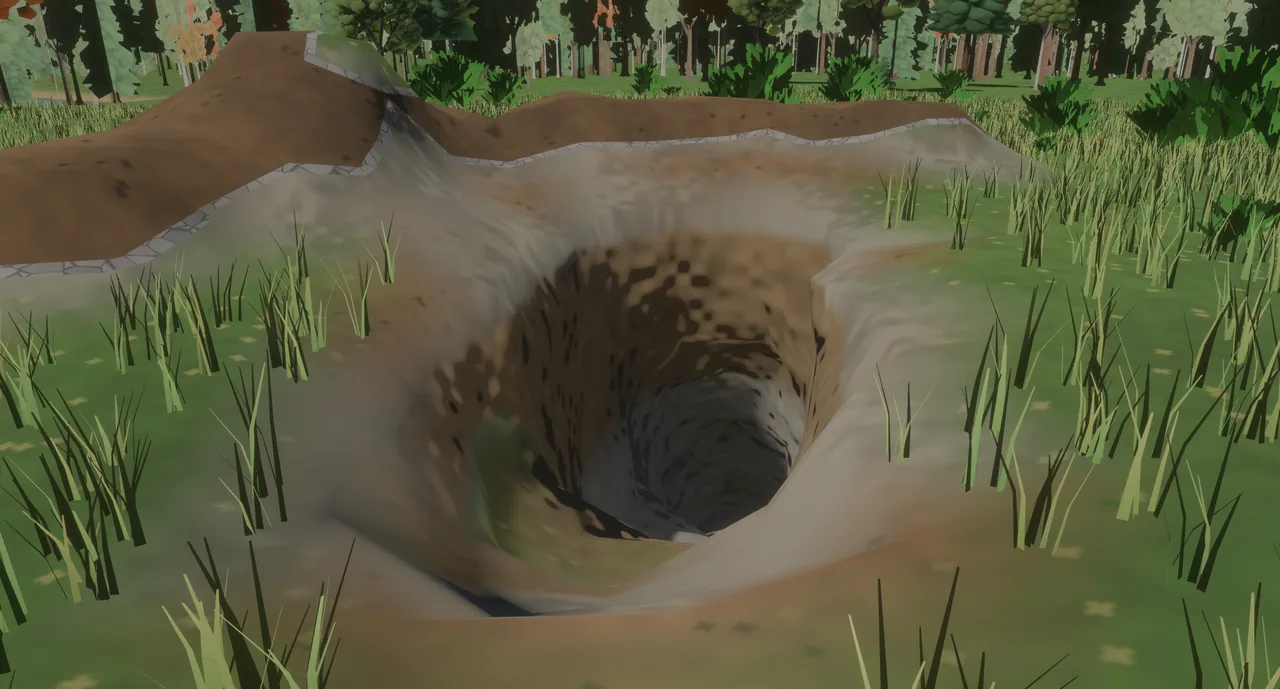
A dug hole curving down into the dark, rock showing at its rim.

The sky became an instrument

The planet has two hemispheres and a real calendar. The sun follows your latitude and the date, the moon follows its phase, and the stars are a real catalog that turns with the season. Planets wander against the star field, eclipses darken the day on schedule, meteor showers land on their dates, and a sextant can read your latitude off the sky. Weather is a place now too: storms are somewhere and you can walk into them, wind has a bearing the clouds lean into, snow and ice arrived (walk on one, wade through the other), the snowline moves with the season, the forest turns in autumn, and there is an aurora where an aurora belongs.

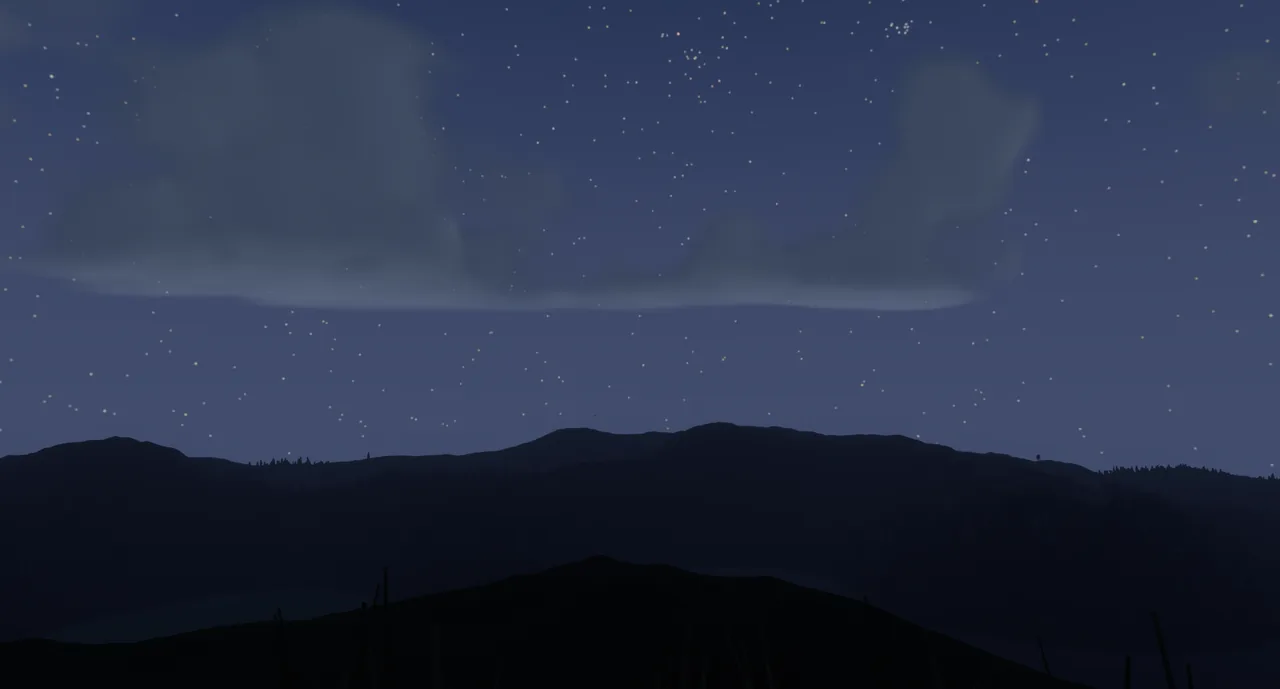
Stars and a thin band of cloud over dark forested hills.

Multiplayer grows a spine

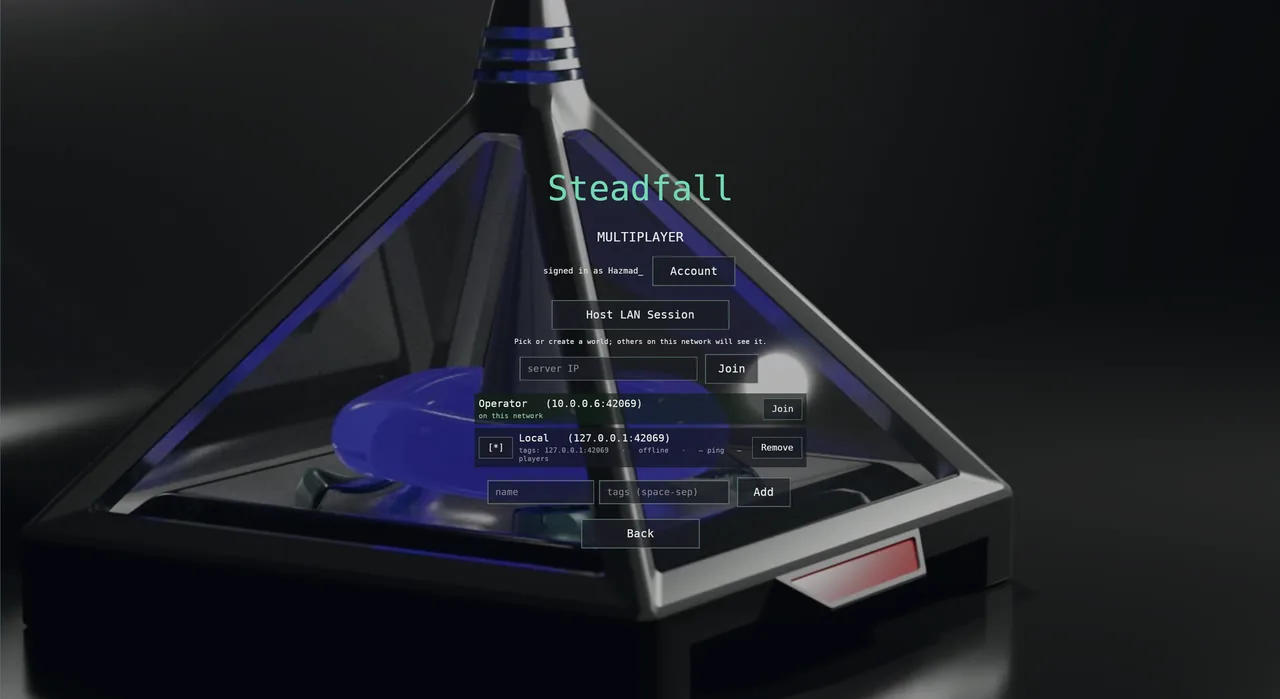
This is where most of my time went, especially this last week. The game now has a proper dedicated server, its own program with no screen, that owns the world and runs the rules. Hosting a LAN session, finding one, and setting your name all happen from the menu. Chat crosses the wire, proximity voice chat is in on push to talk, players have names above their heads, and there is a join line when someone arrives.

Under that is the unglamorous part: making the server the authority on everything. Building pieces, terrain edits, containers, machines, power, fluids and inventories all replicate now, and the host charges for what you build and resolves what you earn. Then came the long hunt through every case where a client and the host quietly disagreed: grenades that only existed on one screen, bandages that healed nobody, armor that protected only the host, beds that did not respawn you where you slept, reconnecting players treated as strangers while a ghost kept their belongings. Dozens of those, found by comparing the two worlds number by number and by long soak tests with two players, and fixed one by one. Client prediction and reconciliation went in as well, so movement holds up instead of rubber banding.

The multiplayer menu: signed in, a Host LAN Session button, and a server list with one host found on the network.

The art track

Dragonfly9307 has been busy in parallel: character models and the lighting pass that makes models sit properly in the world, plus trees and foliage. The new flint knife is already in the game, the emitter now turns behind the title on the main menu, and glass got real layered rendering. Trees are also becoming procedural on the code side, so authored art and generated geometry can meet in the middle. More of this lands every week and it shows.

The force field emitter, rendered, its ring glowing violet in the dark.
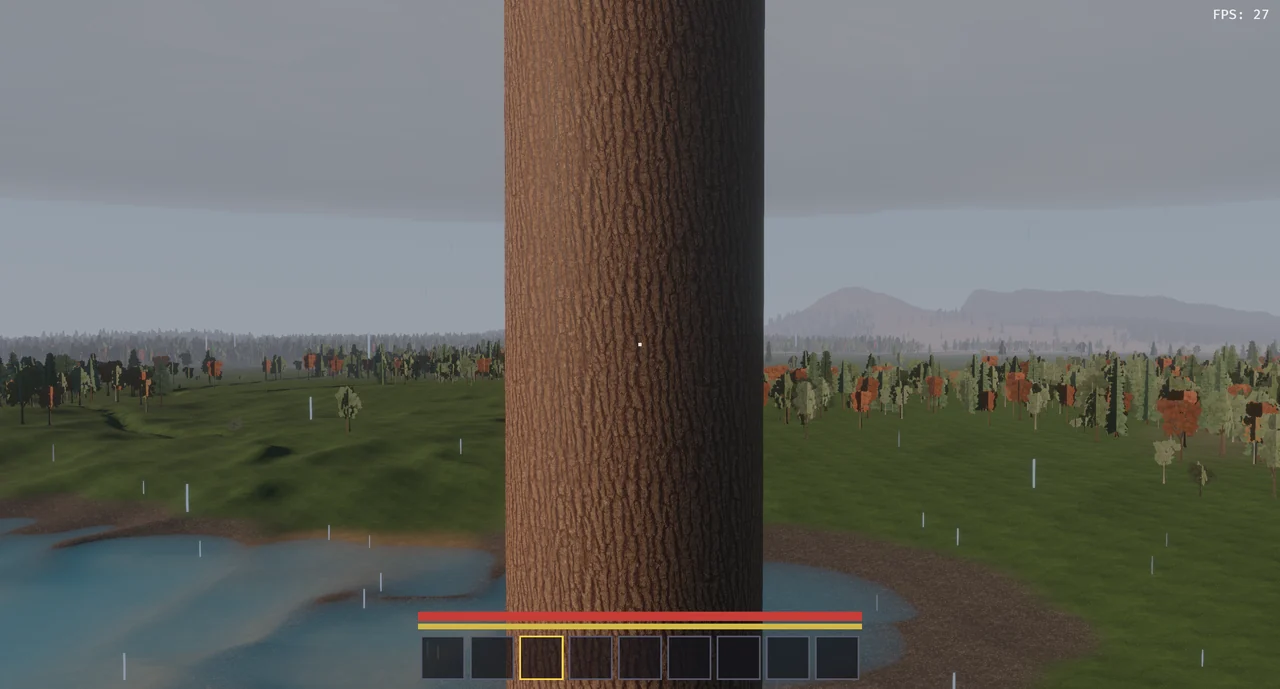
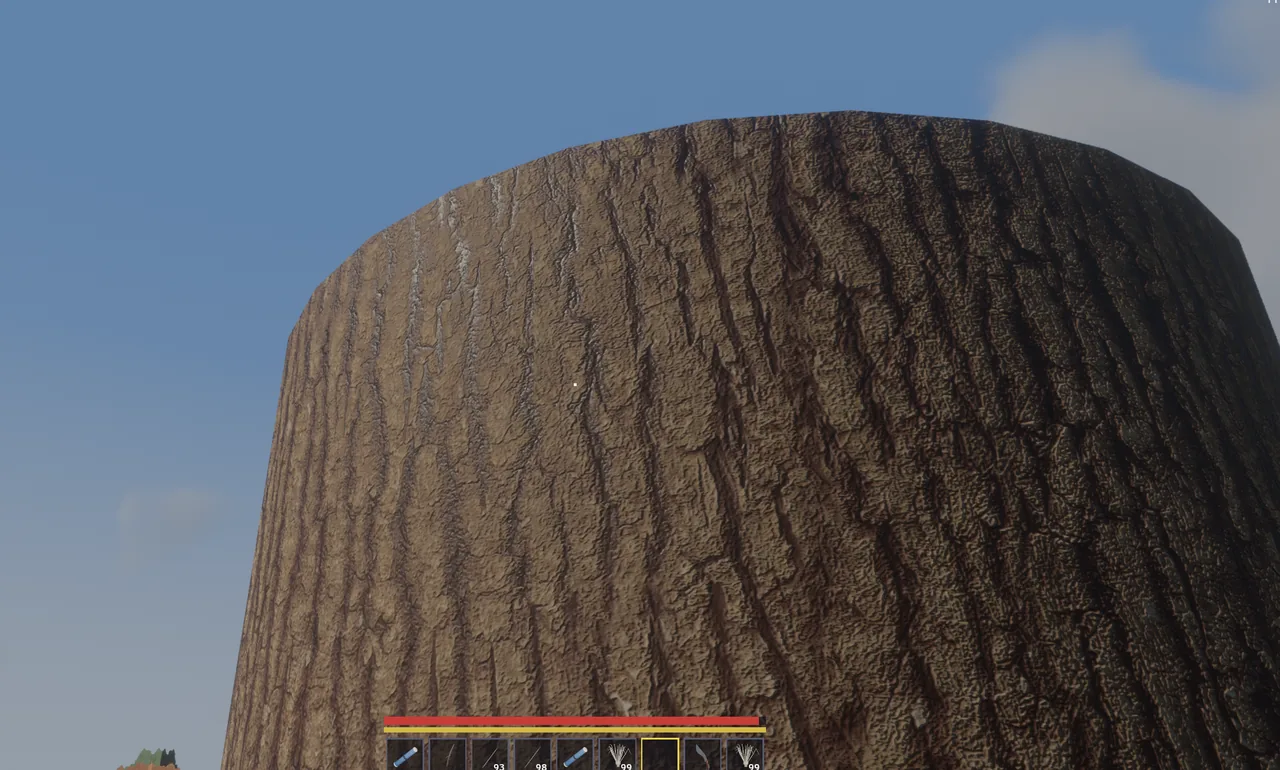
A tree trunk filling the sky, bark in full detail.
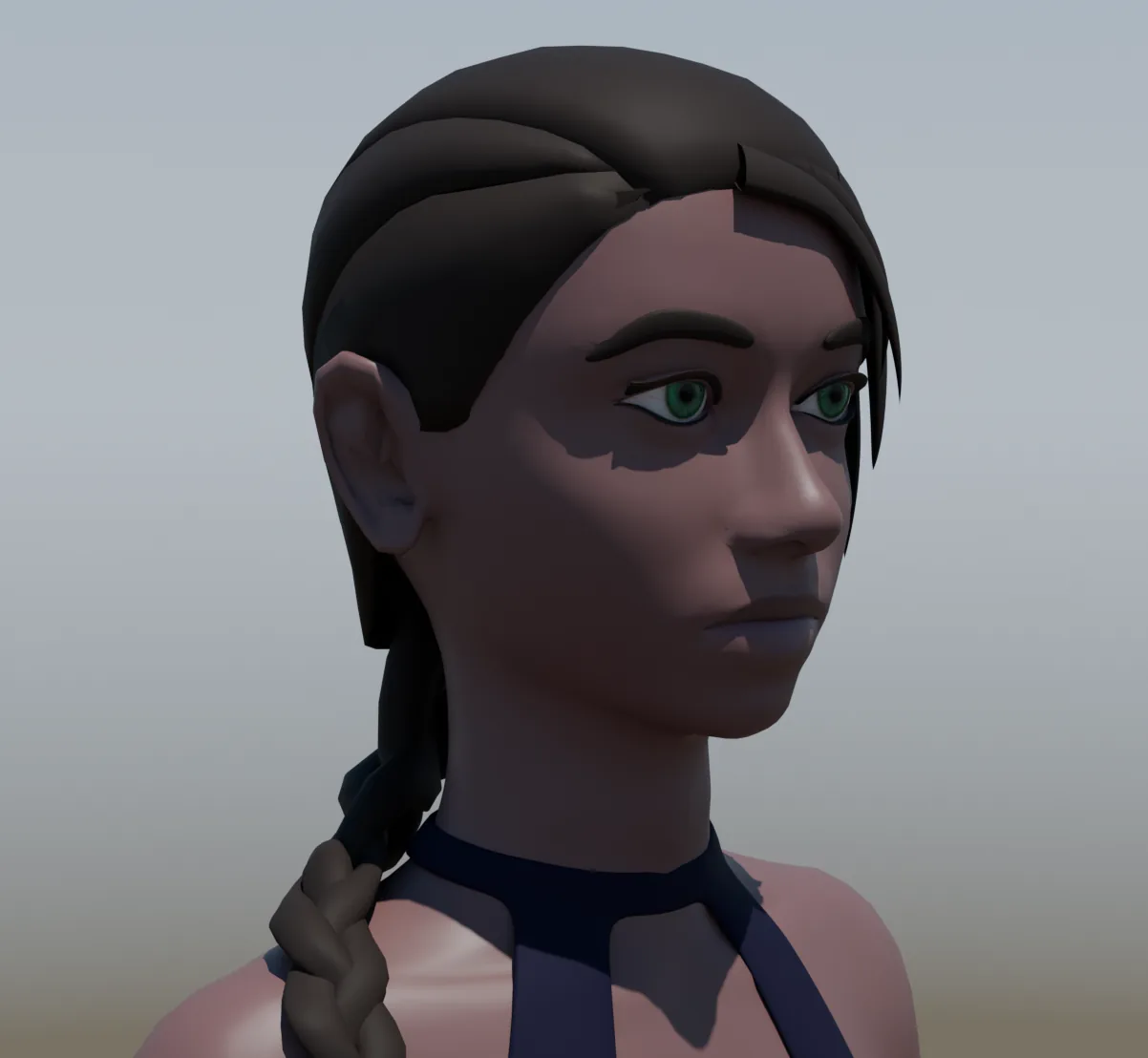
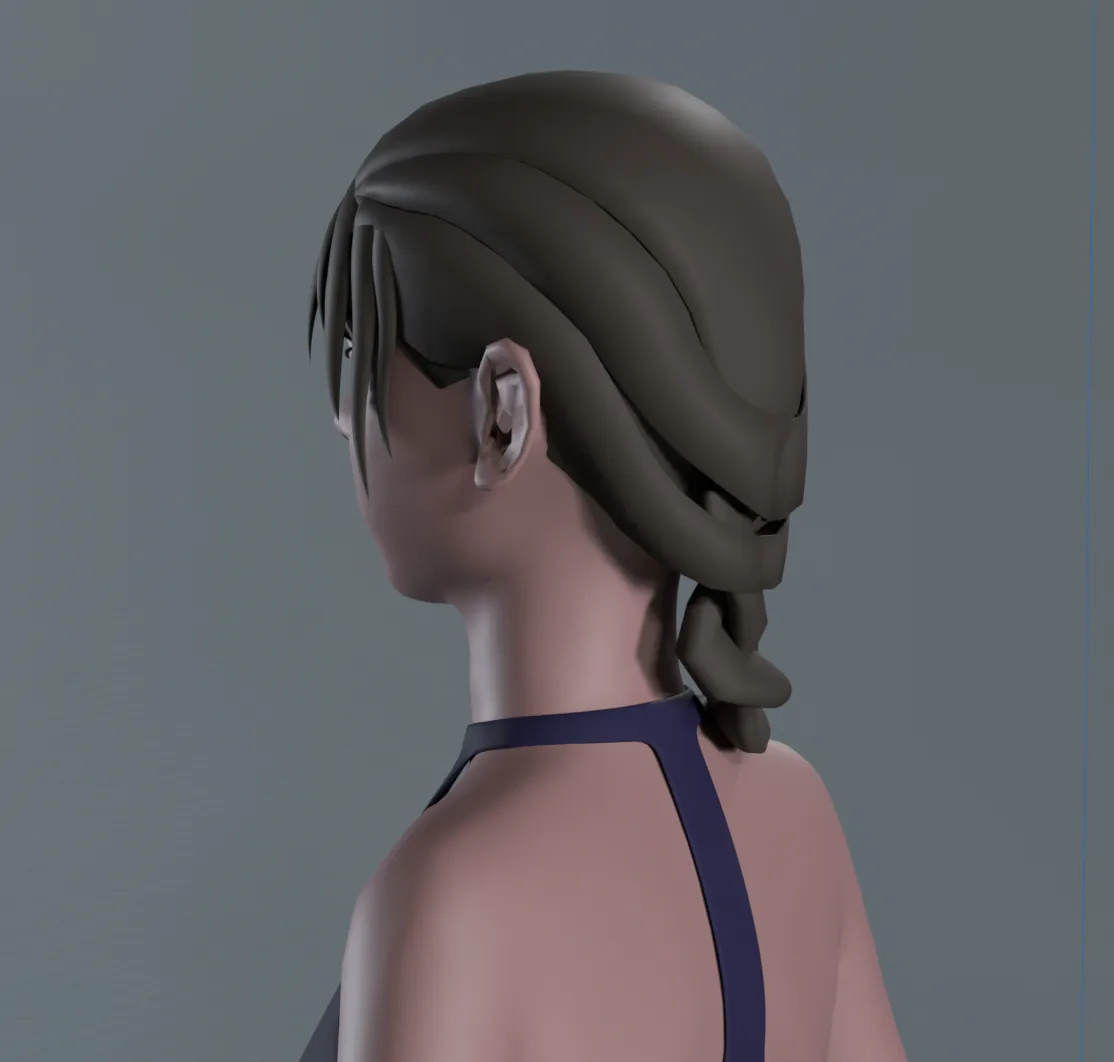
The Eve character model in progress, hair and braid from behind.
The Eve head in hard shadow, testing how the model sits in the light.
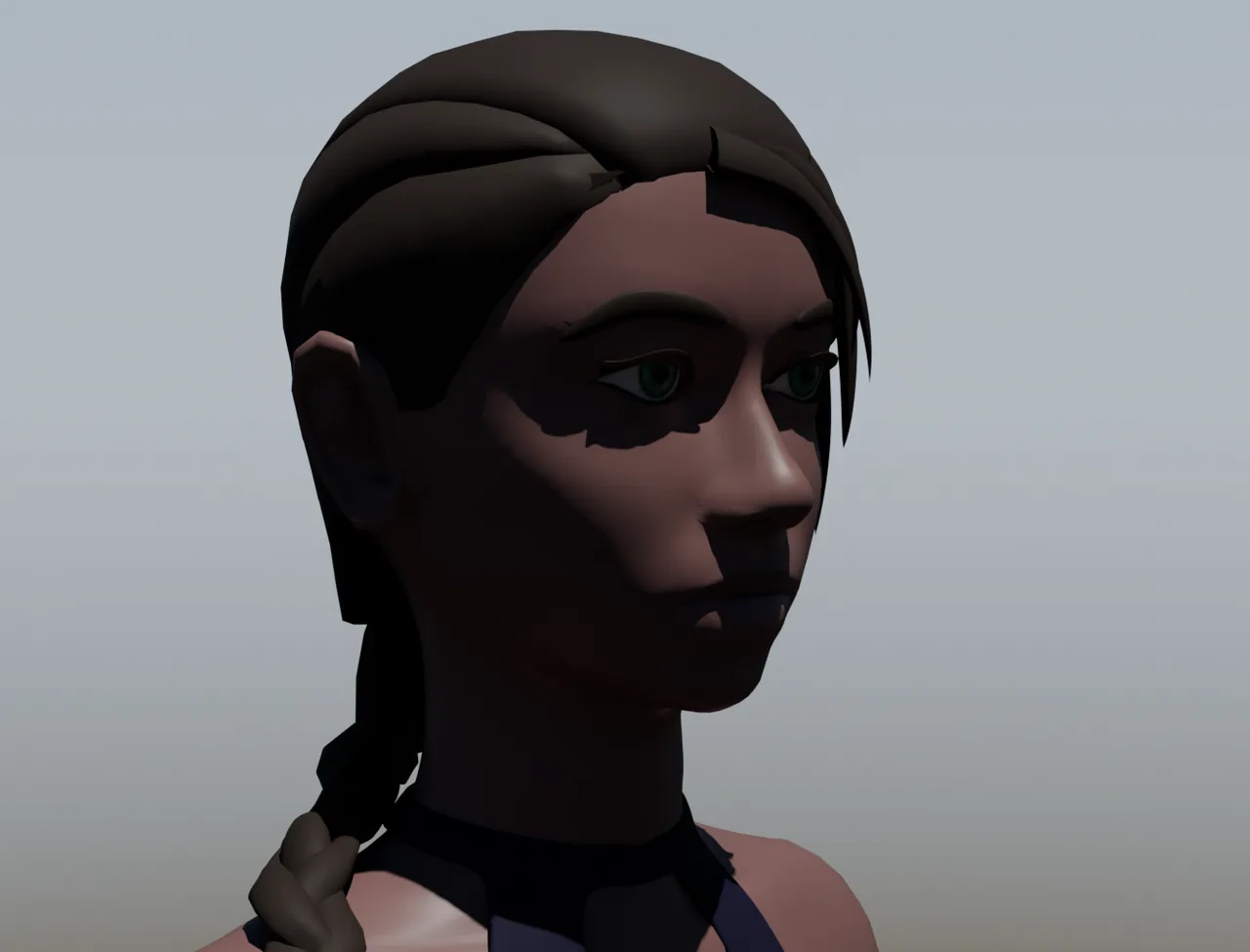
The Eve head lit, green eyes and a braid.
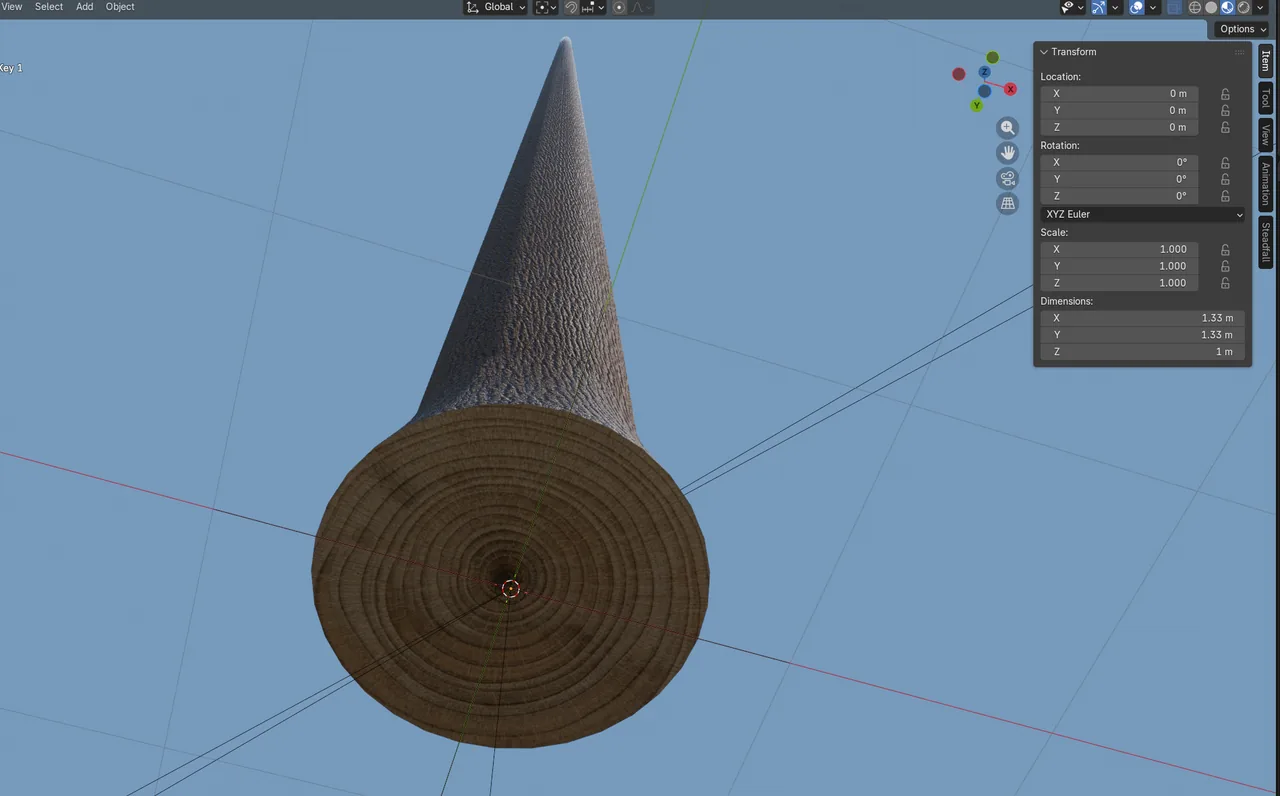
A procedural trunk in the modeling kit, growth rings on the cut face.
A log wall in the modeling kit with taper curves plotted against it.
The force field emitter placed out in a dark field at night, its ring glowing.

The website and accounts

steadfall.com is built and open for the first time: this devlog, a press kit, and the account system that gives every player a permanent Player ID, which is what servers use to recognize you, hand your belongings back, and make bans mean something. Accounts include email confirmation and display name checks. To be clear, accounts are not open to the public yet. The site is still behind a wall while the alpha is private, and they will open up when there is something to sign in for.

The steadfall.com home page: the tagline, the manifest with its state chips, and the in engine figures.

That is the fortnight. Next up is mobile game testing, alongside more of Dragonfly9307's art direction, covered above, landing in the game.

15 August 2026 · Hazmad

What Steadfall has grown into

When we first posted the "Arms Race Proto" core loop, it described exactly one way to play: raid or be raided. That is still in the game, and it is still a big part of the identity, but it turned out to only be one mode of a much bigger thing we had already started designing around it. The project now has a real name, Steadfall, and a scope that has grown past PvP into something closer to "sci-fi survival sandbox" than "arms race simulator." Raiding is a scenario now, not the whole game, sitting alongside Survival (PvE, solo or co-op) and a full Sandbox creative mode, all built on the same editable scenario system so servers and worlds can be tuned to whatever ruleset people actually want to play.

The core fantasy is still the same climb we described before: start with nothing, smash flint into tools, work up through metal, electricity, and automation, and eventually reach rockets, force fields, energy weapons, and full modular power armor, with other planets in the solar system opening up as you research your way there. What is new since the original pitch is everything around that climb: hand crafting with real muscle memory based animations before automation takes over, deep character customization, a Steam backed marketplace for player made cosmetics, full mod support, and terrain that is not just diggable but geologically real. Layered minerals, tectonic structure, caves, biomes, the works. Raiding, salvage, and the whole "your base can fall and you can rebuild" system are still very much in, just now as one piece of a bigger picture instead of the entire pitch.

It is still just the two of us on this: me handling code and design, and a 3D modeler who has joined and already put in a lot of hours getting real assets in place. The placeholder look you have seen so far is on its way out for good, and the finished product is going to look a lot better than the early screenshots suggested.

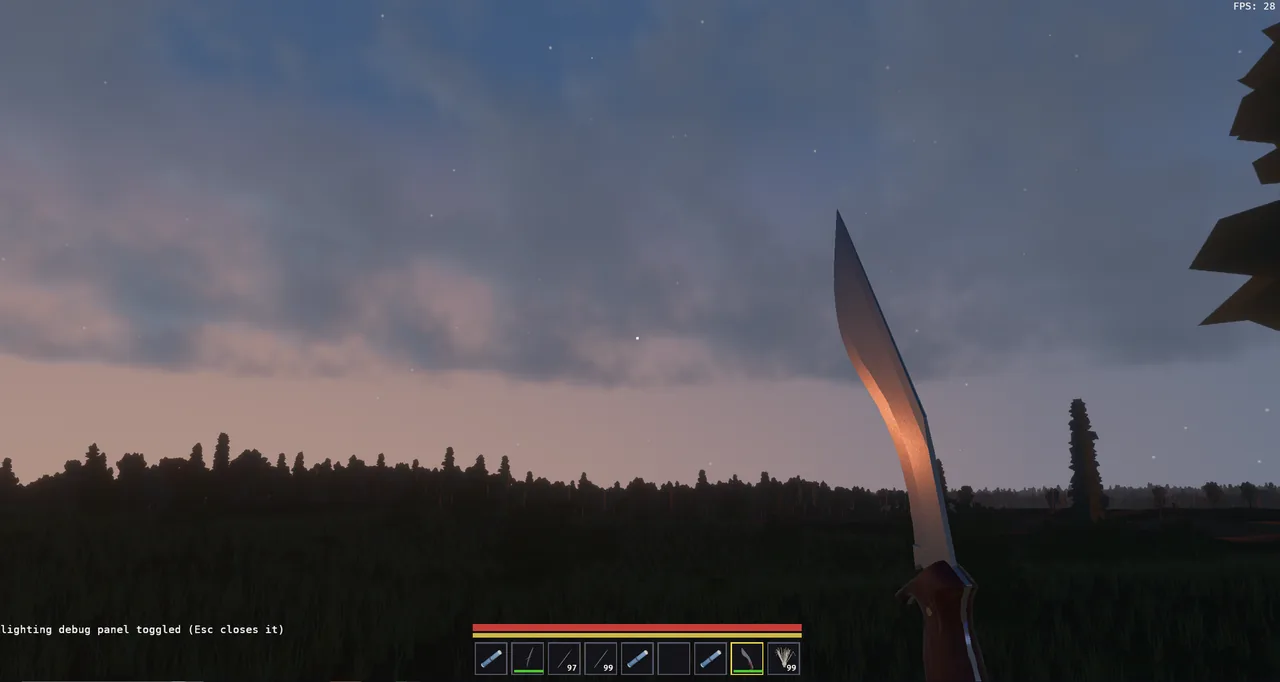
The kukri raised against a dusk sky, the blade catching the last of the orange light.

Everything here is still subject to change. This is still a small two person effort, still early, still full of rough edges in places while things get replaced properly. But if the last announcement made you think this was purely a PvP arms race game, that is not the full picture anymore, and I wanted to get the real scope out there. Feedback is still very welcome, especially if something here sounds like a bad idea.

11 August 2026 · Hazmad

Bow test and ammo swapping

Dragonfly9307 has been putting in some good work on the bow animations and arrow types.

9 August 2026 · Hazmad

The game finally has a real name

Big news first: the game finally has a real name. It is called Steadfall. The old placeholder name is gone for good, and we have been scrubbing it out of the docs this week.

Laying the groundwork for character customization

This was the main focus this week, though to be clear, it is all planning and foundation so far, not the customization system itself yet. We mapped out how it will work: body sliders, scalable proportions, and clothing that deforms to fit instead of clipping through you. We will start with two baseline player models, "Adam" and "Eve", and get the skeleton properly rigged for both first person and third person so everything lines up right before we build customization on top of it.

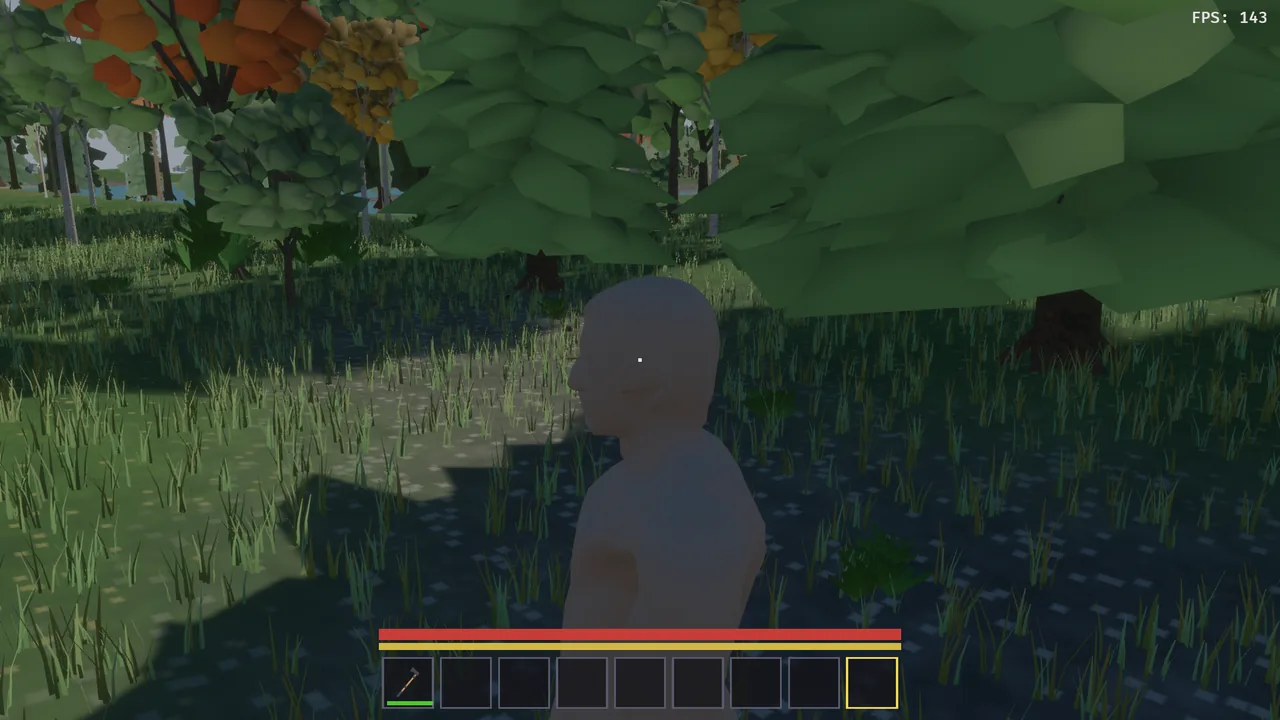
Right now the player model on screen is just a plain clay mannequin. It is not meant to look good. It is there so we can work out how the arms and legs should actually move before we put real character art on top of it.

The clay mannequin player model standing in the grass under the trees, seen in third person.

To be clear, actually building the customization system is taking a backseat for now. We are spending this time carefully planning what needs to be in place first, so we are not redoing the same work later once the real system goes in.

As part of that rigging work, we also got other players actually animating for the first time. Before this, they would just stand there like mannequins: not looking where they aimed, not swinging weapons, not even registering as airborne. Now you will see other players moving, aiming, and using their gear like real people instead of statues.

That work goes hand in hand with netcode, which we have been shoring up alongside it. Real multiplayer tests will be dropping soon.

On top of that, we added a mods folder, mainly to speed up our own development. You can drop a custom model in and define what type of object it is, and the game will pick it up without touching any code, and it will tell you clearly if something is wrong with a mod that fails to load. This is not a real modding API yet. That is something we want to build out properly for workshop content down the road, but for now it is mostly a dev tool.

Bow rework

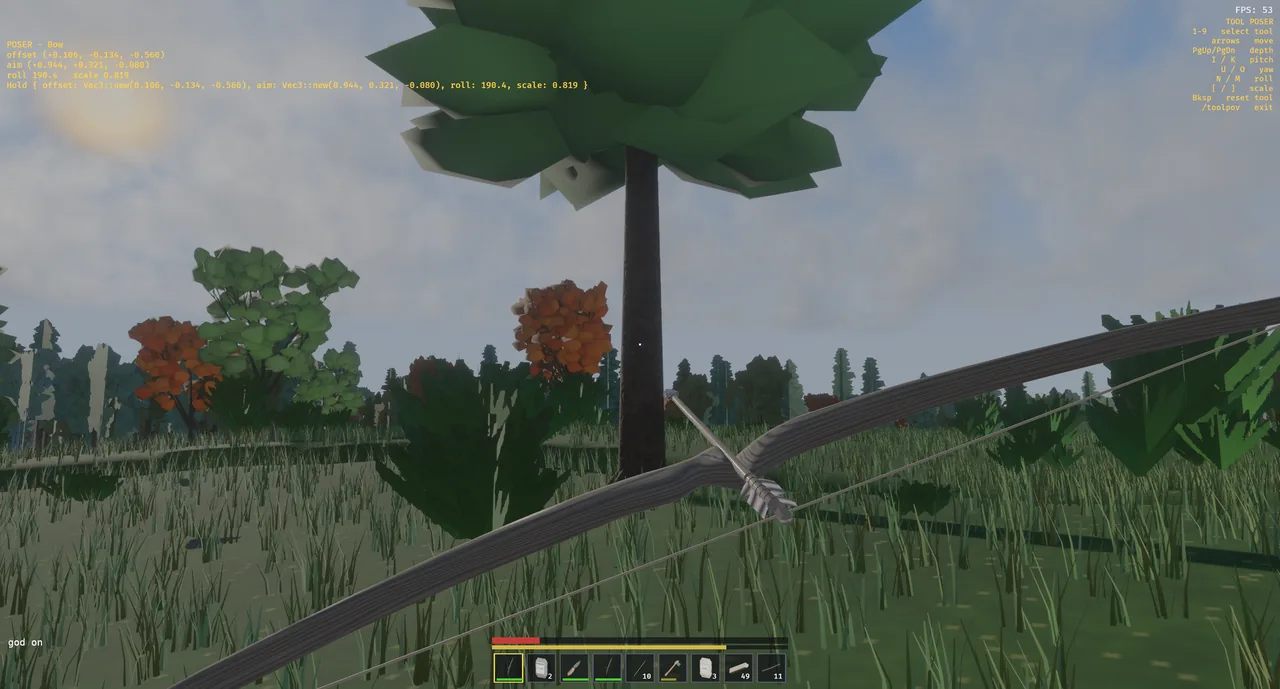
Earlier in the week the bow and arrow got a solid upgrade. The arrow is now a real, physical object that sticks around through the reload instead of vanishing, and the whole thing is scaled correctly to the world. We also cleaned up a ton of console spam that was quietly hammering performance from the main menu.

The bow held in first person in the tool poser, out in the meadow.

Behind the scenes fixes

Early in the week was mostly foundational work: builds now show exactly which version you are running, assets got reorganized so they are easier to manage, and we squashed a few annoying bugs, including worlds freezing you in midair on load, the main menu weirdly staying on screen after hitting Play, and a major rendering issue that was quietly costing over 100 FPS.

That is the week. Excited for where customization goes from here.

31 July 2026 · Hazmad

Build notes for July 31

Big news first: a new 3D designer has joined the project. Welcome Dragonfly9307! The kukri and the force field emitter that just landed in game are both theirs, and having proper authored models next to the procedural stuff has already lifted how the whole thing looks. There is a modeler kit in the repo now so deliveries drop straight in. More of their work is on the way.

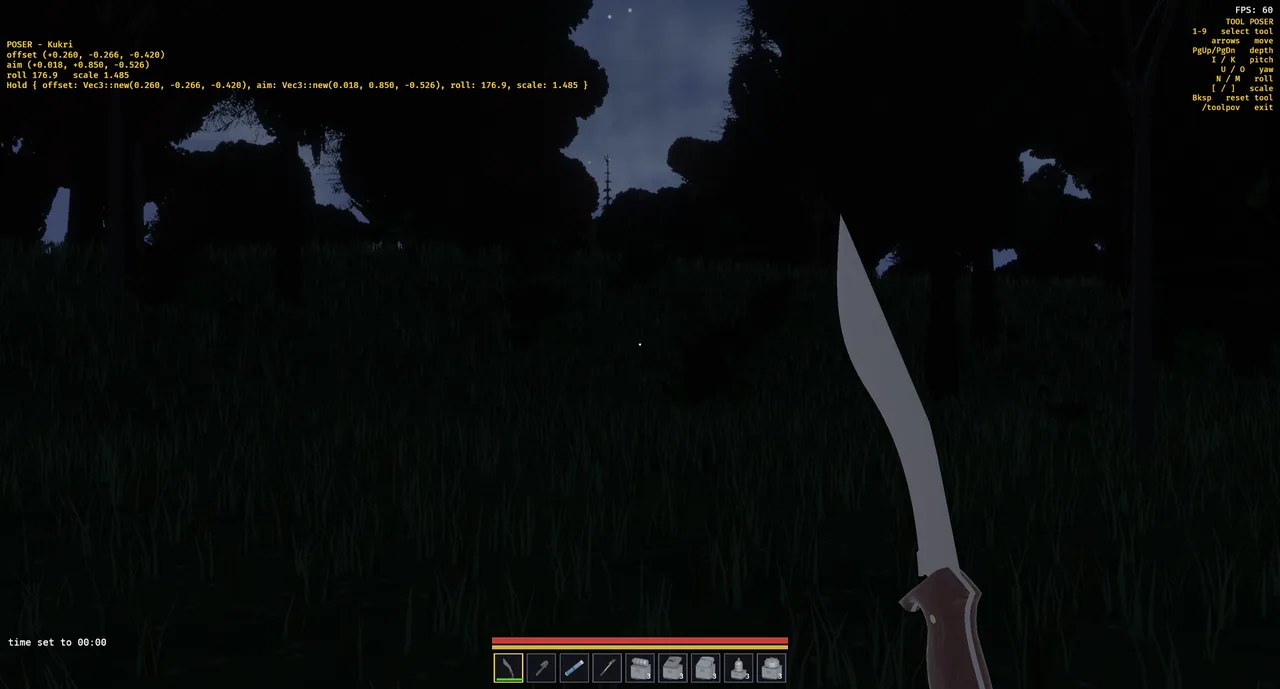
The kukri held up in the tool poser at night, the blade catching the moonlight.

The rest of the stretch was lighting and polish. Metal actually reflects the sky now instead of looking like flat gray paint. Blades, machines and ingots all read completely differently. Night is lit by the moon and has real direction to it for the first time. And your held tool goes dark underground, so the headlamp is finally something you carry because you need it, not because it is there.

The force field emitter placed out in a dark field, its ring glowing violet.

Odds and ends: the kukri is the steel tier machete and has its own slash animation. The force field emitter is placeable but inert for now, since force fields are not built yet. The art just arrived early. Placement got a proper cleanup, so the blue ghost now shows exactly where things land, and Alt+scroll rotates whatever you are holding. The pneumatic tube fittings got halved in size (a run of plumbing was taking up more floor than the machines it fed) and remodeled so you can actually tell a splitter from a combiner.

Lots more progress coming down the pipeline as we shore up the engine and figure out where all the emissions, lighting and reflections will land.

25 July 2026 · Hazmad

Opening the doors

Development is now happening in the open. There is a Discord server for sharing development updates, showcasing progress, and building a community around the game as development continues. If you are interested in following along or offering feedback, I would love to have you there.

Also, "Arms Race Proto" is just a working title and not the final name of the game, so expect that to change as development progresses.